
The reason I decided to write this article is that while reviewing the scientific literature on squats, I noticed that the definition of squat depth varies considerably across studies. In some cases, the same squat variation is even defined differently in different papers.
The inconsistency is not limited to the names themselves.
If you’ve read research on squats, you’ll know that one of the most common ways researchers describe squat depth is by referring to the knee joint angle.
However, even this isn’t standardized. Different studies use different methods to express knee angle, and some papers even switch between two different angle systems within the same article.
As a result, many articles misinterpret or incorrectly cite the original research. I’ve even found mistakes on well-known fitness websites, and personally spent a considerable amount of time trying to determine what the original studies actually meant.
For this reason, this article aims to clarify the most common sources of confusion and present my own proposed naming system for different squat depths.
Hopefully, this approach will give you a much clearer understanding of the various squat variations.
- Defining Different Squat Depths
- Fitness Squats vs. Powerlifting Squats vs. Weightlifting Squat
Defining Different Squat Depths
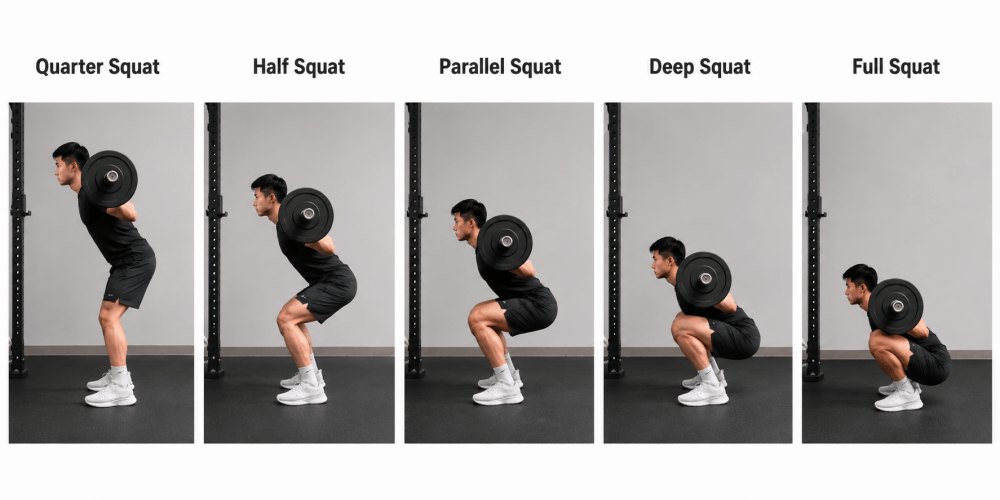
The squat depths we commonly hear about include:
- Quarter Squat
- Half Squat
- Parallel Squat
- Deep Squat
- Full Squat
Among these, Deep Squat and Full Squat are often used interchangeably. They generally refer to a full range of motion squat (Full ROM or FROM).
Any squat that does not reach this depth is typically classified as a partial range of motion squat (Partial ROM or PROM).
However, as pointed out by Drinkwater et al. (2012), the term “squat” has traditionally been defined in two different ways:
- The hip descends below the level of the knee joint.
- The hip descends to the same level as the knee joint.
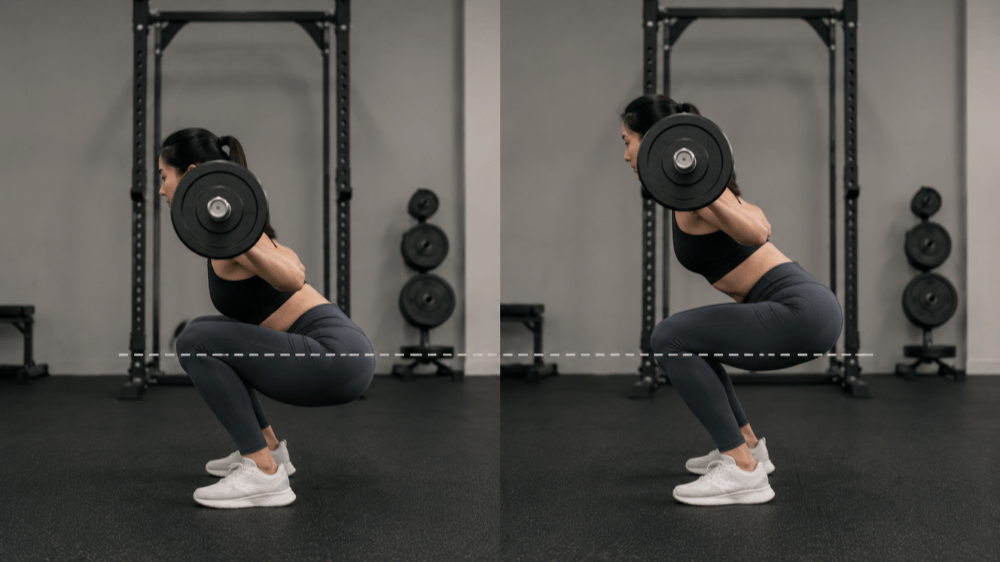
Under the first definition, a parallel squat is exactly the point where the hip reaches knee level.
Under the second definition, however, a parallel squat is already considered a deep squat, leaving no clear terminology for squatting even deeper.
Could this ambiguity be eliminated by defining squat depth using knee flexion angle instead?
Defining Squat Depth by Knee Flexion Angle
In human anatomy, knee flexion is always measured as the angle between the femur and tibia—that is, the knee flexion angle.
Under this anatomical definition:
- 0° = Full knee extension (standing upright)
- 60° = Shallow squat
- 90° = Thigh slightly above parallel
- 100° = Thigh approximately parallel to the floor
- 120° = Clearly below parallel
- 140°+ = Full-depth squat with the hips nearly touching the heels (ATG)
At first glance, this system seems straightforward, and personally, I think it is the clearest way to describe squat depth.
However, it also conflicts with what many people intuitively believe.
Most people assume that when a squat reaches 90°, the thighs should already be parallel to the floor.
The problem is that during a real squat, the tibia naturally moves forward.
Because of this forward knee travel, by the time the thighs become parallel to the floor, the actual angle between the femur and tibia is usually around 100–105° of knee flexion, not 90°.
Another common source of confusion is mixing up the included knee angle with the knee flexion angle.
The included knee angle actually represents knee extension, making it the complementary angle of knee flexion rather than the same measurement.
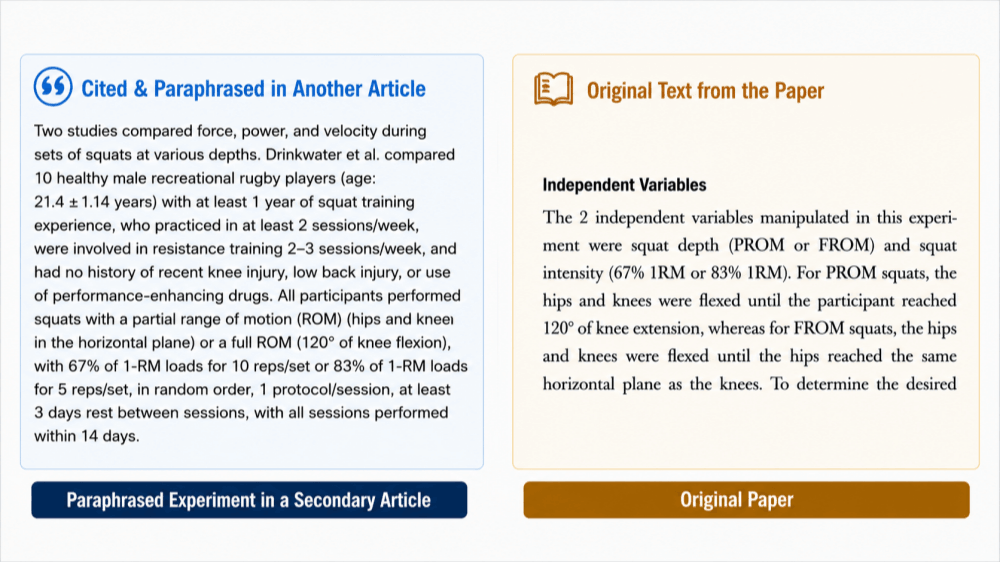
As shown in the figure at the beginning of this article, some authors mistakenly interpret knee extension values reported in the original study as knee flexion.
This completely changes the interpretation of the results. A study that originally compared a half squat with a parallel squat may incorrectly appear to compare a parallel squat with a deep squat.
P.S. In the original study, the researchers used 120° of knee extension, which corresponds to only 60° of knee flexion—roughly the depth of a quarter squat to a half squat.
Now that we’ve cleared up these misunderstandings, we can combine anatomical definitions with visual landmarks to create a more practical way of classifying squat depth.
A Practical Definition of Different Squat Depths
Now that the confusion has been cleared up, we can define different squat depths based on both anatomical knee flexion angles and visual landmarks.
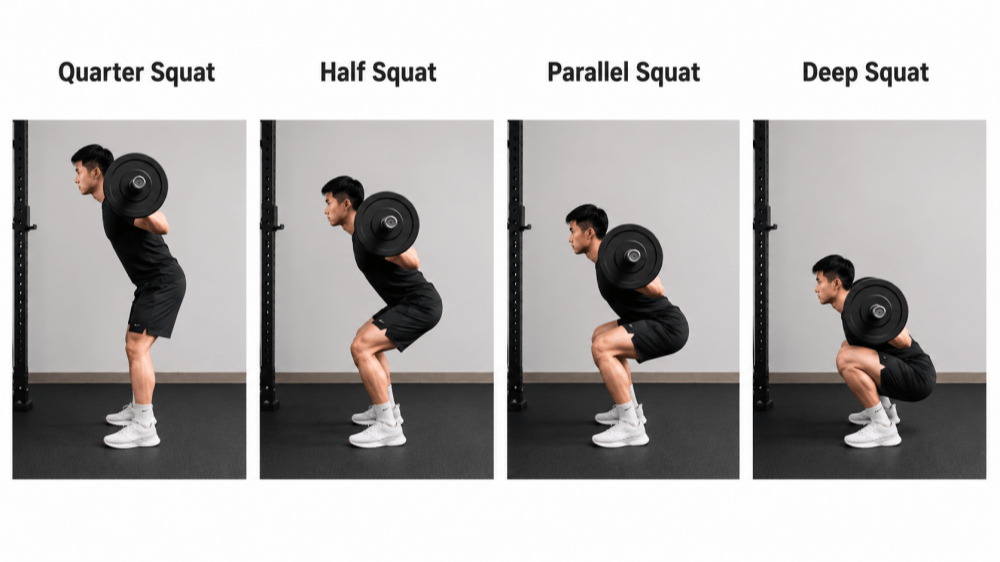
Quarter Squat (Mini Squat)
- Knee flexion: approximately 30°–60°
- A shallow squat with only a small amount of knee and hip flexion.
Half Squat
- Knee flexion: approximately 60°–90°
- Visually, the thighs remain clearly above parallel when viewed from the side.
- The femur and tibia form an angle close to 90°.
Parallel Squat
- Knee flexion: approximately 90°–105°
- Visually, the thighs are parallel to the floor.
- The hip (greater trochanter) is approximately level with the top of the knee (patella).
Deep Squat / Full Squat
- Knee flexion: greater than 105°
- Visually, the thighs descend below parallel.
- The hip drops lower than the knee.
P.S. Because everyone has different tibia lengths, hip anatomy, and mobility, knee flexion angles should only be considered approximate. In practice, visual landmarks are a more reliable way to judge squat depth.
Should We Further Divide Deep Squats?
Personally, I think so.
The reason is simple.
Even after reaching 105° of knee flexion, there is still a considerable amount of available range of motion.
When people say they squat “all the way down” or “hips to heels,” knee flexion often reaches around 135–140°.
More importantly, many studies suggest that 120° of knee flexion represents an important transition point.
For example, in a study on squat depth published by Bloomquist et al. (2013), a deep squat was defined as reaching 120° of knee flexion, while participants were also required to squat at least until the thighs were parallel to the floor, corresponding to what we defined above as a parallel squat.
Similarly, Bryanton et al. (2012)found that every participant could comfortably squat to 120° of knee flexion, whereas only some participants were able to squat deeper.
A 2024 systematic review investigating quadriceps electromyographic activity during squats also reported that once knee flexion reaches approximately 90°–120°, the knee extensors begin to lose their mechanical advantage for force production.
Taken together, these findings suggest that around 120° of knee flexion is close to the practical lower limit for most people.
Going deeper may not provide additional benefits for the average trainee, and many individuals simply do not have the mobility required to reach those depths.
For this reason, I believe the definitions can be refined further.
A More Practical Classification
Quarter Squat (Mini Squat)
- Knee flexion: 30°–60°
- A shallow squat with only a small amount of knee and hip flexion.
Half Squat
- Knee flexion: 60°–90°
- The thighs remain clearly above parallel.
- The femur and tibia form an angle close to a right angle.
Parallel Squat
- Knee flexion: 90°–105°
- Visually, the thighs are parallel to the floor.
- The hip (greater trochanter) is approximately level with the top of the knee (patella).
Deep Squat
- Knee flexion: 105°–120°
- The thighs descend noticeably below parallel.
- The hip sits lower than the knee.
Full Squat
- Knee flexion: greater than 120°
- The back of the thighs comes into contact with the calves.
- The hips are nearly resting on the heels.
How Deep Should Most People Squat?
For general resistance training, reaching parallel squat depth or a deep squat is already sufficient.
There is usually no need to deliberately chase a full squat.
It’s also worth remembering that your achievable squat depth depends on factors such as bar position and stance width. For example, with a high-bar squat or a wide stance, reaching a true full squat—where the backs of your thighs touch your calves—is naturally much more difficult.
If you do want to squat deeper, a better goal is simply:
Squat as deep as your body naturally allows while maintaining a neutral spine.
This is a much more practical objective than trying to force your hips all the way to your heels.
At this point, you may wonder:
If a full squat isn’t necessary, why do Olympic weightlifters almost always squat all the way down?
Fitness Squats vs. Powerlifting Squats vs. Weightlifting Squat
First, it’s important to clarify one thing.
The squat depths defined above refer to the barbell squat commonly performed in general fitness training. Whether you use a high-bar back squat, low-bar back squat, front squat, safety bar squat, or another variation, the depth classifications discussed earlier still apply.
The squat used in Olympic weightlifting, however, is different.
Often referred to as the Olympic squat or Weightlifting squat, its primary purpose is to support the snatch and the clean & jerk rather than maximize muscle growth or general fitness.
Because weightlifters must receive the barbell underneath the bar during these lifts, they need to keep their torso much more upright while allowing the knees to travel further forward.
As a result, they naturally squat much deeper than most recreational lifters.
This style of squat also requires exceptional ankle dorsiflexion mobility. Without years of dedicated mobility and technical training, most people simply cannot achieve this position.
A good everyday comparison is the Asian squat.
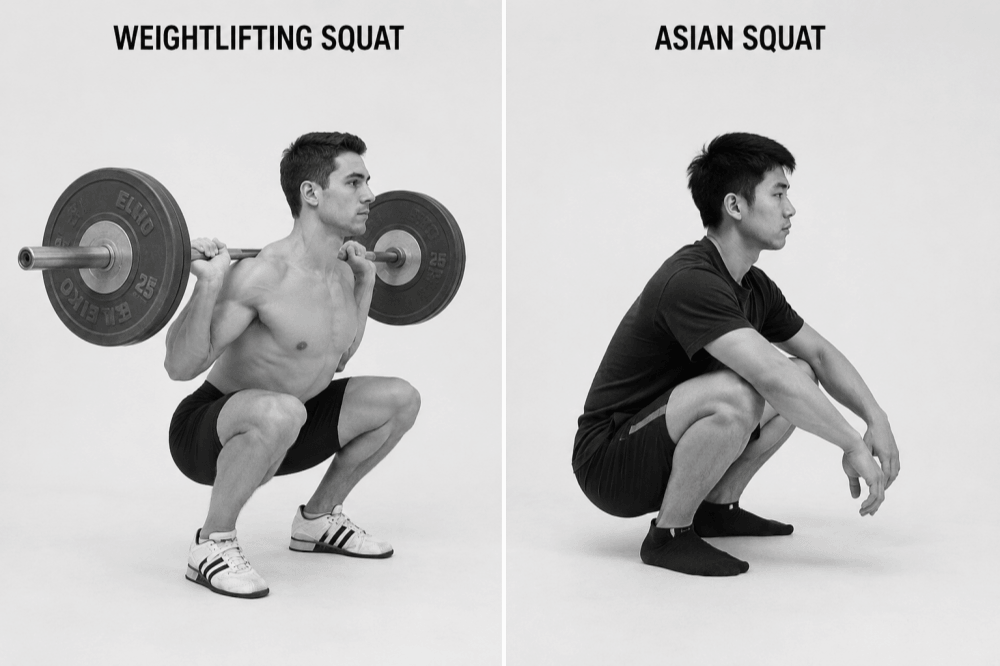
Both movements involve deep hip flexion, deep knee flexion, and substantial ankle dorsiflexion.
The difference is that many people performing an Asian squat compensate by rounding the upper back or losing a neutral spine in order to reach a deeper position.
Even that can be difficult for many individuals.
An Olympic squat, on the other hand, requires you to maintain a neutral spine while supporting a loaded barbell, making it significantly more demanding.
What About the Powerlifting Squat?
Another squat variation that often reaches full squat depth is the powerlifting squat.
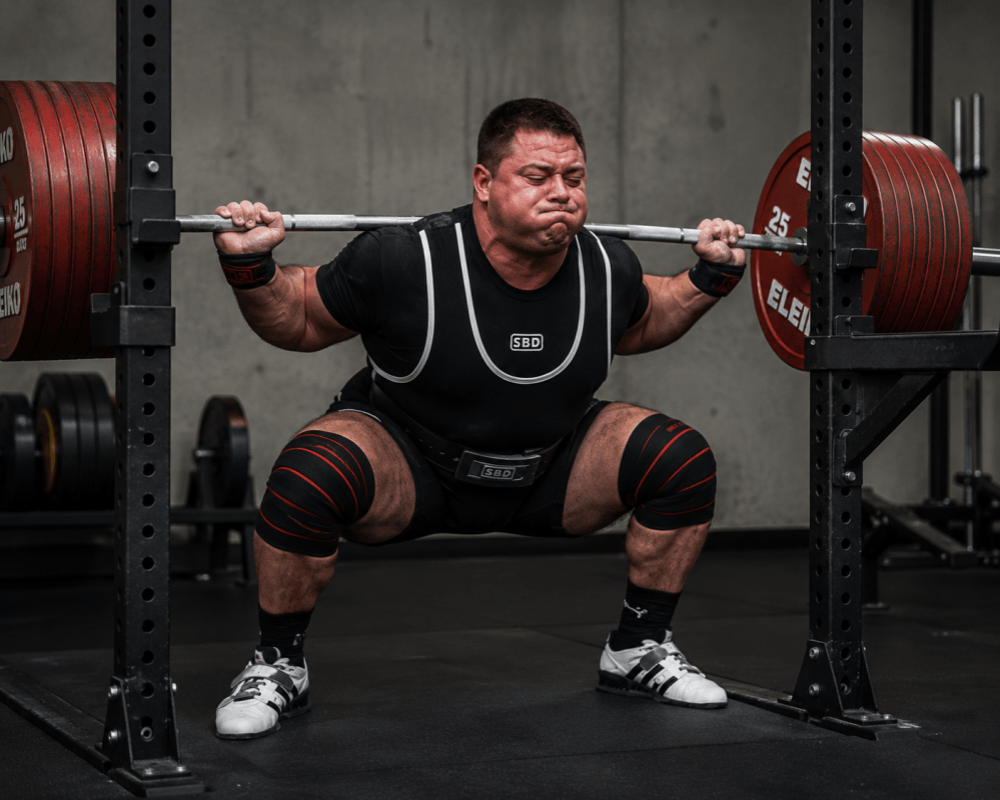
However, its goal is entirely different.
The objective in powerlifting is to lift the maximum possible weight.
To achieve this, lifters typically:
- Lean the torso further forward
- Sit the hips farther back
- Keep the shins relatively vertical
This technique shortens the moment arm around the knees and shifts more of the load toward the hips and posterior chain, making it more efficient for lifting heavy weights.
As shown in the figure, both the Olympic squat and the powerlifting squat differ noticeably from the barbell squat that most people perform for general fitness.
Each squat style is designed to serve a specific purpose.
If you’re interested in powerlifting or Olympic weightlifting, it makes sense to learn and practice these specialized squat techniques.
However, if your goal is building muscle, losing fat, or simply improving your overall health, there is no need to imitate competition-specific squats.
Instead, choose a squat variation that suits your body, perform it with proper technique, and stay consistent over the long term.
That will provide the greatest benefits for most people.
References