

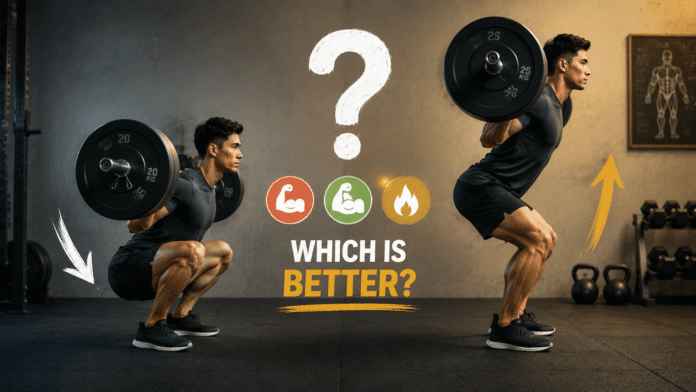
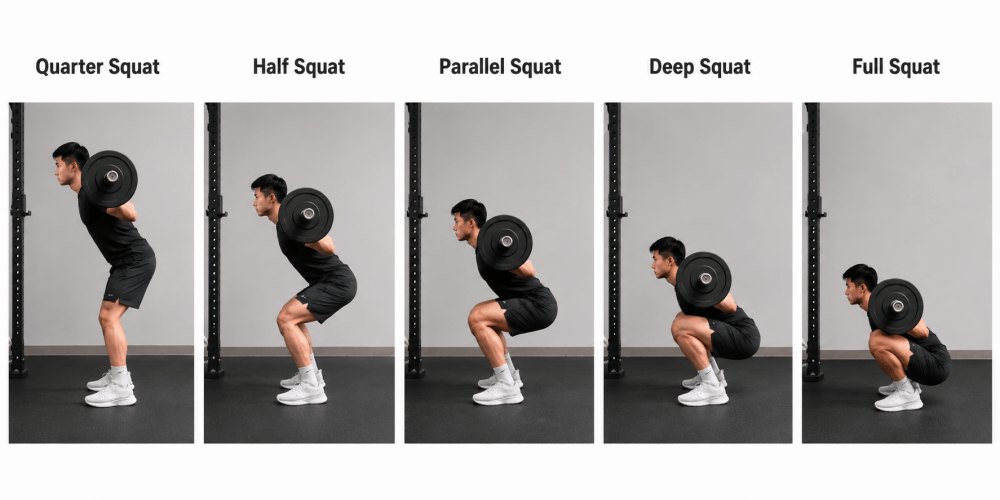
In the previous article, we proposed a clearer naming system and definition for different squat depths. The main reason for doing so was to establish a consistent framework for discussing squat-related topics in future articles.
Today’s topic is one of the most debated questions in strength training:
How deep should you squat?
(To avoid confusion, the exercise discussed throughout this article refers specifically to the barbell back squat. The term deep squat refers to a barbell back squat performed to approximately 105°–120° of knee flexion, based on the definitions established in our previous article.)
Imagine two people performing barbell back squats.
One only descends halfway before standing back up, while the other squats until their hips are almost touching their heels.
Which squat would you consider better?
Most people would probably choose the latter. In fact, I’ve heard countless coaches in commercial gyms tell their clients to “squat lower.”
But does that mean quarter squats and half squats have little or no training value?
And if a half squat isn’t deep enough, what about a parallel squat?
One of the biggest debates surrounding the barbell back squat has long been whether squatting until the thighs are parallel to the floor is sufficient.
Let’s take a look at what the research actually says.
Sports Performance & Maximal Strength
From the perspective of improving sport-specific performance and maximal strength, current evidence generally supports the principle of specificity.
In other words, you become strongest within the range of motion that you train.
If you primarily perform quarter squats, you’ll improve your quarter squat strength the most, along with athletic movements that rely on similar joint angles, such as sprinting and jumping.
If you train deep squats, you’ll see the greatest improvements in deep squat strength.
Even so, deep squats still offer an important advantage:
They improve strength throughout a larger range of motion.
For example, in the 12-week study by Bloomquist et al., the deep squat group increased both their half squat 1RM and deep squat 1RM by approximately 20%.
The half squat group, however, improved their half squat 1RM by 36%, while their deep squat 1RM increased by only 9%.
An even more striking finding came from Hartmann et al., who reported that heavy quarter squat training actually reduced deep squat 1RM performance.
Taken together, these findings suggest that unless you have a specific sport-related reason to emphasize partial squats, deep squats are generally the better choice, especially for beginners with limited training experience, who are likely to benefit more from training through a larger range of motion.
P.S. It is worth mentioning that although studies on 1RM strength are relatively consistent, the evidence regarding explosive performance (such as jumping ability and power output) remains mixed.
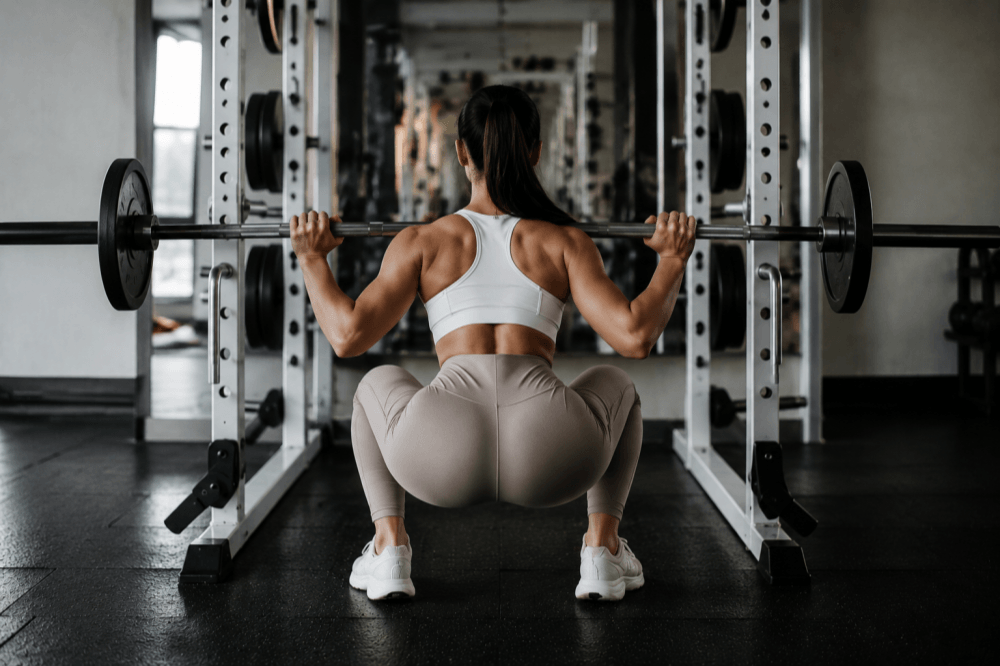
Muscle Hypertrophy
This is probably the section most people care about.
We know that one of the fundamental principles of muscle growth is providing sufficient mechanical stimulus to the target muscles.
In research, this is commonly evaluated using electromyography (EMG) or measurements of joint torque, both of which estimate how much individual muscles contribute during an exercise.
For the lower body, the three primary muscle groups involved in the squat are:
- Knee extensors: rectus femoris, vastus medialis, and vastus lateralis
- Ankle plantar flexors: the calf muscles
- Hip extensors: gluteus maximus and hamstrings
A 2023 systematic review summarized studies conducted by Caterisano, Contreras, Da Silva, and O’Neil, all of which investigated individuals with prior resistance training experience and compared knee extensor activation at different barbell back squat depths.
Overall, the review concluded that EMG activity of the knee extensors showed no significant difference between half squats and deep squats.
It’s important to understand what “no significant difference” actually means.
It does not mean the muscles behaved identically in every study.
For example, Caterisano et al. found that, when the same external load was used, deep squats produced lower vastus medialis activation during the concentric phase (standing up) than either quarter squats or half squats.
(Han et al. interpreted this finding by suggesting that the closer the knee is to full extension, the greater the relative contribution of the vastus medialis within the quadriceps group.)
Meanwhile, O’Neil et al. reported that, using the same external load, half squats elicited greater activation of the vastus lateralis than quarter squats.
However, when participants performed half squats and deep squats using their respective 10RM loads, no meaningful difference in knee extensor activation was observed.
The primary advantage of deeper squats appeared elsewhere.
As squat depth increased, EMG activity of the gluteus maximus and tibialis anterior increased significantly, suggesting greater involvement of these muscles during deeper ranges of motion.
A similar conclusion was reached by Bryanton et al., although their study used a different measurement.
Instead of EMG, they evaluated Relative Muscular Effort (RME).
Their findings showed that:
- Knee extensor RME was influenced primarily by squat depth, with external load playing a relatively smaller role.
- Ankle plantar flexor RME depended mainly on barbell load rather than squat depth.
- Hip extensor RME was influenced by both squat depth and external load.
You may have already noticed an apparent contradiction.
The RME study suggests that knee extensor stimulus changes with squat depth, whereas EMG studies generally report little difference.
In my opinion, there are two likely explanations.
First, EMG and RME measure different physiological variables, so some disagreement is expected.
Second, in the study by Bryanton et al., participants used the same absolute barbell load at every squat depth.
In practice, however, everyone knows that people can normally lift much heavier weights during partial squats than during deep squats.
This experimental design may therefore have influenced the results.
Of course, neither EMG nor RME directly predicts the long-term outcomes of resistance training.
To answer that question, we need to look at longitudinal training studies instead.
Longitudinal Training Studies
Bloomquist et al. reported that after the training intervention:
- Quadriceps cross-sectional area (CSA) increased by approximately 4–7% following deep squat training.
- Lean leg mass increased by approximately 2%.
- The half squat group showed no significant improvements in these measurements.
However, Kubo et al. and Hammami et al. reached somewhat different conclusions.
Kubo et al. found that:
- Both full squats and half squats increased quadriceps muscle volume, with no significant difference between them.
- Neither squat depth produced substantial hypertrophy of the hamstrings or rectus femoris.
- Full squats were more effective only for increasing the size of the gluteus maximus and adductor muscles.
Meanwhile, Hammami et al., after measuring the volume of the entire thigh and lower leg, concluded that deep squats and half squats produced similar overall hypertrophy.
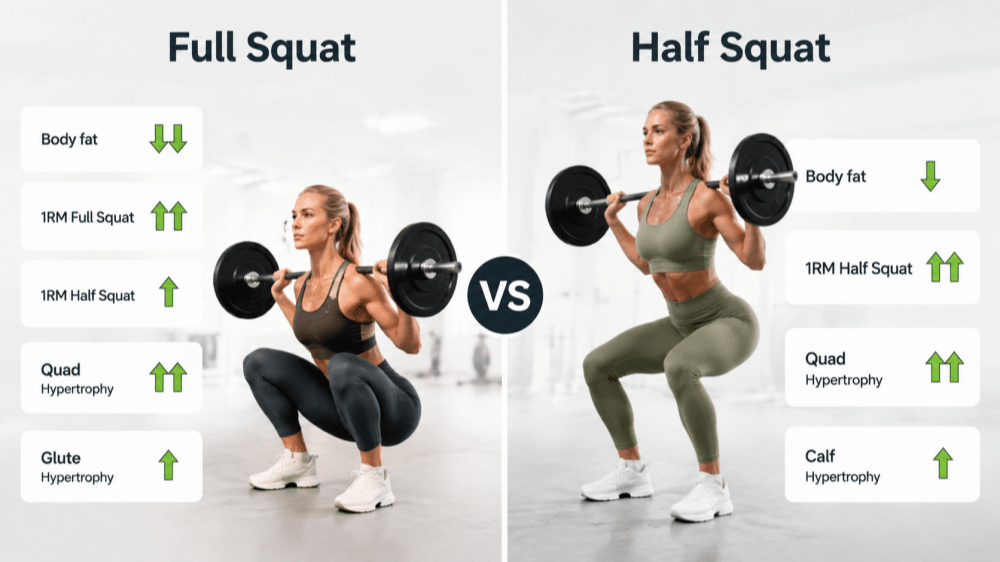
Taken together, the available evidence suggests that deep squats may provide a slight overall advantage for muscle growth, particularly for the gluteus maximus, adductors, and to some extent the vastus lateralis.
That said, the difference is relatively small.
Because half squats are easier to perform and allow substantially heavier loads, they may be a better option for emphasizing the ankle plantar flexors and vastus medialis.
Overall, half squats do not appear to be inferior to deep squats for stimulating the vastus lateralis either.
Fat Loss
This is probably the least controversial aspect.
Compared with half squats, deep squats involve:
- A larger range of motion
- Greater total mechanical work
- Higher joint moments
- More muscles working throughout the movement
For these reasons, deep squats are generally superior for increasing energy expenditure and promoting lean body mass.
Although half squats allow you to use heavier weights and often perform more repetitions, these advantages are generally not enough to offset the greater overall workload of deep squats.
Final Thoughts
Overall, deep squats offer more comprehensive training benefits than half squats.
The primary advantage of half squats lies in sport-specific applications, where training a particular range of motion may better transfer to certain athletic movements.
However, for most people, the difference between the two is not nearly as dramatic as it is often portrayed.
If you can comfortably perform a deep squat without sacrificing technique or experiencing pain, it is generally the better option.
If you cannot—for example, during rehabilitation or if you have severely limited ankle dorsiflexion—half squats and parallel squats are still excellent training choices.
As for whether you should deliberately pursue a full squat, the answer is straightforward:
Unless you are specifically training for powerlifting or Olympic weightlifting, there is usually no need.
Across virtually all of the studies discussed in this article, a deep squat was generally defined as reaching approximately 110°–120° of knee flexion, and some studies required no more than the thighs reaching parallel to the floor.
In other words, reaching a deep squat is already sufficient for most training goals.
In future articles, we’ll also discuss why squat depth may be limited and how to improve it safely and effectively.
If you’re interested, be sure to bookmark this website and check back for future updates.
I found a really helpful article on recommended squat depth that doesn’t seem to be ranking very well on Google. I thought I’d share it with you.Squat Depth Recommendations: Based on All Available Research
References
- Hammami R, et al. (2025). Full Squats Enhance Performance and Body Composition, but Not Hypertrophy, Compared to Half Squats in Elite Young Tennis Players. Journal of Functional Morphology and Kinesiology.
- Kubo K, et al. (2019). Knee Extensor Electromyographic Activity During Different Depths of Squat Exercise in Strength Training Experienced Adults: A Systematic Review. Journal of Physical Therapy Science.
- Bryanton MA, Kennedy MD, Carey JP, & Chiu LZF. (2012). Effect of Squat Depth and Barbell Load on Relative Muscular Effort in Squatting. Journal of Strength and Conditioning Research.
- Bloomquist K, Langberg H, Karlsen S, Madsgaard S, Boesen M, & Raastad T. (2013). Effect of Range of Motion in Heavy Load Squatting on Muscle and Tendon Adaptations. European Journal of Applied Physiology.
- Hartmann H, et al. (2012). Influence of Squatting Depth on Jumping Performance. Journal of Strength and Conditioning Research.
- Weiss LW, Fry AC, Wood LE, Relyea GE, & Melton C. (2000). Comparative Effects of Deep Versus Shallow Squat and Leg-Press Training on Vertical Jumping Ability and Related Factors. Journal of Strength and Conditioning Research.
- Rhea MR, Peterson MD, et al. (2016). Joint-Angle Specific Strength Adaptations Influence Improvements in Power in Highly Trained Athletes. Human Movement Science.
- Pallarés JG, et al. (2020). Impact of Range of Motion During Ecologically Valid Resistance Training Protocols on Muscle Size, Subcutaneous Fat, and Strength. Journal of Strength and Conditioning Research.
- Kubo K, Ikebukuro T, Yata H, Tomita M, & Okuwaki T. (2019). Effects of Squat Training with Different Depths on Lower Limb Muscle Volumes. European Journal of Applied Physiology.
