

How to Plan Weekly Meals? whether your goal is muscle hypertrophy or weight loss, a structured healthy eating meal plan is an indispensable foundation for success.
While the end goals may differ, the fundamental methodology behind designing a nutritional strategy remains remarkably consistent regardless of the desired outcome. A truly robust diet must encompass appropriate caloric levels, a balanced ratio of macronutrients and micronutrients, proper hydration, and electrolyte management. Furthermore, specific supplements may be integrated to address any underlying nutritional deficiencies.
In today’s guide, we will break down the meal planning process through the lens of these critical dimensions.
Determining Appropriate Caloric Levels
Since our primary focus is either building muscle or shedding body fat, the pivotal first step is to estimate your energy requirements.
This estimation can be achieved through direct measurement or mathematical modeling, primarily focusing on two metrics: RMR (Resting Metabolic Rate) and BMR (Basal Metabolic Rate).
Generally, we lean towards estimating RMR as a practical proxy for BMR. Due to the thermic effect of food and daily physical activity, RMR typically sits 10% to 20% higher than BMR—a discrepancy observed in both laboratory settings and mathematical formulas.
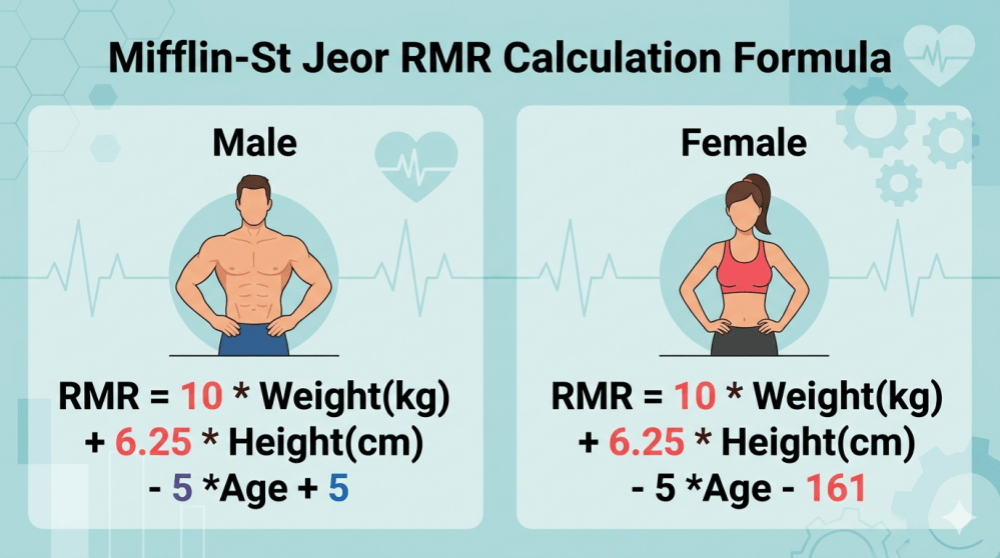
Currently, the most widely adopted standard is the Mifflin-St Jeor Equation, calculated as follows:
- Men: RMR = (10 x weight in kg) + (6.25 x height in cm) – (5 x age) + 5
- Women: RMR = (10 x weight in kg) + (6.25 x height in cm) – (5 x age) – 161
Once the RMR is established, it must be multiplied by an Activity Factor to determine your TDEE (Total Daily Energy Expenditure). These activity levels are generally categorized into the following tiers:
| Activity Level | Physical Activity Level (PAL) | Typical Lifestyle/Exercise Description |
| Sedentary | 1.2 | Office desk job; negligible exercise; no physical activity beyond eating and walking to the car. |
| Lightly Active | 1.375 | Light exercise (e.g., walking, yoga) 1–3 days per week. |
| Moderately Active | 1.55 | Moderate-intensity exercise (e.g., jogging, resistance training) 3–5 days per week. |
| Very Active | 1.725 | High-intensity exercise 6–7 days per week, or a physically demanding occupation. |
| Extra Active | 1.9 | Professional athletes, twice-a-day training, or extremely strenuous labor (e.g., mining, heavy construction). |
Let’s look at a practical example: Consider a 30-year-old male, weighing 70kg at 175cm tall, who exercises 1–3 times per week. His RMR would be approximately 1,649 kcal/day, resulting in a TDEE of 2,267 kcal/day.
As a side note, it is important to recognize that Lean Body Mass (LBM) significantly influences RMR and BMR. Therefore, for advanced fitness enthusiasts or athletes, the Katch-McArdle or Cunningham formulas are often preferred over Mifflin-St Jeor. Specifically, Katch-McArdle is recommended for those with higher muscle mass, while Cunningham is the go-to for professional athletes.
This is because Katch-McArdle tends to yield more conservative figures, whereas Cunningham is more “aggressive.” For the average gym-goer aiming for fat loss or maintenance, a more conservative RMR helps prevent overconsumption. Conversely, elite athletes require higher caloric intakes to facilitate recovery, making the Cunningham formula more appropriate.
To illustrate the difference, if our 30-year-old subject has a Lean Body Mass of 55.6kg, the formulas yield the following:
- Katch-McArdle: RMR = 370 + (21.6 x LBM) = 370 + (21.6 x 55.6) = 1,570.96 kcal/day
- Cunningham: RMR = 500 + (22 x LBM) = 500 + (22 x 55.6) = 1,723 kcal/day
Evidently, the hierarchy of results is Cunningham > Mifflin-St Jeor > Katch-McArdle.
Keep in mind that these figures represent only the RMR. After applying the 1.375 activity factor to the Katch-McArdle result, we find this individual’s TDEE to be 2,160 kcal/day.
Now, moving to the next stage, we must determine the total daily intake based on your specific objectives.
Regarding Muscle Gain (Hypertrophy)
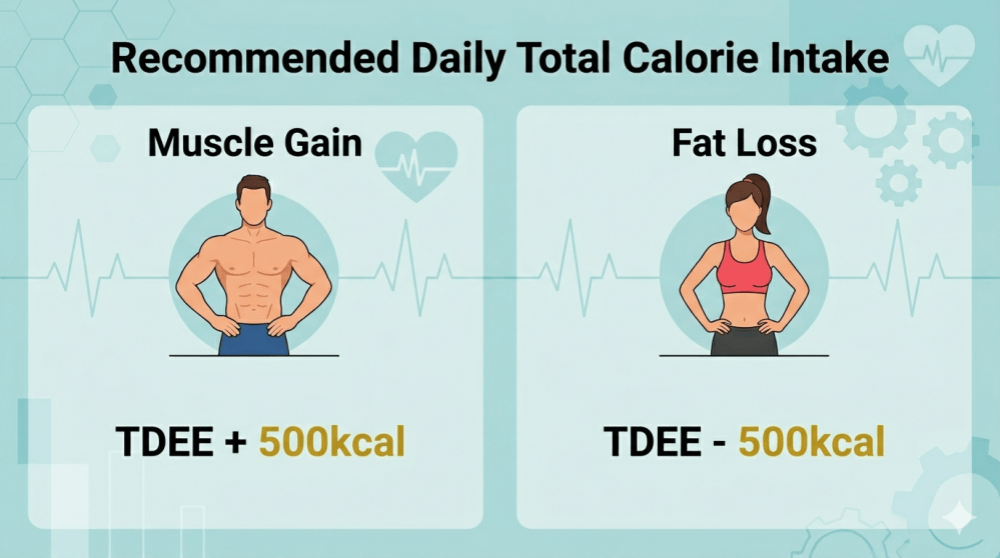
It is generally advised that those in a bulking phase consume a surplus of approximately 500 kcal above their TDEE (Target Intake = TDEE + 500 kcal).
Beyond total calories, increasing protein intake is paramount. Research indicates that high-protein diets (>25% of total calories) allow roughly 45% of excess energy to be stored as lean mass, whereas in low-protein diets (5%), nearly 95% of that excess is stored as body fat.
We will delve deeper into specific protein types and dosages later in this article.
Regarding Fat Loss
Conversely, fat loss strategies typically involve a deficit of roughly 500 kcal (Target Intake = TDEE – 500 kcal). It is vital to remember that total caloric control and strict adherence are the two most critical pillars of weight loss.
There is a common misconception that “late-night snacking” inherently causes weight gain. Scientifically speaking, if you remain within your caloric limits, the timing is secondary. However, heavy meals before bed can impair sleep quality, so we generally discourage excessive late-night eating.
Similar to the muscle-building phase, high protein intake is essential during a cut. Muscle tissue is metabolically expensive to maintain; when the body faces a caloric deficit, it may prioritize breaking down muscle for energy. To mitigate this, one must combine resistance training with a high-protein diet.
Think of it this way: a standard weight loss ratio might be 70% fat and 30% water/muscle. If you neglect strength training and protein, that ratio could shift to a detrimental 50% fat and 50% muscle. Regarding the debate between low-carb versus low-fat diets, current research demonstrates no significant difference in efficacy as long as calories are controlled.
Another frequent question arises: “Can I accelerate fat loss by further reducing my intake?”
Our recommendation is: No!!
The 500 kcal deficit is widely considered the “sweet spot” for maximizing fat loss while minimizing muscle atrophy.
Crashing your calories too low will lead to significant muscle wasting, regardless of protein intake.
A scientifically sound benchmark is to aim for a 10% reduction in body weight over a six-month period for those who are overweight. If your pace far exceeds this, you should re-evaluate if your deficit is too extreme.
Macronutrient Intake Recommendations
Once your TDEE is calculated and your daily target is set, the focus shifts to the distribution of the three “macros”—Protein, Carbohydrates, and Fats.
Please remember this cardinal rule: When designing a meal plan, always establish your protein requirements first, then fill the remaining caloric “budget” with carbohydrates and fats.
1. Protein
Protein “quality” is determined by its amino acid profile and digestibility. High-quality proteins are easily absorbed and contain all eight essential amino acids. This explains why animal proteins are generally superior to plant-based sources; animal products are complete and highly bioavailable. Among plant proteins, only soy contains all eight essential amino acids.
P.S. Note that the “digestibility” of animal protein can be influenced by cooking methods; for instance, the Maillard reaction can sometimes hinder the absorption of certain amino acids.
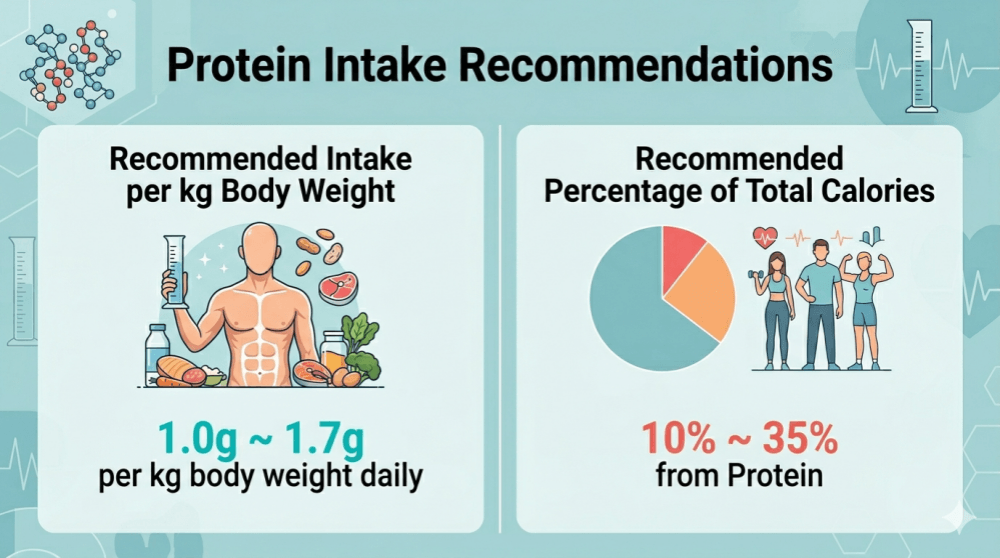
Recommended Daily Intake: You may have heard of two standards: RDA (based on grams per kg of body weight) and AMDR (percentage of total calories).
- Sedentary individuals/General fitness: 0.8g – 1.0g per kg.
- Endurance athletes: 1.0g – 1.6g per kg.
- Strength/Anaerobic athletes: 1.4g – 1.7g per kg.
According to the Institute of Medicine (IOM), the AMDR for protein is between 10% and 35% of total calories. This wide range exists because nearly all evidence suggests it is better to lean toward a higher intake. Why?
- Low protein intake (based strictly on minimal RDA) can negatively impact calcium absorption.
- Higher protein promotes satiety, aiding weight management.
- Protein has a higher Thermic Effect of Food (TEF), meaning you burn more calories just digesting it compared to carbs or fats.
- It protects against muscle loss during caloric deficits.
- It facilitates amino acid uptake for muscle repair post-exercise.
Are there side effects to “too much” protein?
A common concern is whether high protein damages the kidneys. However, studies involving intakes as high as 2.8g – 3.4g per kg have shown no adverse effects on renal function in healthy individuals. While “excess” protein isn’t necessarily harmful, it isn’t strictly recommended either.
Our stomach capacity is limited; over-consuming protein may displace essential carbohydrates, healthy fats, and dietary fiber, leading to an unbalanced nutritional profile.
2. Carbohydrates

Carbohydrates remain our primary energy source and are categorized into monosaccharides, disaccharides, and polysaccharides. Polysaccharides (complex carbs), primarily starches found in rice, potatoes, oats, and whole grains, should constitute 75% or more of your carb intake.
The remaining portion consists of “sugars” (mono- and disaccharides). The NSCA suggests that added sugars should not exceed 10% of total calories. Note: This does not include natural sugars in fruit or milk, which are recommended due to their broader nutritional value.
Daily recommendations are relatively fixed:
- Fat Loss: 2–3g per kg (approx. 140–210g for a 70kg person).
- General Fitness: 3–5g per kg (approx. 210–350g).
- Strength/Sprint Training: 5–7g per kg (approx. 350–490g).
- Endurance Athletes: 8–10g per kg (approx. 560–800g).
A word on low-carb diets: While they can help the body rely more on fat for fuel, chronic low-carb intake can lead to muscle loss and a metabolic slowdown. The most logical approach is Carbohydrate Cycling—consuming higher carbs on high-intensity training days and lower carbs on rest or cardio days.
Regarding Fiber: Fiber is a complex carbohydrate that is virtually indigestible and contains negligible calories, so it is not counted toward your total carb grams. Men should aim for 30–38g daily, and women 21–29g.
3. Fats
Having calculated your protein and carb targets, the remainder of your TDEE will be allocated to fats. Remember that fat is energy-dense, providing 9 kcal per gram, compared to 4 kcal for protein and carbs.
The focus here should be on the type of fat:
- Avoid Trans Fats entirely.
- Saturated Fats: Limit to under 10% of total calories.
- Unsaturated Fats: Prioritize monounsaturated (olive oil, avocados) and polyunsaturated fats.
- The Omega Ratio: While Omega-3 and Omega-6 are both essential, Omega-6 is abundant in modern diets. You should focus on increasing Omega-3 intake, often through fish oil supplementation.
Summary
By following the steps above, you have mastered the most critical 70% of a healthy eating meal plan: Energy Balance and Macronutrient Ratios.
Looking ahead, we have 2–3 more articles planned to cover the remaining essentials: micronutrient selection, nutrient timing (what to eat before and after training), and the supplement guide that many fitness enthusiasts have been asking for.
If you found this guide helpful and are currently refining your meal plan, be sure to bookmark our site so you don’t miss the upcoming installments!