
When it comes to improving sports performance, most people immediately think about practicing the movement itself. However, countless examples show that mental skills also play a crucial role in athletic performance. In fact, sports psychology techniques have become a dedicated field of study aimed at helping athletes improve performance through psychological training.
So the real question is: how to improve focus in sports?
Although this website mainly focuses on fitness-related knowledge, mental focus exercises are also highly useful for helping people get in the zone during sports and increase workout intensity. For this reason, we will also introduce some basic mental skills training here.
Mental skills training is mainly about using relaxation techniques to manage your mind, so you can stay focused on what truly matters during your workout—especially when you’re doing heavy lifting and pushing your limits—like when you’re trying to break through a bench press plateau and hit 150 kg.
Diaphragmatic Breathing
One of the simplest and most familiar mental skills that can simultaneously relax both the body and mind is diaphragmatic breathing.
The purpose of diaphragmatic breathing is to improve focus by directing attention to the breathing process, which helps clear the mind and enhance concentration.
Of course, there is also a physiological basis behind it:
Through feedback mechanisms, the respiratory regulation system in the brainstem is connected to the cardiovascular control center. This breathing pattern has a significant influence on heart rate and muscle tension.
By performing slow, deep inhalations followed by controlled exhalations, you can shift the balance of the autonomic nervous system, increasing vagal tone and parasympathetic activity.
The parasympathetic branch produces the opposite effect of the “fight-or-flight” response. It reduces neural stimulation in skeletal muscles and internal organs, leading to a state of deep relaxation.
In simpler terms:
When we breathe slowly and deeply with controlled exhalation, the body gradually shifts from a stress and tension state into a relaxation and recovery state. Heart rate slows down, muscles relax, and overall physiological arousal decreases.
Diaphragmatic Breathing Practice
- Start in a standing position with your arms relaxed at your sides
- (Optionally, take a few deep breaths first to relax the neck, shoulders, and abdominal muscles)
- Place one hand on your chest and the other on your abdomen (around the navel area)
- Inhale for 4 seconds — exhale for 6 seconds
- Repeat for 10 cycles, or practice for 5–10 minutes
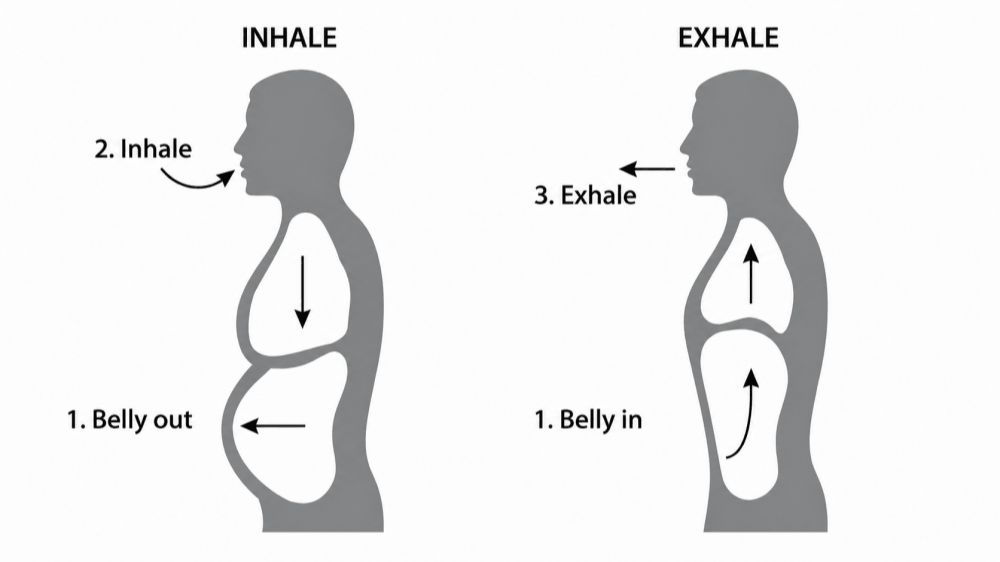
Important notes:
Each breath should begin with a relaxed abdomen. The abdomen should naturally expand during inhalation. Do not forcefully “push” your stomach outward.
If your chest rises significantly during breathing, it means you are using chest breathing, not diaphragmatic breathing.
Proper diaphragmatic breathing involves the diaphragm contracting and moving downward, allowing you to take noticeably deeper breaths.
Why Practice in a Standing Position?
Standing is the closest posture to real-life movement and athletic conditions. At this point:
- The chest is fully open
- The abdomen is not compressed
- Breathing is not restricted
Therefore, standing is considered the most effective and ultimate practice position.
However, for beginners, standing practice may feel more difficult. In contrast, lying down makes it easier to feel abdominal movement due to gravity and the support of the surface—although this sensation is partly passive.
Dynamic Muscle Relaxation Techniques
Beyond diaphragmatic breathing, there are also dynamic muscle relaxation techniques, mainly including:
- Progressive Muscle Relaxation (PMR)
- Autogenic Training (AT), which can be considered an advanced form of PMR
Progressive Muscle Relaxation (PMR)
PMR is a method where you intentionally tension and then relax muscles in order to become aware of physical tension and learn what true relaxation feels like.
The logic is simple: many people live in a state of low-level chronic tension without realizing it—for example, raised shoulders or clenched teeth, which are common signs of stress.
Once you understand this, the method becomes clear: you move through different muscle groups, cycling between tension and relaxation until the entire body is relaxed.
There are two standard PMR sequences:
- From top to bottom
- From bottom to top
Standard PMR Practice
- Lie down and maintain natural breathing
- Choose either a top-down or bottom-up sequence
- Tense each muscle group for 5–10 seconds
- Fully relax for 15–20 seconds, consciously feeling the release
A full PMR session typically takes around 10 minutes. Since it strongly activates the parasympathetic nervous system, it may cause drowsiness or sleepiness.
Therefore, PMR is not recommended before workouts. It is better suited for:
- Morning practice
- Before sleep
Recommended reading for a detailed understanding of the muscle groups involved in standard PMR practice.
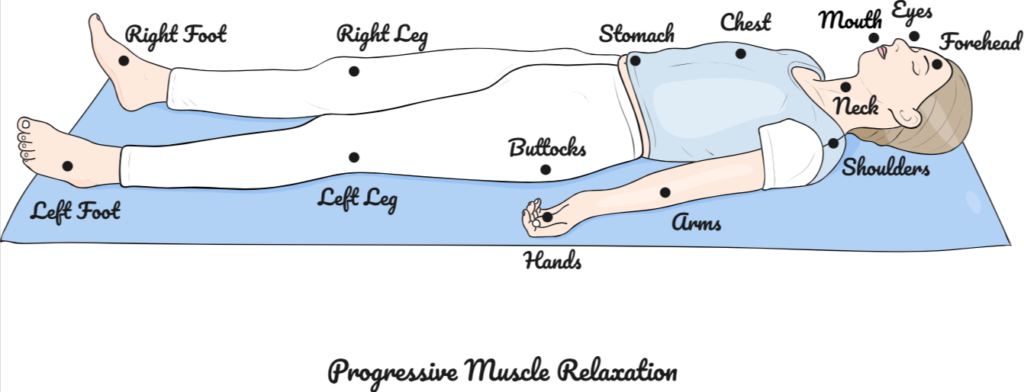
About Muscle Tension Duration
Some literature suggests 10–15 seconds of tension, but this is usually designed for professional athletes with stronger neuromuscular control.
For most people, 5–10 seconds is sufficient. In fact, many beginners cannot maintain longer contractions effectively.
Because standard PMR takes time and requires a calm environment, it is best practiced in a comfortable setting.
Simplified PMR
- Lie down or sit comfortably, maintain natural breathing
- Start with the hands and forearms
- Tense for 3–5 seconds
- Relax for 10–15 seconds
- Continue in order: hands → shoulders → face → abdomen
P.S. In some situations where sympathetic activation is needed (such as before exercise), PMR can also be performed in a standing position.
Autogenic Training (AT)
If PMR is about “doing” relaxation, then AT is about “thinking” relaxation.
It works through self-suggestion and passive attention, helping activate the parasympathetic nervous system and induce a relaxed state.
The core of AT focuses on sensations such as:
- Heaviness in the limbs
- Warmth in the body
- Calm internal organ activity
You simply repeat a set of formulas silently 3–6 times.
Important: you are not trying to force belief—this is a form of autonomic conditioning training.
Standard AT Practice
- Lie down, close your eyes, and breathe naturally
- Quiet your mind and repeat the following phrases 3–6 times each:
- My limbs are heavy
- My hands and feet are warm
- My heartbeat is calm and regular
- My breathing is easy and natural
- My abdomen is warm and relaxed
- My forehead is cool
- Take 1–2 deep breaths, then slowly move your fingers and toes before opening your eyes
Like PMR, full AT practice may take 10 minutes or longer. Therefore, simplified versions are often used in daily life.
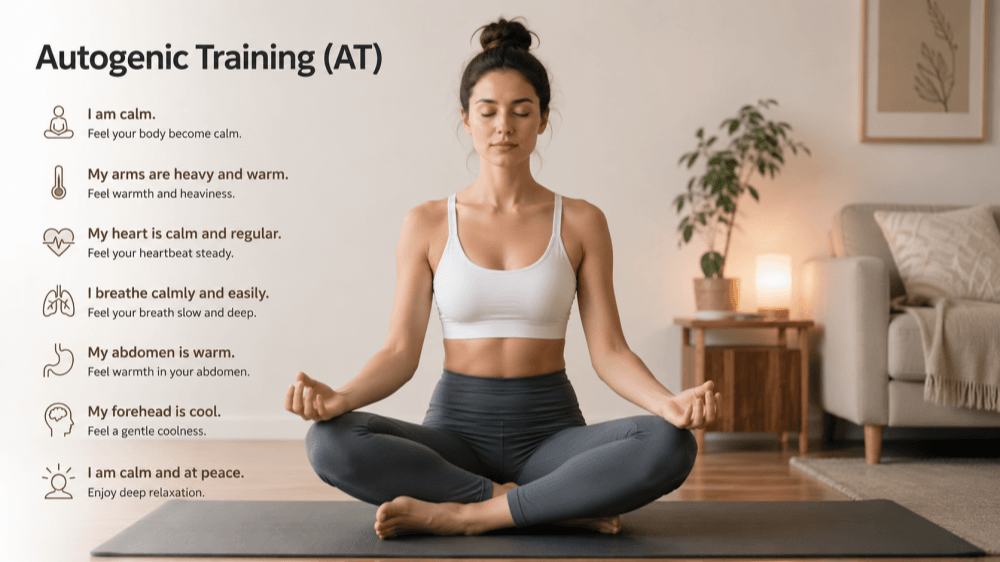
Simplified AT Practice
- Lie down or sit comfortably, close your eyes, and relax
- Repeat the following phrases internally with different counts:
- My limbs are heavy (6 times)
- My hands and feet are warm (4 times)
- My heartbeat is calm and regular (3 times)
- My breathing is easy and natural (3 times)
- My abdomen is warm and relaxed (2–3 times)
- My forehead is cool (0–2 times)
- Take 1–2 deep breaths, then gently move your fingers and toes before opening your eyes
Note on “Cool Forehead”
The phrase “my forehead is cool” is not primarily for deeper relaxation. Instead, its purpose is to bring your awareness back toward a slightly more alert and awake state.
Therefore:
- It can be omitted in daily relaxation or sleep preparation
- It is optional before workouts
- It can be used depending on context
PMR vs AT
In general, it is recommended to combine both methods:
- Start with PMR
- Then follow with AT
However, they can also be practiced separately:
- PMR is more suitable for people with high physical tension or beginners
- AT is often preferred by people who dislike physical tension, such as older adults or individuals in rehabilitation
Once you have more experience, you may even rely mainly on AT alone.
Final Thoughts
These are the three main types of mental skills training, designed to improve both sports performance and daily functioning.
Among them, diaphragmatic breathing is the foundation and most important skill. PMR and AT serve as advanced methods that can be combined with breathing exercises.
Ultimately, the best approach depends on individual preference and physical condition.
But the key principle remains the same:Start practicing first.