

The debate over sweetener vs sugar is one I know all too well. It reminds me of a recent dinner at a relative’s house. Before we sat down, my cousins and I went downstairs to grab some sodas, and an immediate rift formed.
I was firmly in the diet soda camp. However, my two older brothers adamantly demanded regular, sugar-sweetened coke. One claimed he had read a report stating that artificial sweeteners actually stimulate your appetite and make you eat more. The other chimed in, asserting that aspartame messes with your insulin levels and might even cause cancer.
For a while, a massive wave of “sweetener fear-mongering” swept across the internet. Media outlets left and right were hyper-focused on highlighting the downsides of alternative sweeteners. Some of this was admittedly intentional mudslinging between competing manufacturers. For example, brands utilizing erythritol would aggressively attack the aspartame used in traditional diet sodas, claiming erythritol was the vastly superior, “cleaner” choice.
Worse still, some pseudo-scientific articles went as far as claiming that regular, sugar-laden drinks are actually healthier than any alternative sweetener on the market.
Because brands pushed these loose, unscientific claims purely to drive sales, consumers—who already preferred the taste of regular soda anyway—selectively believed the hype. They ultimately arrived at a convenient conclusion: “Since sweeteners are problematic too, I might as well just drink real sugar.”
But are artificial sweeteners actually bad for you? To answer that, let’s first peel back the layers on what these substances actually are.
What is Sweetener?
To put it simply, a sweetener is a low-calorie or zero-calorie food additive that mimics the taste of sugar. It is primarily used as a direct substitute for granulated sugar and sucrose.
Because their caloric footprint is incredibly negligible, products formulated with these additives can legally be labeled as “sugar-free.” However, if we are being strictly scientific, alternative sweeteners are rarely truly zero calories.
What is Sweetener Made Of?
If you are wondering what is sweetener made of, these sugar substitutes generally fall into three distinct buckets: artificial sweeteners, natural sweeteners, and sugar alcohols.
- Artificial Sweetener: Classic examples of an artificial sweetener include aspartame and sucralose. These are chemically synthesized in a laboratory setting through artificial processes.
- Natural Sweeteners: In direct contrast to chemical synthesis, natural sweeteners refer to compounds extracted directly from botanical plants. Stevia and monk fruit extract are the two reigning champions of this category.
- Sugar Alcohols (Polyols): Sugar alcohols are sweeteners derived from the processing or fermentation of carbohydrates. For instance, the highly popularized erythritol is produced by fermenting the glucose found in corn starch.
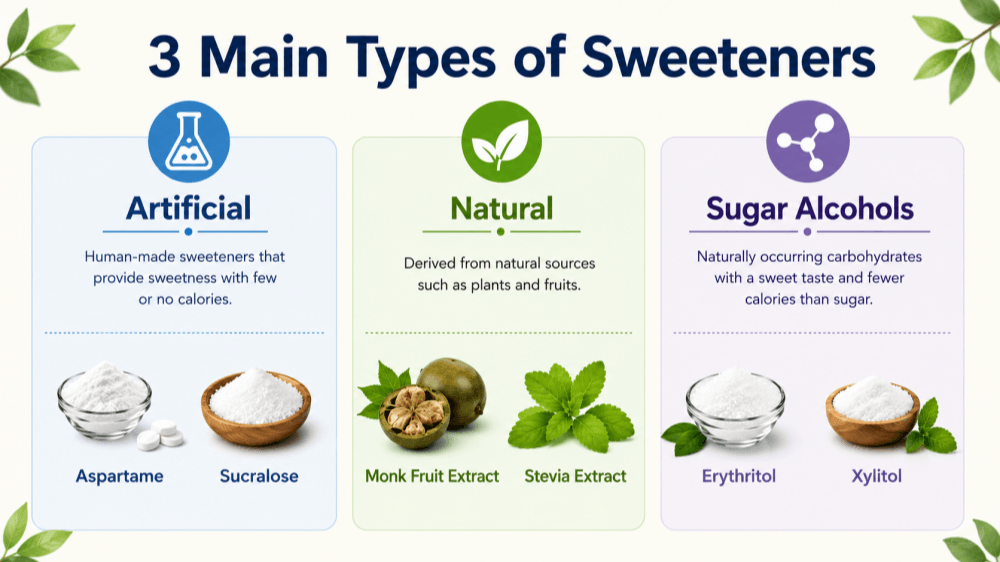
The world of sugar alcohols is actually quite vast, encompassing erythritol, xylitol, sorbitol, mannitol, maltitol, isomalt, and lactitol, among others.
While they all sit under the “sweetener” umbrella, it is critical to note that apart from erythritol—which boasts a caloric value of nearly absolute zero—most sugar alcohols aren’t actually that low in calories. They typically yield about 1.6 to 2.6 kcal/g, which is roughly half the caloric density of white sugar.
This introduces a crucial distinction that consumers often miss: “sugar-free” does not automatically mean “0 calories.” Any product using these substitutes can claim to be sugar-free, but only specific compounds like erythritol or aspartame truly deliver a zero-calorie profile.
Many people blindly assume that “sugar-free” equals “diet-friendly,” without realizing that a lot of these products still carry a heavy caloric load.
P.S. Another “sugar-free” ingredient that manufacturers absolutely love to sneak into products is maltodextrin. In reality, from a metabolic standpoint, it is far more detrimental than sugar alcohols. I’ll dive deeper into that specific trap in a future article.
Natural Sweeteners vs. Artificial Sweeteners vs. Sugar Alcohols
When faced with the words “artificial” and “natural,” most people instinctively assume the former is toxic and the latter is a health food.
In reality, “natural” simply dictates a plant-based origin; it does not inherently guarantee that a compound is better for your body. Furthermore, the commercial extraction and refinement process itself is a highly complex, industrialized human intervention.
Ironically, classic artificial options like aspartame and sucralose have been around the longest. Because of their seniority, they are arguably the most thoroughly researched, heavily scrutinized, and stringently regulated food additives in human history.
Therefore, pitting these sweeteners against one another from a pure “health” standpoint is largely missing the point. When you see different brands opting for different chemical profiles, their decisions are almost entirely driven by production costs and taste profiles, not your wellness.
- Aspartame possesses an incredibly high sweetening power (roughly 200 times sweeter than table sugar), but its taste profile doesn’t perfectly mimic sucrose. This is what people commonly refer to as that lingering, “chemical-tasting fake sweetness.”
- Erythritol offers a mouthfeel that is remarkably close to real sugar, but it lacks punch—delivering only about 70% of the sweetness of sucrose.
What this means logistically is that to achieve the same level of sweetness in a beverage, aspartame is the most cost-effective solution, whereas erythritol requires a much higher financial investment. Consequently, budget-friendly sodas almost always rely on aspartame, while premium, high-ticket beverages opt for erythritol.
As for natural sweeteners, they are mostly relegated to specialized herbal or organic drinks. This is partly because botanical extracts are by far the most expensive sweeteners on the market, and partly because plant-derived sweeteners often carry a distinct aftertaste or a subtle, inherent bitterness.
Now that we’ve broken down the playing field, let’s get into the real meat of the debate: Are these sweeteners actually good or bad for you?
Is Sweetener Good or Bad for You?
When looking into the potential downsides of alternative sweeteners, you have likely heard a laundry list of terrifying claims: they mess with your insulin, spike your appetite, disrupt your gut microbiome, and—in the worst-case scenarios—cause cancer or leukemia.
But how do these claims hold up under scientific scrutiny? Let’s break down the actual data.
The Big C: Do Sweeteners Cause Cancer?
There is indeed a heavily cited study that found a connection: when aspartame intake exceeded 20mg per kilogram of body weight, the risk of lymphoma and leukemia in subjects began to rise significantly.
However, please look closer at the details of this study. First, it was an animal trial conducted strictly on rats. Second, these rats were pumped with astronomical amounts of aspartame.
We already know that rodent studies cannot be blindly copy-pasted onto human physiology. But even if we assumed they could, let’s do the math. For a 60kg human, matching that specific dosage would require ingesting at least 1,200mg of aspartame a day—the equivalent of chugging 7 or more cans of diet soda every single day. For the average person, hitting this threshold is practically impossible.
As you can see, this terrifying headline completely falls apart under a basic reality check.
Cardiovascular Health: A Scarier Headline?
Between 2009 and 2021, a massive nutritional cohort study tracked 103,388 participants. Every six months, these individuals submitted a detailed three-day dietary record. Researchers used these logs to estimate each person’s alternative sweetener intake and analyzed it against their incidence of cardiovascular disease.
In the study, the “low-intake group” averaged 7.46mg of sweetener per day, while the “high-intake group” averaged 77.62mg. The final conclusion? The high-intake group faced a 9% higher risk of developing cardiovascular disease than the low-intake group.
An extra 70mg of sweetener—roughly the amount in just half a can of diet soda—spikes your risk by 9%? That sounds horrifying on paper.
However, you need to understand the absolute baseline risk here. We are looking at a nominal shift from 0.31% to 0.34%. Furthermore, this was a purely observational study based on self-reported logs. With so many confounding, uncontrolled lifestyle factors at play, this correlation is a far cry from proving direct causation.
Metabolism and Weight Loss: The “Slowing Down” Myth
Because alternative sweeteners contain virtually no calories, they do not directly stimulate insulin production. However, a popular counter-theory suggests that sweeteners alter your gut microbiota, cultivating harmful bacterial strains that impair your body’s ability to process blood glucose, ultimately leading to obesity and metabolic syndrome via a backdoor route.
This theory stems primarily from a widely publicized 2014 study. Yet, its flaws are identical to the rat study on cancer. The experiment was conducted on mice, and the dosages used were absurdly high—equivalent to a human drinking more than 10 cans of diet soda a day.
In contrast, subsequent human clinical trials have painted a very different picture. Even when human subjects consumed the sweetener equivalent of three cans of diet soda daily for two consecutive weeks, the impact on their gut microbiota and glucose metabolism was entirely negligible.
When it comes to actual weight management, the overwhelming majority of current literature views alternative sweeteners as either neutral or explicitly positive.
The prevailing reason is psychological and behavioral: simply drinking plain water rarely satisfies a person’s biological craving for sweets. Incorporating low-calorie sweeteners satisfies that psychological sweet tooth while simultaneously slashing total caloric intake.
A Quick Warning: Some individuals do fall into a psychological trap of “indulgence compensation.” Much like someone who thinks they can overeat at dinner just because they went to the gym, a person might subconsciously consume more calories from food because they chose a diet drink. This is a purely behavioral pitfall—it is not a metabolic fault of the sweetener itself. Never forget: when it comes to weight management, total caloric balance remains the ultimate king.
Decoding the 2023 WHO Guidelines on Non-Sugar Sweeteners
The publication of the World Health Organization (WHO) guidelines was arguably the catalyst that reignited the massive “sweetener panic” across the internet. Let’s look at what the document actually states.
The WHO did indeed note that “non-sugar sweeteners (NSS) should not be used as a means of achieving weight control or reducing the risk of non-communicable diseases.” They further noted that long-term consumption might be linked to an increased risk of type 2 diabetes, cardiovascular diseases, and overall mortality.
Predictably, mainstream media outlets ran wild with this specific excerpt to generate clickbait headlines.
However, there are two critical pieces of context the media conveniently left out:
- Right below this directive, the WHO explicitly clarified that these findings suggest a correlation, not a causal relationship. Because the evidence was not definitive, the WHO classified this as a “conditional recommendation.” The media, of course, stayed completely silent on this nuance.
- If you dig into the comprehensive literature review cited in the guidelines, you will find that the actual data aligns perfectly with what independent nutritionists have known for years: there might be a link, but the certainty of the evidence is remarkably weak.
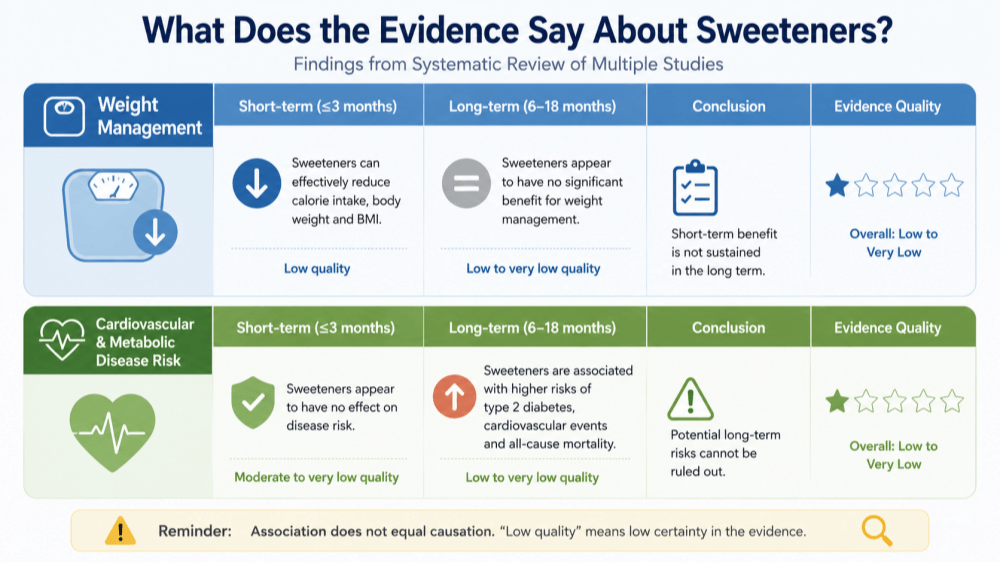
To illustrate this, please look at the breakdown below, compiled and synthesized from literature citations by registered dietitian Rachel:
Weight Management:
- Short-term studies (under 3 months): Sweetener use effectively reduces total energy intake, body weight, and BMI. [Certainty of Evidence: Low]
- Long-term studies (6 to 18 months): Sweeteners appear to offer no significant long-term benefit for weight management. [Certainty of Evidence: Low to Very Low]
Cardiovascular & Metabolic Disease Risk:
- Short-term studies (under 3 months): Sweetener intake does not appear to negatively impact disease biomarkers. [Certainty of Evidence: Moderate to Very Low]
- Long-term studies (6 to 18 months): Sweetener intake shows a positive correlation with higher risks of type 2 diabetes, cardiovascular issues, and mortality. [Certainty of Evidence: Low to Very Low]
A grading of “Low” or “Very Low” quality simply means the certainty of the data is weak.
In its closing remarks, the WHO even raised the high probability of “reverse causation.” This means that individuals who are already overweight, unhealthy, or predisposed to chronic illness are naturally the ones most likely to switch to alternative sweeteners in an attempt to manage their health.
The true, underlying intent of the WHO guideline was to warn the public not to treat sweeteners as a magical crutch for weight loss and health. Instead, people should focus on reforming their overall dietary structure, reducing their threshold for sweetness across the board, leaning into whole foods with natural sugars (like fruit), and ruthlessly minimizing added sugars.
Understood through this objective lens, there is absolutely no scientific basis to panic over the casual, everyday consumption of a sugar-free beverage.
WHO Guidelines and Systematic Reviews:
https://www.who.int/publications/i/item/9789240046429
The Only Real Side Effect: Sugar Alcohols and Digestion
If you are looking for a legitimate, proven side effect of alternative sweeteners, it is gastrointestinal distress—specifically, diarrhea.
However, this issue is almost exclusively confined to sugar alcohols. It is primarily a localized absorption issue, highly reminiscent of how lactose intolerance or caffeine sensitivity can trigger sudden bowel movements.
Because of this osmotic effect, sports nutrition guidelines for aerobic endurance athletes explicitly mandate avoiding sugar alcohol products prior to a race or heavy training session. If you personally notice that certain sugar alcohols trigger stomach discomfort, the solution is simple: cut them out or scale back your intake.
The Takeaway
The goal of this breakdown isn’t to put alternative sweeteners on a pedestal or claim they are a health food. Rather, it is to demystify the irrational fear surrounding them.
When we look at the hard data, the clinical evidence proving the devastating harms of high-sugar diets is infinitely stronger, more consistent, and more conclusive than any hypothetical risk pinned on alternative sweeteners. If a diet soda helps you transition away from liquid sugar, it is a net win for your health.