

In our previous discussions, we covered the most common foundational dietary supplement—the multivitamin. If we envision a multivitamin as the bedrock or “base” of your nutritional status, then the supplements we are about to discuss represent the “structural reinforcement” designed to elevate athletic performance.
While multivitamins essentially help maintain normal physiological functions, they often fall short when our goals shift toward accelerating muscle synthesis or preventing muscle loss after extreme training sessions. In these scenarios, the body requires specific nutrients in high, singular dosages that standard diets or “all-in-one” products simply cannot provide.
Today, we will explore the key dietary supplements that can truly help you push your physical boundaries.
Recommended reading: Before diving in, feel free to check out our previous article, [A Scientific Guide to Custom Vitamin Packs for Athletes]. It is important to emphasize that we are strictly discussing dietary supplements here; this guide does not involve hormonal drugs, such as HGH or steroids.
About This Guide
The world of sports supplements is vast and often clouded by conflicting data (it’s common to find one study proving a supplement’s efficacy while another deems it useless).
Staring at a mountain of pills, capsules, and powders every day can be a daunting experience. Therefore, I will focus on supplements that are either scientifically backed or that I have personally found effective. Others that are “mostly ineffective” or “highly questionable” will be mentioned only briefly.
Creatine
If I could only recommend one sports supplement, the vast majority of experts (myself included) would point to Creatine. It is arguably the only supplement consistently proven to increase maximal strength—power, explosiveness, and force—while remaining remarkably safe for long-term use.
I won’t go into the granular biochemical mechanics here, but I’ve linked a detailed resource for those interested in the deep dive.
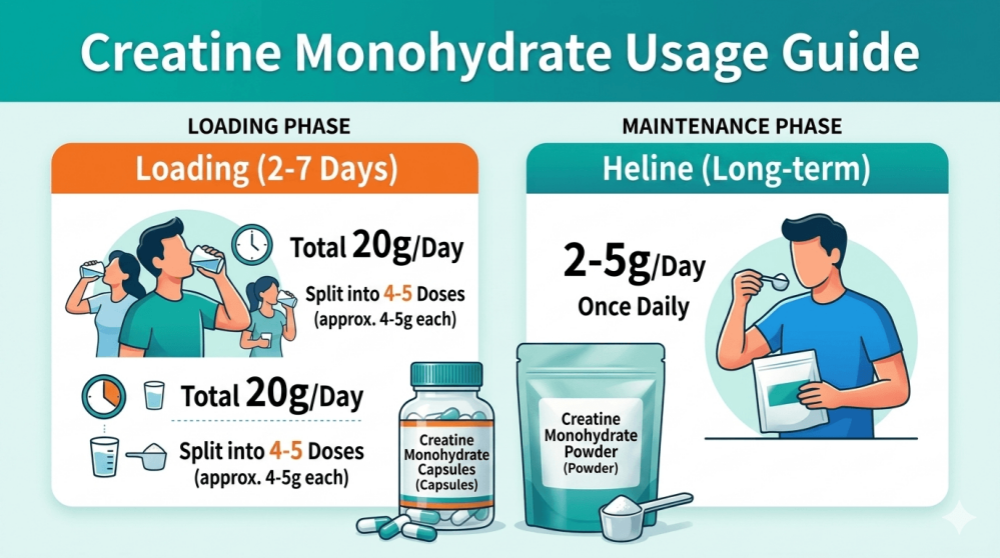
There are two typical ways to supplement with creatine:
- The Loading Phase + Maintenance: During the loading phase (2–7 days), you take 20g daily, split into 4–5 doses. This is followed by a maintenance phase of 2–5g per day.
- Maintenance Only: Skip the loading and simply take 2–5g daily.
While the loading phase is the traditional “classic” method, a growing body of research suggests that the “maintenance only” approach yields similar results over time without the initial hassle.
Two critical points to remember:
- Creatine’s benefits are not “permanent.” Once you stop supplementation, the creatine levels in your body will eventually return to their baseline. If you want the performance edge, consistency is key.
- Avoid taking too much at once. Never exceed a single dose of 5g, as this is a one-way ticket to digestive upset and diarrhea.
HMB (β-Hydroxy β-Methylbutyrate)
HMB is a metabolite of the amino acid Leucine. Its primary function is to inhibit muscle protein breakdown and minimize muscle damage. To put it simply: it helps with repair and prevents you from losing hard-earned muscle.
Here’s the catch: this means HMB does not directly increase maximal strength or the “explosive” performance metrics most people chase.
Typically, HMB shines in two specific scenarios:
- Beginners: Novice lifters are more prone to significant muscle damage and soreness. By accelerating recovery, HMB indirectly boosts strength gains and lean mass for those just starting out.
- Experienced Athletes Changing Routines: Multiple studies indicate that veterans rarely benefit from HMB unless they significantly alter their training program to introduce new, high-intensity stimuli.
In short: unless your training is intense enough to truly challenge your current physical state, HMB likely won’t move the needle for you.
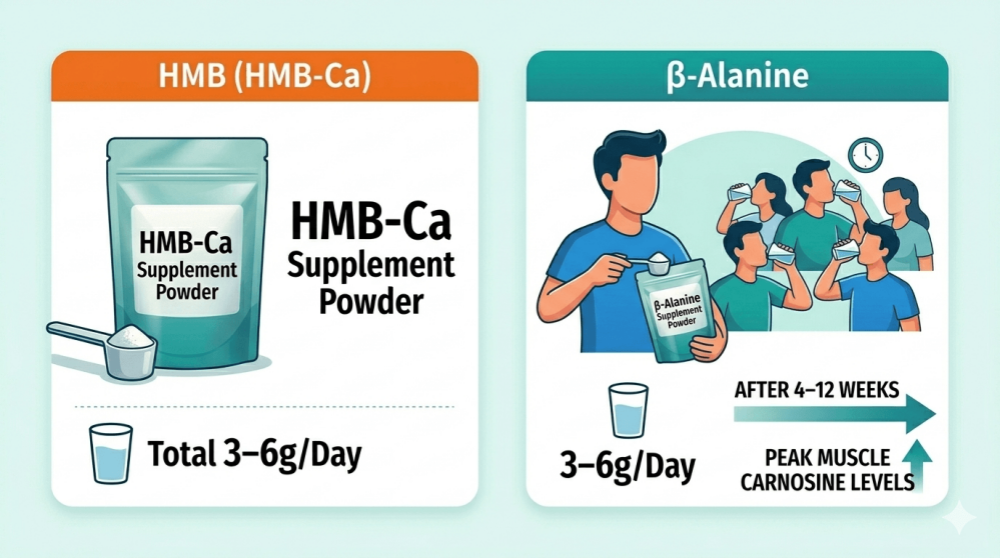
How to take it: 3–6g daily is sufficient. By the way, if you see HMB-Ca on a label, don’t overthink it—that’s just the calcium-bound form of HMB. Just buy it.
β-Alanine
β-Alanine works by increasing the concentration of carnosine in your muscles. Carnosine acts as a buffer, slowing down the drop in pH levels (acidification) caused by high-intensity exercise.
Think of it this way: if long-term creatine use helps you increase your bench press from 100kg to 102kg, β-Alanine’s job is to help you grind out that 9th rep when you would usually fail at 8. It increases your “anaerobic threshold,” allowing you to sustain high-intensity efforts for longer.
I should mention that while most experiments support its efficacy, some studies have found it to be ineffective. If you decide to try it, a dose of 3–6g daily is safe and effective. Usually, after 4–12 weeks of consistent use, your muscle carnosine levels will peak.
A quick heads-up: If you’re new to β-Alanine, you might experience a tingling sensation on your skin (paresthesia). This is completely normal. If you’ve ever taken a “Pre-workout” and felt that itchy, pins-and-needles sensation, that’s the β-Alanine doing its thing.
BCAA (Branched-Chain Amino Acids)
Amino acids are the literal building blocks of protein, so it seems logically sound that supplementing them would stimulate protein synthesis.
BCAA is a collective term for three essential amino acids: Leucine, Isoleucine, and Valine. These are the primary drivers of muscle protein synthesis (MPS). While numerous studies have indeed confirmed their efficacy, the “catch” is that high-quality protein sources already contain all eight essential amino acids, including BCAAs.
In fact, research has shown that supplementing with whole protein after a workout is more effective than taking BCAAs in isolation. Given that most modern protein powders are already fortified with BCAAs, buying them as a standalone supplement is often redundant.
A quick side note on Leucine: Leucine is the “master switch” for muscle protein synthesis. Interestingly, some research suggests that pairing white rice with Leucine can stimulate protein synthesis as effectively as high-quality animal protein. So, if your diet is heavy on rice, supplementing with 2–3g of Leucine daily might actually be a smart, cost-effective move.
Arginine
Arginine has long been marketed under the premise that it boosts nitric oxide (NO) levels, thereby enhancing athletic performance through improved blood flow.
However, modern clinical trials have largely debunked this. Whether we are talking about endurance or anaerobic performance, oral Arginine supplements have shown virtually no effect. Save your money—this is one “fitness tax” you don’t need to pay.
Sodium Bicarbonate / Sodium Citrate
You’re likely familiar with Sodium Bicarbonate as the main ingredient in baking soda. Because it acts as an antacid that raises blood pH, it can buffer the acidity produced during high-intensity exercise, thereby boosting performance.
The standard protocol is 0.3g per kg of body weight, taken 60–90 minutes before exercise. The major drawback? It is notorious for causing gastrointestinal distress. Since its function overlaps significantly with β-Alanine, most athletes now simply opt for the latter to avoid the “stomach gymnastics.”
As for Sodium Citrate, some claim it offers the same buffering benefits without the GI issues. Unfortunately, the weight of current research suggests it isn’t nearly as effective as sodium bicarbonate. My advice? Ignore it.
Glycerol
This is a supplement you might not hear about often. Glycerol is the backbone of triglycerides, and its hallmark is its ability to draw and hold significant amounts of water. This “hyper-hydration” effect can technically improve performance before endurance events.
However, it’s not a blanket recommendation for all cardio. Research suggests that for standard endurance sessions, a simple beverage containing 6%–8% carbohydrates is more effective (refer to our previous article: How to Stay Hydrated During Workouts).
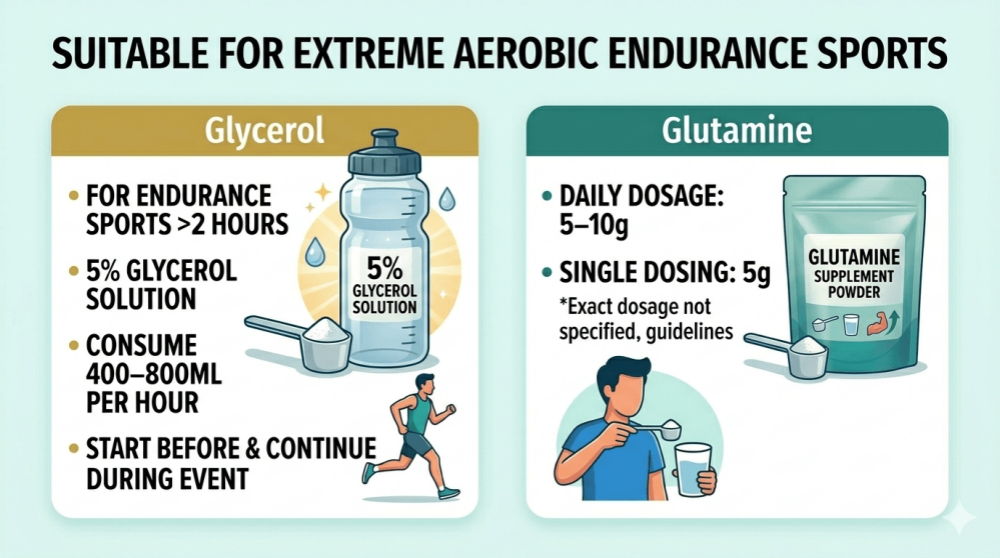
Glycerol only becomes truly advantageous for endurance efforts exceeding two hours. In such cases, the protocol is to consume 400–800ml of a 5% glycerol solution per hour before and during the event.
A Final Word on “Pre-Workouts”
I’ve noticed that many Pre-workout (PWO) products now include glycerol, alongside the usual mix of β-Alanine and BCAAs.
If you’ve followed along this far, you should realize that different supplements target vastly different types of exercise. If you are shopping for a Pre-workout, please read the ingredient label first. Evaluate whether your specific training style and intensity actually justify the ingredients in that tub.
Glutamine
You’ve probably seen Glutamine marketed as a recovery essential. While technically true, most marketers conveniently forget to tell you which type of recovery it helps with.
Most of the body’s glutamine is stored in slow-twitch muscle fibers. Consequently, it is primarily during prolonged aerobic endurance activities that we see a significant demand for it. Most studies proving glutamine’s efficacy focus on endurance athletes, not those doing resistance training.
If you’re a “gym rat” focused on lifting weights, Glutamine is likely a waste of your time. Even for cardio enthusiasts, the body is usually quite efficient at maintaining its own glutamine levels. Unless you are undergoing extreme physical stress or ultra-endurance events, your body has more than enough.
L-Carnitine
The biological role of L-Carnitine is to transport fatty acids from the cytosol into the mitochondria, where they are oxidized to produce energy. Because of this, you’ve likely seen it aggressively marketed as a “fat burner” that mobilizes fat for weight loss.
However, the current consensus in research is a bit of a letdown: oral supplementation of L-Carnitine does not effectively increase the carnitine content within the muscles. In other words, simply swallowing a pill doesn’t seem to translate into the theoretical fat-burning benefits promised in advertisements.
Interestingly, research has uncovered a “side quest” benefit: supplementing with L-Carnitine after high-intensity resistance training can reduce soreness and muscle damage, effectively aiding in post-workout recovery.
The Verdict: If you’re buying it for weight loss, you’re likely wasting your money. But if you’re deep into high-intensity lifting, 2g daily might be worth trying to speed up your recovery.
CLA (Conjugated Linoleic Acid)
CLA is claimed to inhibit fat growth and promote fat breakdown. The “catch”? These impressive results were almost exclusively found in animal studies.
Research on humans has failed to replicate these effects. Even at a dosage of 3g per day, it remains largely ineffective. To make matters worse, most commercial CLA supplements only suggest 1g daily. I think you can connect the dots—this is one supplement you can safely cross off your shopping list.
Caffeine
Enter the “heavy hitter.” As a stimulant, Caffeine is one of the few supplements widely used across both aerobic and anaerobic disciplines.
Caffeine seems almost superhuman in its range of benefits: it extends time-to-exhaustion in endurance sports, blunts the perception of fatigue, reduces muscle soreness, enhances glycogen resynthesis, increases lipolysis (fat breakdown) and thermogenesis, and boosts explosive power.
While some studies remain ambiguous—particularly regarding its ability to increase absolute maximal strength—the general scientific consensus is that it works, especially for aerobic endurance and power-based movements.
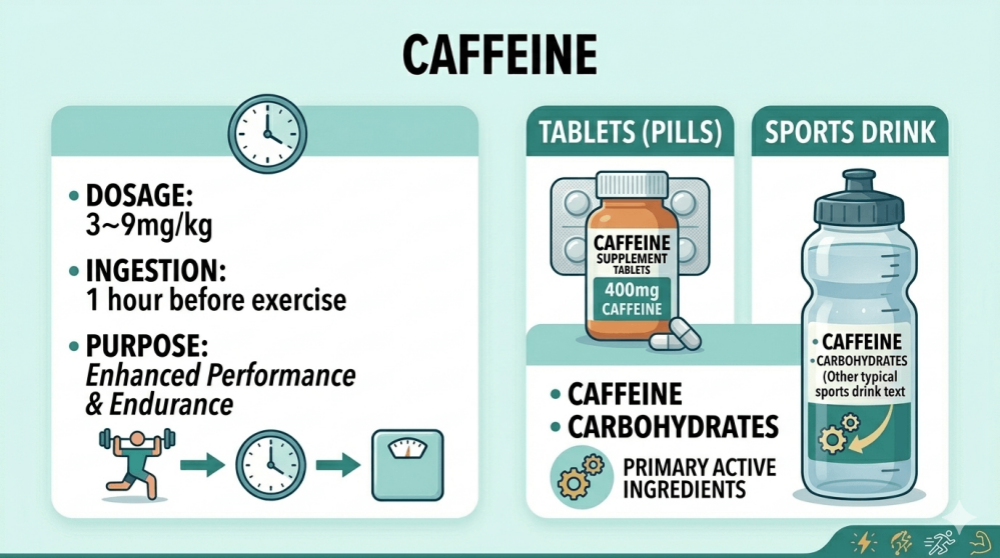
Key takeaways for using Caffeine:
- Dosage: A range of 3–9mg per kg of body weight appears safe and effective. However, many experts suggest capping daily intake at 400mg to avoid adverse effects.
- Timing: Caffeine is fully absorbed within an hour, and its half-life can last 4–6 hours. For peak performance, take it one hour before your workout.
- Form Matters: Interestingly, pure caffeine (such as tablets or anhydrous powder) has been shown to be more effective for performance than food-based sources like coffee.
- Synergy: Caffeine can increase the absorption rate of carbohydrates, so pairing your pre-workout caffeine with some carbs is a pro move.
A Note on Sports & Energy Drinks
Since we’re talking about caffeine, we have to mention energy drinks. These products are essentially “liquid pre-workouts”—a blend of various nutrients like caffeine, carbohydrates, B-vitamins, Tyrosine, and Taurine. You’ll often see exotic herbal additions like Theanine or even Sialic acid.
Regardless of the “fluff” on the label, make no mistake: the heavy lifters in any energy drink are the carbohydrates and the caffeine. Everything else is mostly window dressing.
Final Summary
We’ve covered almost all the mainstream supplements. To wrap things up, here is your quick-reference cheat sheet:
- To Build Strength: Stick with Creatine.
- To Speed Up Recovery (especially after high-intensity sessions): Consider HMB and L-Carnitine.
- To Sustain High-Intensity Performance and Delay Fatigue: β-Alanine is your go-to.
- For Extreme Endurance: Use Glycerol to hyper-hydrate before the event and Glutamine to assist recovery afterward.
- The “Swiss Army Knife”: Caffeine can be used across almost all activities to boost endurance and power, though its effect on raw strength is still up for debate.
Closing Thoughts: I’ve spent a lot of time detailing these supplements, but I want to end with a reality check: Supplements do not produce miracles. They are the “reinforcement,” not the foundation.
Compared to any pill or powder, your daily nutritional structure and your consistency in hard training are the real drivers of your athletic performance.
Don’t let the supplement industry convince you otherwise—train hard, eat right, and use supplements only to bridge the final gap.