

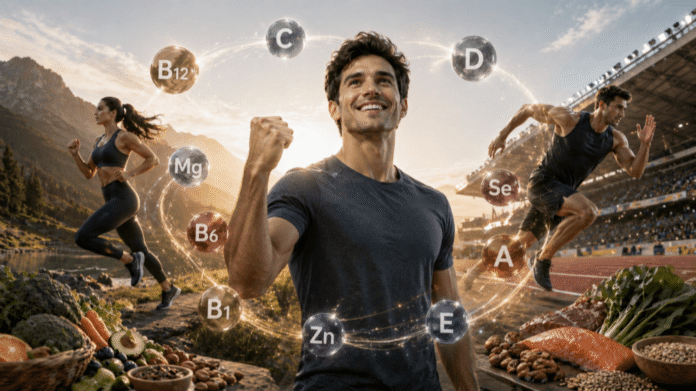
In our last deep dive, we talked about the heavy hitters of your weekly meal plan: macros and the math behind TDEE. But calories aren’t the whole story. To keep the engine running smoothly, we need to talk about vitamins and minerals. Think of them as the “co-enzymes” that act like the spark plugs for your metabolism.
Now, technically, you could get everything you need from a colorful plate of veggies, fruits, seeds, and meats. But let’s be real: even with a solid diet, it’s surprisingly easy to miss a few key players. On the flip side, some nutrients are so easy to find that you might end up overdoing it, which brings its own set of headaches.
In today’s post, we’re looking at the best vitamins for energy and athletic performance to help you figure out what actually deserves a spot in your kitchen.
Vitamins: The Metabolic “Support Crew”
Vitamins are mainly divided into fat-soluble and water-soluble groups. The fat-soluble vitamins include Vitamin A, Vitamin D, Vitamin E, and Vitamin K, while the water-soluble ones include Vitamin C and the B-complex vitamins.
In many supplements, you will also see beta-carotene. It is a precursor to Vitamin A; once ingested, your body converts it into Vitamin A based on its actual physiological needs.
Another special group is the B-complex vitamins. Many people mistakenly assume Vitamin B is just one single vitamin, but it is actually an entire family, and each one serves a unique function:
- B1 (Thiamine): The energy metabolism specialist.
- B2 (Riboflavin): Great for your skin and cellular function.
- B3 (Niacin): Keeps your nerves and digestion in check.
- B5 (Pantothenic Acid): Helps with hormones and fat metabolism.
- B6 (Pyridoxine): Brain power and metabolic support.
- B7 (Biotin): The “beauty” vitamin for hair, skin, and nails.
- B9 (Folate): Essential for DNA and red blood cells.
- B12 (Cobalamin): A must for nerve function and blood health.
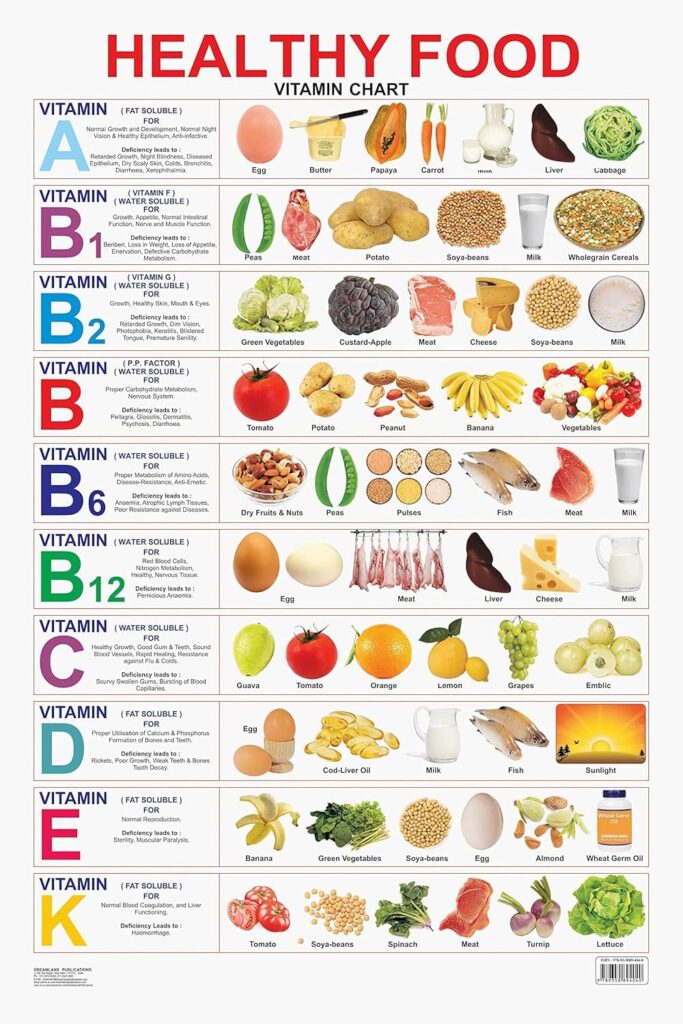
There is a massive amount of information available online regarding the functions and recommended daily intake of each vitamin, so we will simply refer to an online image and webpage here for reference.
You might wonder why this article doesn’t specifically introduce how to supplement each type of vitamin.
The reason is that, in practice, as long as your dietary structure is reasonable, most vitamins—with the exception of Vitamin D—can be fully met through vegetables, fruits, grains, eggs, dairy, and meat.
Therefore, rather than focusing on how to supplement individual vitamins, building a healthy, complete dietary structure is much more important.
Below is the intake framework established by MyPlate, a globally recognized dietary standard. This standard is also cited by top professional institutions such as the NSCA as the foundational dietary framework for athletes and fitness enthusiasts:
| Age & Gender | Calorie Level | Fruit | Vegetables | Grains | Protein Foods | Dairy | Oils |
| Children 2-3 | 1000 | 1 cup | 1 cup | 3 oz-eq (1.5) | 2 oz-eq | 2 cups | 3 tsp |
| Children 4-8 | 1200-1400 | 1-1.5 cups | 1.5 cups | 5 oz-eq (2.5) | 4 oz-eq | 2.5 cups | 4 tsp |
| Girls 9-13 | 1600 | 1.5 cups | 2 cups | 5 oz-eq (3) | 5 oz-eq | 3 cups | 5 tsp |
| Girls 14-18 | 1800 | 1.5 cups | 2.5 cups | 6 oz-eq (3) | 5 oz-eq | 3 cups | 5 tsp |
| Boys 9-13 | 1800 | 1.5 cups | 2.5 cups | 6 oz-eq (3) | 5 oz-eq | 3 cups | 5 tsp |
| Boys 14-18 | 2200 | 2 cups | 3 cups | 8 oz-eq (4) | 6.5 oz-eq | 3 cups | 6 tsp |
| Women 19-30 | 2000 | 2 cups | 2.5 cups | 6 oz-eq (3) | 5.5 oz-eq | 3 cups | 6 tsp |
| Women 31-50 | 1800 | 1.5 cups | 2.5 cups | 6 oz-eq (3) | 5 oz-eq | 3 cups | 5 tsp |
| Women 51+ | 1600 | 1.5 cups | 2 cups | 5 oz-eq (3) | 5 oz-eq | 3 cups | 5 tsp |
| Men 19-30 | 2400 | 2 cups | 3 cups | 8 oz-eq (4) | 6.5 oz-eq | 3 cups | 7 tsp |
| Men 31-50 | 2200 | 2 cups | 3 cups | 7 oz-eq (3.5) | 6 oz-eq | 3 cups | 6 tsp |
| Men 51+ | 2000 | 2 cups | 2.5 cups | 6 oz-eq (3) | 5.5 oz-eq | 3 cups | 6 tsp |
MyPlate Daily Food Group Targets (Daily Amounts)
| Age & Gender | Dark-Green Veggies | Red & Orange Veggies | Beans & Peas | Starchy Veggies | Other Veggies |
| Children 2-3 | 1/2 cup | 2.5 cups | 1/2 cup | 2 cups | 1.5 cups |
| Children 4-8 | 1 cup | 3 cups | 1/2 cup | 3.5 cups | 2.5 cups |
| Girls 9-13 | 1.5 cups | 4 cups | 1 cup | 4 cups | 3.5 cups |
| Girls 14-18 | 1.5 cups | 5.5 cups | 1.5 cups | 5 cups | 4 cups |
| Boys 9-13 | 1.5 cups | 5.5 cups | 1.5 cups | 5 cups | 4 cups |
| Boys 14-18 | 2 cups | 6 cups | 2 cups | 6 cups | 5 cups |
| Women 19-30 | 1.5 cups | 5.5 cups | 1.5 cups | 5 cups | 4 cups |
| Women 31-50 | 1.5 cups | 5.5 cups | 1.5 cups | 5 cups | 4 cups |
| Women 51+ | 1.5 cups | 4 cups | 1 cup | 4 cups | 3.5 cups |
| Men 19-30 | 2 cups | 6 cups | 2 cups | 6 cups | 5 cups |
| Men 31-50 | 2 cups | 6 cups | 2 cups | 6 cups | 5 cups |
| Men 51+ | 1.5 cups | 5.5 cups | 1.5 cups | 5 cups | 4 cups |
MyPlate Vegetable Subgroup Targets (Weekly Amounts)
Source: U.S. Department of Agriculture and U.S. Department of Health and Human Services. Dietary Guidelines for Americans, 2020-2025. 9th Edition. Available at DietaryGuidelines.gov.
The 3 Types of Vitamins You Are Most Likely to Lack
1. Vitamin D
Vitamin D has very few natural food sources; it relies more on synthesis from sunlight. Today, people’s awareness of sun protection is generally quite high—especially among women—which makes a Vitamin D deficiency relatively common.
If you feel emotionally down or notice a drop in your immune system, it could be due to a lack of Vitamin D.
2. Vitamin B12
Vitamin B12 is mainly found in animal products. If you are a strict vegan, it is highly likely that you will be deficient in B12. Fortunately, the RDA (Recommended Dietary Allowance) for Vitamin B12 is only 0.9 to 2.4 µg.
3. Vitamin B1
Vitamin B1 is primarily found in the outer layers of grains or the germ and husk of seeds. Considering that the staple foods we eat today are mostly highly processed, we run the risk of a Vitamin B1 deficiency.
Therefore, make sure to include foods like oats, pecans, or peas in your daily diet. If you truly dislike these, oranges—one of the few fruits that provide Vitamin B1—can also be considered.
A deficiency in Vitamin B1 can easily cause fatigue or a loss of appetite, so you must pay close attention to it.
The 4 Types of Vitamins Prone to Overconsumption and Their Side Effects
To put it in one sentence: all fat-soluble vitamins are easily overconsumed because they typically do not exit the body through urine.
1. Vitamin A
Your daily diet will almost never lack Vitamin A. In such cases, if you take high-dose supplements or fish liver oil over the long term, it may lead to a Vitamin A overdose.
Typical side effects include liver damage, dizziness, nausea, itchy skin, and bone pain.
2. Vitamin D
You read that right. Although Vitamin D is easily lacking in natural settings, there are far too many Vitamin D supplements on the market today, and many are high-dose.
Since fat-soluble vitamins are not easily excreted via urine, Vitamin D is stored in the body. In this state, long-term high-dose intake of supplements can lead to toxicity, resulting in hypercalcemia, which in turn causes damage to the heart, blood vessels, and kidneys.
3. Vitamin E
Almost all vegetable oils and nuts are rich in Vitamin E, so you generally don’t need to worry about deficiency.
However, frequently over-consuming Vitamin E can lead to excessively high serum concentrations, which can interfere with blood clotting and even increase the risk of hemorrhagic stroke.
4. Vitamin K
As long as your daily diet includes green leafy vegetables, you will practically never lack Vitamin K.
Furthermore, even if it is overdosed through supplements, the toxicity of Vitamin K is far lower than that of Vitamin A or D. Its impact is mainly related to blood coagulation. If taken in excess, it will interact with and inhibit anticoagulant medications (like Warfarin).
Today, many people treat vitamins as a “magic pill.” The author was exactly like this a few years ago—whenever anything felt off with my body, I would immediately go online and search for things like best vitamins for energy or best vitamins for men.
After reading the above, you should understand that unless you are extremely picky with your food, you are not likely to lack vitamins. Therefore, supplements like multivitamins are not a necessity for the average person.
Of course, there are two groups of people to whom the author highly suggests adding extra supplements outside their normal diet: long-term fitness enthusiasts and the elderly.
- The former is due to the wear and tear and increased metabolic demands brought on by exercise.
- The latter is due to reduced absorption and synthesis capacity caused by aging.
But here, the supplements we are talking about go beyond just vitamins. They are another category that is even more easily ignored—minerals.
Minerals: The Underdog of Nutrition
While the media loves to talk about vitamins, minerals are actually the micronutrients most people miss in their daily diet.
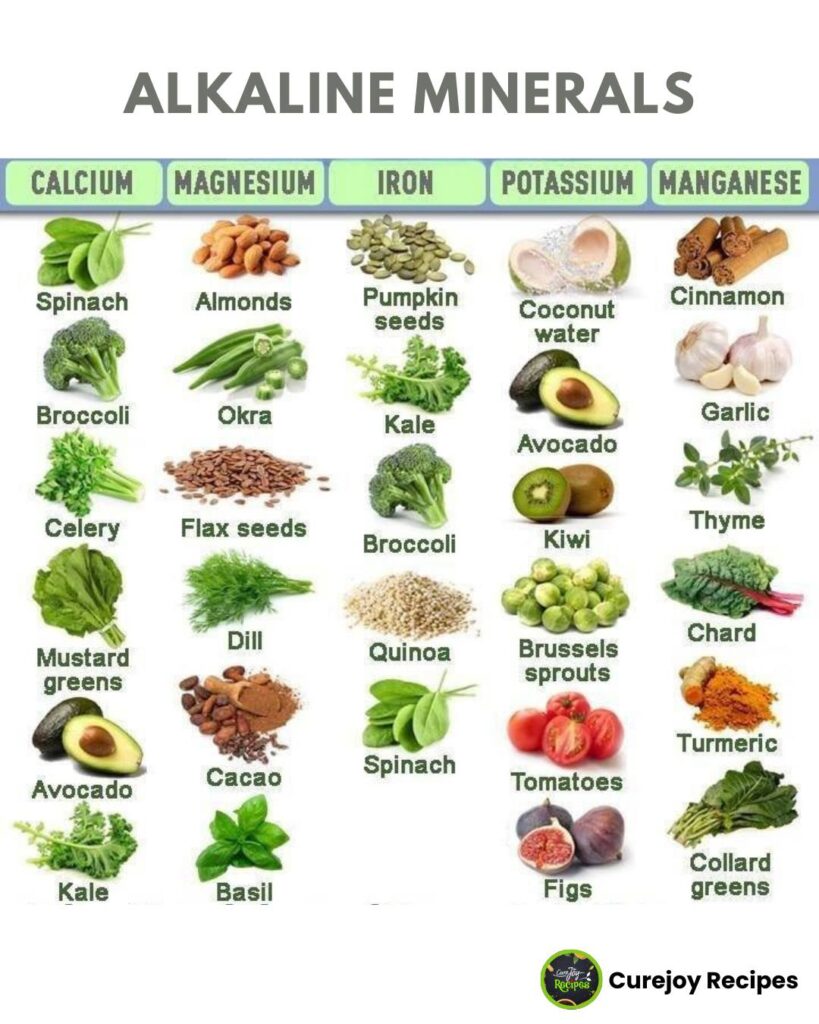
As illustrated in the infographic below (credited to Curejoy Recipes), while a balanced diet can meet many needs, some minerals are extremely hard to get enough of through food alone. Because of their critical role in health, targeted supplementation is often necessary.
1. Calcium
Primary food sources of calcium are dairy products and dark green vegetables.
- Recommended Intake: The Recommended Daily Allowance (RDA) for adult men and women is 700 to 1300 mg per day.
- The Problem: Standard whole milk or leafy greens contain only about 100 to 110 mg per 100g. This means that simply relying on milk or greens requires eating 750g to 1000g (1.5 to 2 pounds) every day. Given the natural absorption rate, the required intake is even higher.
- The Challenge: If you suffer from lactose intolerance, this becomes a massive headache. Think about it: who can realistically eat two pounds of vegetables a day?
P.S. You might think of taking a multivitamin to fix this, but standard multivitamins usually contain very low amounts of calcium.
2. Iron
Iron is primarily sourced from organ meats and red meat.
- Recommended Intake: The RDA for adult men is 7 to 11 mg, meaning men rarely face iron deficiency.
- The Female Factor: For women, iron deficiency is incredibly common. Because of menstruation, their daily requirement is nearly double that of men, with an RDA of 7 to 27 mg. Additionally, a higher percentage of women do not consume red meat or organ meats.
- Heme vs. Non-Heme Iron: You might wonder, “Don’t many vegetables contain iron?” (The foods listed in the image above are mostly vegetables). Unfortunately, the iron found in plants is different from the iron in meat.
- Meat contains heme iron, which is easily absorbed by the body (with an absorption rate of 15% to 35%) and is not affected by other foods in your meal.
- Plant foods contain non-heme iron, which has a much lower absorption rate (2% to 20%) and is highly sensitive to external factors.
For example, vegetables contain phytic acid (phytate). Unlike oxalic acid, which can be easily removed by blanching, phytic acid remains and impairs the absorption of non-heme iron. Furthermore, the polyphenols and tannins found in our daily coffee or tea also hinder the absorption of non-heme iron.
P.S. If you plan to take a mineral supplement, you have to pay close attention to the specific type of mineral, because calcium, iron, and zinc can interfere with each other’s absorption.
3. Magnesium
Magnesium is abundant in the bran and germ of grains, which is why foods like oats contain approximately 130 mg of magnesium per 100g.
With such a high content, you might think deficiency is unlikely. But the problem still comes down to the three factors we discussed earlier:
- Volume Required: Although 100g of oats contains 130 mg of magnesium, the recommended daily intake for adults is 400 mg. This means you would need to eat 300g of oats daily just to hit the target. That amounts to nearly all your daily carbohydrates, which puts a massive burden on your digestive system. Even if you replace the oats with dark green vegetables, you would still need to consume over a pound (500g) of vegetables a day.
- Phytic Acid Interference: Both oats and vegetables contain phytic acid, which negatively impacts the absorption of magnesium.
- Cooking Losses: Minerals are water-soluble and easily leach into the cooking liquid. If you boil your vegetables and discard the broth without drinking it, the magnesium ends up down the drain.
4. Zinc
Zinc is a trace element with a daily recommended intake of 10 to 15 mg. While not as prone to deficiency as magnesium, it still carries risks.
- Plant Sources: The plant food with the highest zinc content is pumpkin seeds (7 to 8 mg per 100g). They are highly bioavailable and free of phytic acid. But to get the required 15 mg, you would need to eat 200g of pumpkin seeds, which brings a massive amount of fat and calories.
- Animal Sources: Red meat (beef and lamb) is generally an ideal source, containing 4.5 to 6.0 mg of zinc per 100g, meaning 200g a day is enough to meet your needs.
P.S. Chicken breast, the staple of many gym enthusiasts, contains almost no zinc, making many fitness lovers highly susceptible to zinc deficiency.
However, red meat contains high levels of saturated fat, and popular cooking methods like pan-frying or grilling often destroy the nutrients. Therefore, you must be mindful of your meat cuts and cooking techniques.
- The King of Zinc (Oysters): If conditions permit, oysters are the most ideal zinc source, offering 30 to 70 mg per 100g. You only need to eat 1 or 2 oysters to meet your daily requirement.
- The Drawback: The downside is too obvious—they are expensive! What household can afford to eat oysters every single day?
5. Potassium: The Neglected Mineral
Potassium is often overlooked. The NSCA book doesn’t even mention it, and the NASM guidelines only list a Suggested Upper Level (SUL) of 3,700 mg.
In reality, most people consume only half of this upper level. A lack of potassium makes you feel constantly fatigued. For fitness enthusiasts, sufficient potassium ensures that dietary carbohydrates are efficiently converted into muscle glycogen.
- Why is it ignored? There is no RDA or UL for potassium because its requirement fluctuates dynamically based on your sodium intake and sweat rate. Because the kidneys are highly efficient at excreting potassium, the risk of overdose and toxicity is extremely low.
However, a high single dose of potassium can directly burn the intestinal mucosa, leading to gastrointestinal injury. High potassium concentrations can also cause cardiac arrhythmia. Because of this, potassium supplements are strictly regulated on the market. Since supplement manufacturers do not sell them, you rarely see marketing about potassium.
For the same reason, you won’t find potassium added to regular electrolyte drinks (or if it is, it’s not marketed). Furthermore, potassium has a bitter taste that ruins the flavor of beverages. Consequently, the heavy lifting of potassium supplementation is entirely left to your daily diet.
As shown in the image below, legumes and seaweed are excellent sources of potassium, but eating 200 to 300g of legumes and seaweed a day is highly impractical.
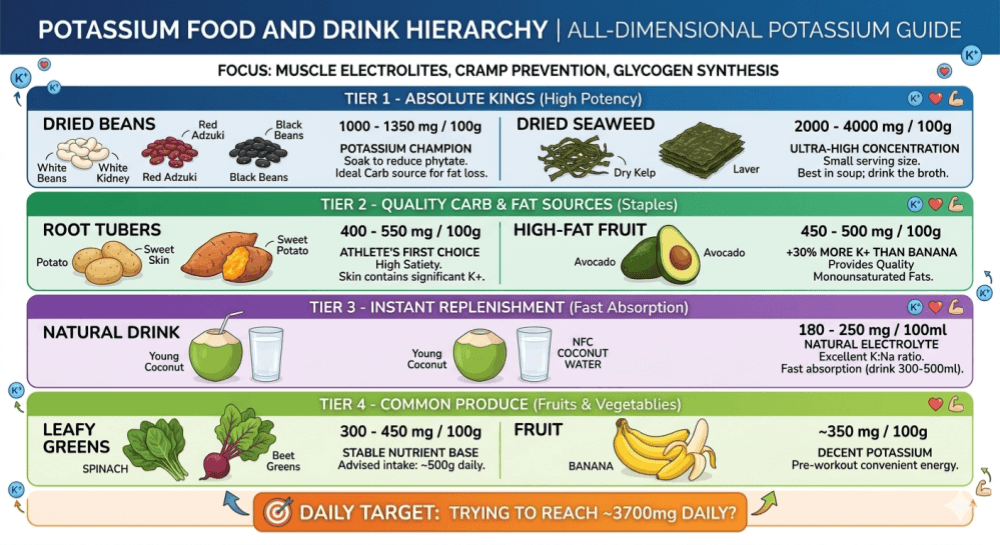
Therefore, we recommend replacing part of your diet with potatoes or avocados, and considering coconut water for supplementation. As for vegetables and the popular potassium hero—the banana—their potassium content is not exceptionally high, but they are recommended simply because they are highly convenient for daily consumption.
Summary
We have now covered the vital roles of both vitamins and minerals in a healthy eating meal plan. Throughout this guide, the topic of supplements has inevitably surfaced.
In our next installment, we will explore how to navigate the supplement market. We will identify which products are genuinely necessary and briefly touch upon the specific supplements that most fitness enthusiasts are curious about.
If you found this breakdown valuable, please bookmark our site so you don’t miss future updates!
