


“I lift weights every week. I’m strong and muscular, so there’s no way I’ll become bedridden when I’m older.”
“Isn’t disability in old age basically the same thing as sarcopenia? Older adults lose mobility because they don’t have enough muscle.”
So, does disability simply equal muscle loss?
This belief is common in the fitness community:
Disability = muscle loss
Therefore, as long as you preserve your muscle mass, you can supposedly protect your independence and dignity in later life.
Is muscle important?
Absolutely.
However, if you believe sarcopenia is the only pathway leading to disability, you may be overlooking another risk factor that can be just as dangerous.
In 2026, the internationally recognized journal GeroScience published a new study examining which physical measurements best predict whether older adults will eventually lose the ability to perform everyday activities independently, such as bathing, dressing, and walking.
The strongest single predictor was not grip strength.
It was not walking speed, balance, running ability, or how much weight someone could lift.
It was a measurement that can be taken with nothing more than a tape measure:
waist circumference.
The study used data from the well-known British Whitehall II prospective cohort study.
Researchers followed 4,593 adults, with an average age of approximately 65 years, for as long as 11 years.
Participants underwent a broad assessment involving ten different health and physical-performance measures, including:
- Walking speed
- Sit-to-stand performance
- Single-leg balance
- Grip strength
- Lung function
- Body mass index (BMI)
- Waist circumference
Most people would naturally assume that the best way to predict future mobility problems would be to test how well someone can currently move.
However, the results were surprising.
Among all individual measurements, waist circumference was the strongest predictor of future disability.
It outperformed walking speed, grip strength, and balance.
The researchers also combined waist circumference with physical-performance measures such as walking speed and balance to see whether prediction accuracy would improve.
It barely did.
In other words, waist circumference alone already captured most of the relevant risk.
Adding the physical-performance tests contributed very little additional predictive value.
Why Did Waist Circumference Outperform Physical Tests?
The key is that waist circumference provides an indirect measure of a hidden threat:
visceral fat.
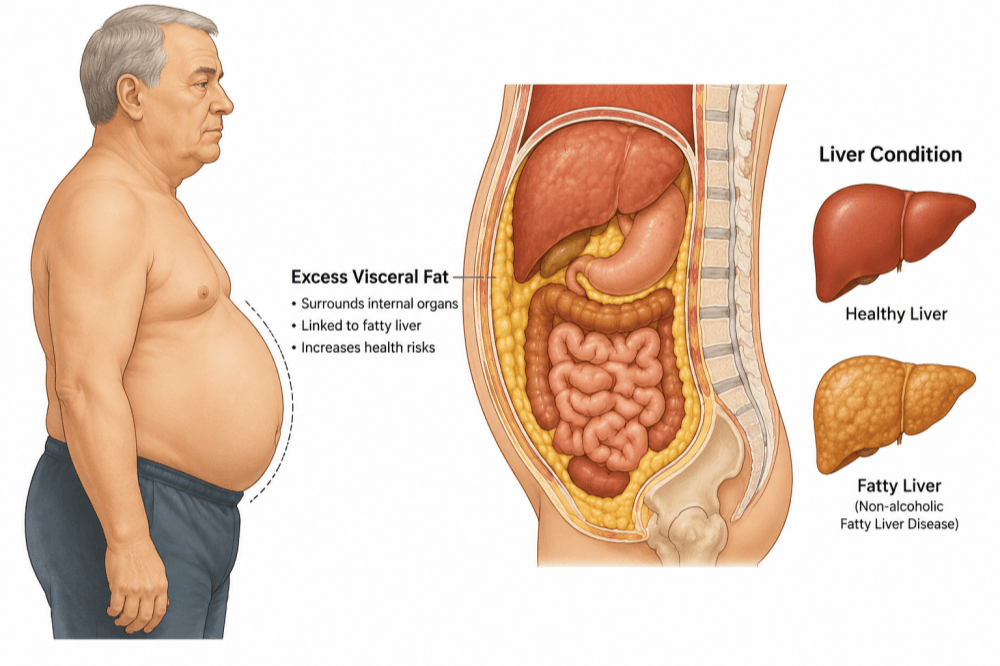
Visceral fat is the fat stored deep inside the abdominal cavity around the internal organs.
It is not simply a passive reserve of stored energy.
Instead, it acts as a metabolically active tissue that can continuously release inflammatory signaling molecules, disrupt insulin-related metabolism, and damage blood vessels.
Higher levels of visceral fat are closely associated with several common modern diseases, including:
- Type 2 diabetes
- Cardiovascular disease and arterial damage
- Chronic systemic inflammation
These metabolic disorders can gradually undermine physical function and contribute to the progression from independent living to disability and, eventually, long-term immobility.
BMI, however, cannot directly show how much visceral fat a person carries.
Two people can have exactly the same BMI while having completely different levels of abdominal and visceral fat.
As a result, their long-term risks of disability may also be dramatically different.
Preventing Disability Isn’t Just About Preserving Muscle
The biggest takeaway from this study is clear:
Preventing disability isn’t simply about maintaining muscle mass. Metabolic health and visceral fat deserve just as much attention.
Imagine someone who has built an impressive physique through years of resistance training.
He can squat heavy, bench press impressive weights, and has plenty of muscle.
But at the same time, he also carries a large waistline and excessive visceral fat.
Despite his strength, his risk of future disability may still be quietly increasing.
Resistance training alone cannot completely offset the metabolic damage associated with excessive visceral fat.
If your goal is healthy aging and maintaining your independence later in life, you need to address both sides of the equation.
1. Preserve Your Muscle Mass
Continue performing regular resistance training and consume sufficient high-quality protein.
For most people, aiming for 30 grams or more of high-quality protein per meal is a practical target to help support muscle maintenance and growth.
2. Reduce Excess Visceral Fat
At the same time, keep your overall calorie intake under control and avoid allowing your waist circumference to steadily increase.
One of the simplest, cheapest, and surprisingly effective ways to estimate visceral fat risk is with something almost everyone already owns:
A tape measure.
It takes less than 30 seconds.
How to Measure Your Waist Circumference
- Stand naturally.
- Relax and exhale normally (don’t suck in your stomach).
- Wrap a tape measure horizontally around your abdomen at the level of your navel.
- Record the measurement.
Recommended Waist Circumference Cutoffs
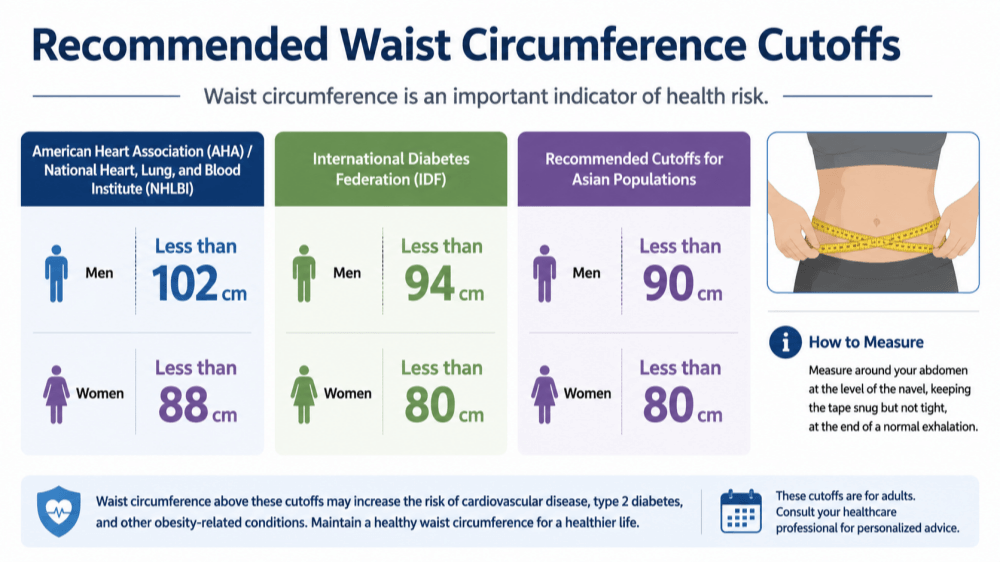
American Heart Association (AHA) / National Heart, Lung, and Blood Institute (NHLBI)
- Men: Less than 102 cm
- Women: Less than 88 cm
International Diabetes Federation (IDF)
- Men: Less than 94 cm
- Women: Less than 80 cm
Recommended Cutoffs for Asian Populations
- Men: Less than 90 cm
- Women: Less than 80 cm
These recommendations differ because waist circumference thresholds vary across ethnic groups.
People of Asian descent tend to accumulate visceral fat at lower waist circumferences than Western populations, which is why the recommended healthy cutoff is more conservative.
In general, keeping your waist circumference below 90 cm for Asian men and below 80 cm for Asian women is considered a reasonable target for reducing metabolic risk.
Once your waist circumference exceeds these thresholds, it may indicate excessive visceral fat—even if you have a muscular physique.
Building muscle matters.
Keeping your waistline under control matters too.
To maximize your chances of remaining healthy, independent, and physically capable later in life, you need both.
References
Ben Hassen C, Fayosse A, Vitiello D, Maillot P, Landré B, Danilevicz IM, Sabia S, Singh-Manoux A. Identifying a fitness tool in early old-age to predict long-term risk of disability, severe disability, and mortality. GeroScience. 2026. doi:10.1007/s11357-026-02305-9.
This article is reproduced from publicly available online sources. If you believe it infringes your copyright, please contact us, and we will remove it promptly.
