
Have you ever paid attention to how deep you actually squat?
It is true that you should not blindly chase depth. You only need to squat as deep as your current mobility and body structure safely allow.
However, deeper squats do offer certain advantages over shallower squats in some areas.
When defining squat depth, we previously explained that a true deep squat requires the hips to descend below the knees, with the thighs clearly dropping below parallel when viewed from the side.
In reality, many people do not squat this deep.
Most stop when their thighs are close to parallel or just reach parallel with the floor.
There is also an important visual trap here.
When you squat while facing a mirror, it may look as if you are going very deep. But when viewed from the side, your hips may still be level with or slightly above your knees.
That is what we would classify as a parallel squat.
In terms of training effects, parallel squats and deep squats are actually quite similar, especially when you are training with heavy loads.
But what if you want to squat lower to increase glute stimulation?
Or what if you simply want to achieve a full squat?
If you were not born with exceptional mobility and body proportions, then you will have to improve it through training.
One more point worth mentioning:
You may have heard that people with relatively long thighs compared with their lower legs, or people with shorter torsos, tend to have more difficulty squatting deep.
That is true.
Both longer femurs and a shorter torso increase the amount of knee flexion and ankle dorsiflexion required during a squat.
But do not worry.
These limitations can be improved substantially through training, so keep reading.
What Determines Squat Depth?
The squat is a compound movement involving multiple joints and body segments, including:
- Knees
- Hips
- Lumbar spine
- Pelvis
- Ankles
If we had to identify the single most important factor limiting squat depth, however, it would almost certainly be ankle mobility, especially the amount of available ankle dorsiflexion.
Ankle Mobility
Interestingly, current research suggests that ankle dorsiflexion may influence squat depth differently in men and women.
For men, ankle dorsiflexion with the knee flexed appears to have a greater influence.
For women, ankle dorsiflexion with the knee extended appears to matter more.
What is the difference between the two?
The answer is simple:
Different muscles are placed under tension.
The gastrocnemius crosses both the knee and ankle joints.
When the knee is extended, the gastrocnemius is lengthened at both ends, making it more likely to restrict ankle dorsiflexion range of motion.
When the knee is flexed, however, the gastrocnemius is placed in a shorter position, so the soleus becomes a more important limiting structure.
This means that when trying to improve ankle dorsiflexion, men and women may benefit from placing slightly different emphasis on these tissues.
We will explain exactly how to improve both later in this article.
Why Not the Tibialis Anterior?
This raises another question:
Isn’t ankle dorsiflexion performed by the tibialis anterior?
Why are we talking about the gastrocnemius and soleus, which are located on the back of the lower leg?
This is a very common misunderstanding.
In fact, I once had the same problem when I struggled to squat deeper. At the time, my coach kept telling me to release my tibialis anterior.
The misunderstanding comes from confusing movement direction with the muscle that actively produces that movement.
During a squat, ankle dorsiflexion is largely a passive movement created by the body moving over the foot.
So the tissues that actually limit dorsiflexion are often the structures being lengthened on the back of the ankle and lower leg.
The main methods used to improve ankle mobility are:
- Static stretching
- Self-myofascial release, such as foam rolling
Stretching the Gastrocnemius and Soleus
Stretching these muscles is very simple.
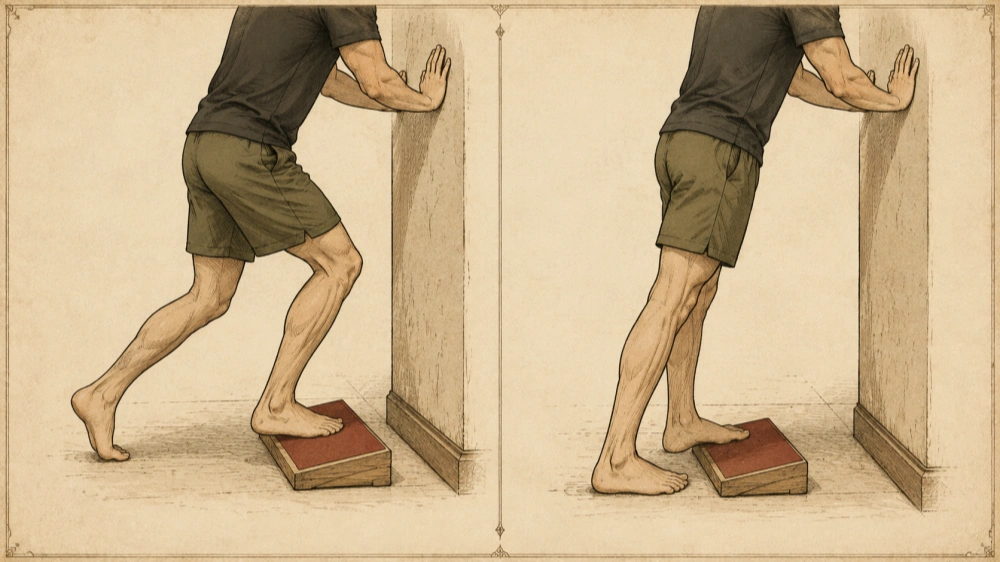
As shown in the illustration:
- Find a small platform, step, or calf-stretching board.
- Place the forefoot of one foot on the edge while allowing the heel to hang freely.
- Keeping this position, gradually shift your body weight forward and downward so the heel slowly drops below the level of the forefoot.
- Keep your toes and knee pointing in the same direction. Stop when you feel a clear stretch through the back of the lower leg.
- Hold the position for 30–60 seconds, then repeat on the other side.
The main difference between emphasizing the soleus and the gastrocnemius is whether the knee is bent.
When the knee is bent, as shown on the left, the stretch places greater emphasis on the soleus.
When the knee remains straight, as shown on the right, the gastrocnemius is stretched more strongly.
Self-Myofascial Release
As shown in the illustration, this is one of the most traditional foam-rolling methods.
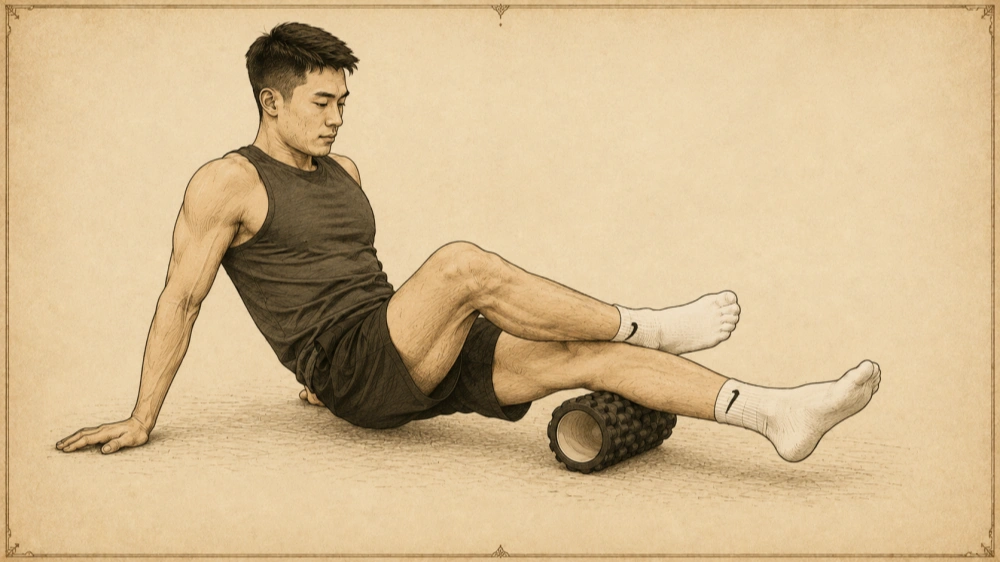
- Sit on the floor with both hands supporting you behind your body and one leg extended forward.
- Place the foam roller horizontally underneath the calf you want to massage, with the back of the lower leg resting directly on the roller.
- Place the other leg on top of the working leg to increase pressure.
- Push through your hands and lift your hips slightly off the floor so that most of your body weight is supported by your hands and the foam roller.
- Use your arms to move your body slowly forward and backward, allowing the roller to travel along the back of the calf, approximately from just above the Achilles tendon to just below the back of the knee.
- Complete one side, then switch legs.
If you feel that this still does not provide enough pressure, you can try a second method.
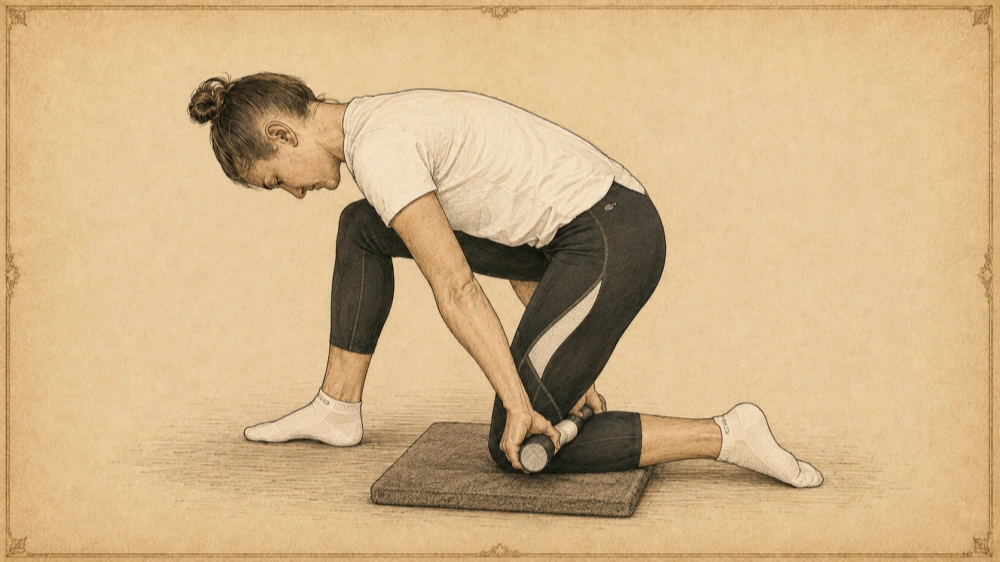
- Start in a half-kneeling position. One leg is bent in front, while the opposite knee rests on a soft pad with the lower leg extending naturally behind you.
- Lean your torso slightly forward and place a roller horizontally across the back of the rear calf.
- Use both hands to apply moderate downward pressure so the roller stays firmly against the triceps surae.
- Maintain pressure and roll slowly from just above the Achilles tendon toward just below the knee crease, then return along the same path.
- Complete one side, then switch legs.
Both methods can effectively target the gastrocnemius and soleus.
A rolling duration of approximately 30–60 seconds is recommended.
A small note:
Many other factors can affect ankle dorsiflexion, including joint restrictions and even neural factors.
Because there are too many details to cover here, we will not expand on them in this article.
Later, we will publish a separate article explaining a complete training plan for improving ankle dorsiflexion mobility.
At this point, we have addressed the most important factor affecting squat depth:
ankle mobility.
But do not click away yet.
We are not finished.
Hip Mobility
Many people assume that if they cannot squat deep, ankle mobility must be the only problem.
That is not correct.
Hip range of motion also has a major influence on squat depth.
According to research by Kim et al., ankle dorsiflexion ROM with the knee flexed alone explained 38.8% of the variation in squat depth.
When hip flexion ROM was added to the model, the explained variance increased to 43.5%.
In addition, men appear to be influenced by hip mobility more strongly than women.
When hip mobility is insufficient, people may compensate by leaning the torso excessively forward in order to reach greater squat depth.
This can increase stress on the lumbar spine and should be avoided.
Another important finding is that greater hip flexion is associated with a more vertical lower leg position during squats.
This means that if your hip mobility improves, the amount of ankle dorsiflexion required during the squat may decrease.
However, this does not mean you should deliberately rely on greater hip flexion while ignoring ankle mobility.
If you push your hips too far backward while ankle dorsiflexion remains limited, your torso will still have to lean excessively forward, increasing spinal loading.
There is another important point:
As hip flexion increases, you also need greater contribution from the hip extensors.
For this reason, improving the hips should involve both:
- Mobility
- Strength
Exercises to Improve Hip Function
Good Morning
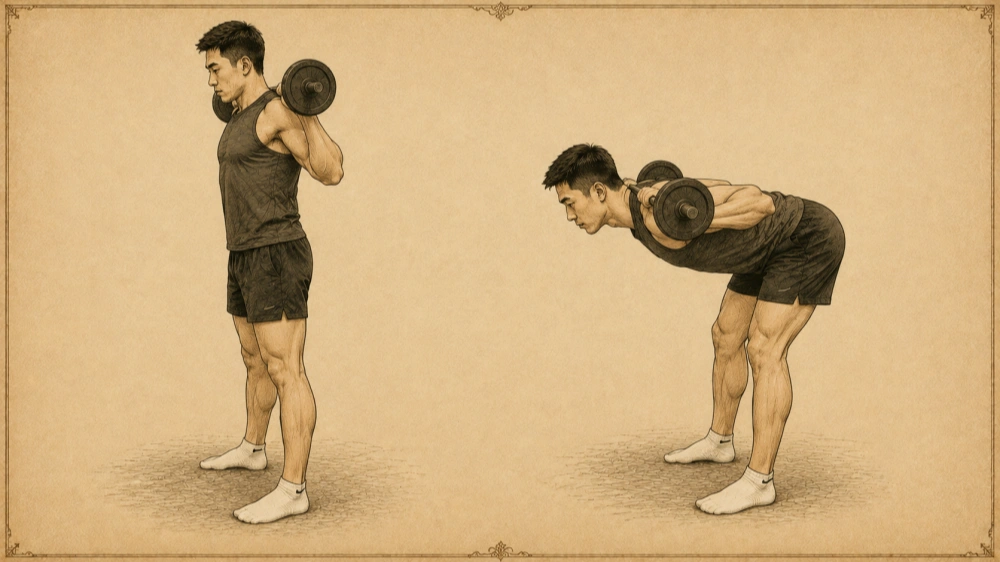
- Stand with your feet approximately shoulder-width apart. Position the barbell securely across your upper back, hold the bar firmly, and brace your core.
- Keep your knees slightly bent, and maintain roughly the same knee angle throughout the movement.
- Inhale, brace your abdomen, and actively push your hips backward, allowing your torso to lean forward through hip flexion.
- Keep your back stable as your torso moves forward. The barbell should travel with your torso. You should gradually feel tension developing in your glutes and hamstrings.
- Descend only as far as you can while maintaining a neutral spine and feeling a clear stretch in the glutes and hamstrings.
- Contract the gluteus maximus and hamstrings, then actively extend the hips forward to return your torso to the upright position.
Hip Thrust
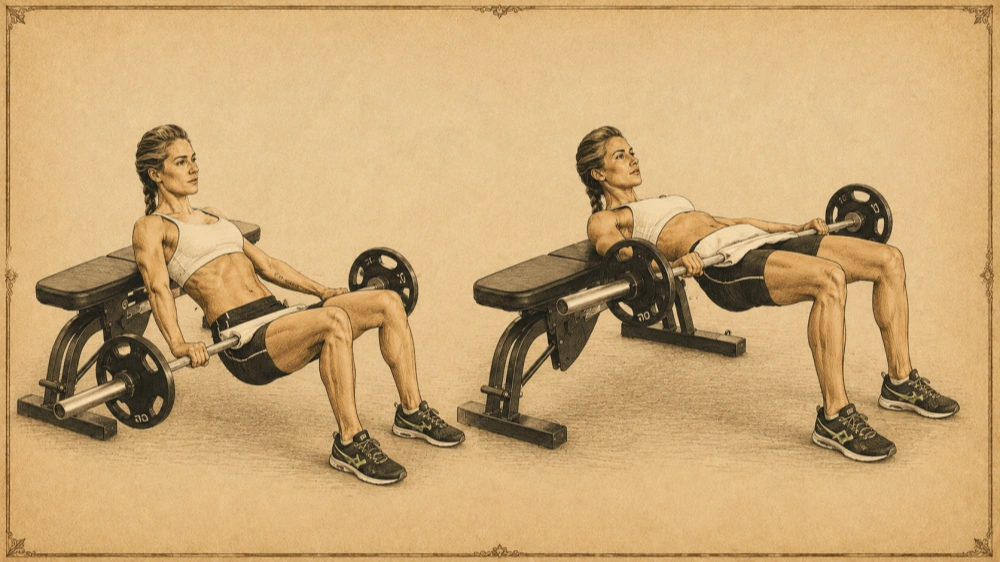
- Position your upper back against the edge of a bench, place both feet firmly on the floor, and bend your knees.
- Place the barbell across the front of your hips. Brace your core, slightly tuck your chin, and keep your head and torso relatively stable.
- Drive your feet into the floor, contract your glutes, and actively extend your hips upward, lifting your hips and the barbell together.
- Continue until you reach the top position and achieve a strong contraction in the gluteus maximus.
- Pause briefly at the top.
- Lower your hips under control until your glutes approach the floor, then repeat.
Muscle Strength
You read that correctly.
The final major factor influencing squat depth is not another joint mobility issue.
It is muscle strength.
Both studies mentioned above found that strength influences squat depth.
Kim et al. also reported that, in women, ankle dorsiflexor strength was the second most important factor after ankle mobility.
People with greater relative muscle strength also appear to rely more heavily on the hips during squatting, and other research has supported this observation.
So if you want to improve your squat depth, do not focus only on stretching and mobility work.
Strength training itself remains essential.
As for how to improve muscular strength, we will not go into detail here.
With the exercises above, many people should begin to notice a meaningful improvement in squat depth within approximately four weeks, assuming they practice consistently.
One Final “Shortcut”: Use a Wider Stance
Finally, here is a method that is not exactly a “cheat,” but can certainly feel like one:
Use a wider squat stance.
Moderately widening your stance and turning your toes outward can reduce how much ankle dorsiflexion and hip flexion you need compared with a narrow stance.
Of course, this does not solve the underlying limitation.
You should also remember that when your stance becomes wider, your squat technique needs to change accordingly.
The most obvious example is that your knees must also track farther outward.
As for how to perform a proper squat and the correct movement sequence during the exercise, we will continue covering those topics in future articles.
Remember to bookmark our website.
References
[1] Kim SH, Kwon OY, Park KN, Jeon IC, Weon JH. Lower Extremity Strength and the Range of Motion in Relation to Squat Depth. Journal of Human Kinetics. 2015;45:59-69. doi:10.1515/hukin-2015-0007.
[2] Kim S, Miller M, Tallarico A, Helder S, Liu Y, Lee S. Relationships between physical characteristics and biomechanics of lower extremity during the squat. Journal of Exercise Science & Fitness. 2021;19(4):269-277. doi:10.1016/j.jesf.2021.09.002.
[3] Tourillon R, M’Baye M, Smith M. Restoring ankle dorsiflexion range of motion in athletes: an individualized clinical decision-making system. Frontiers in Sports and Active Living. 2025;7:1677383. doi:10.3389/fspor.2025.1677383.
[4] Abassi M, Whiteley R. Serial Within-Session Improvements in Ankle Dorsiflexion During Clinical Interventions Including Mobilization-With-Movement and A Novel Manipulation Intervention – A Case Series. International Journal of Sports Physical Therapy. 2021;16(4):1158-1168. doi:10.26603/001c.25544.
[5] Seever TC, Mason J, Zech A. Chronic and Residual Effects of a Two-Week Foam Rolling Intervention on Ankle Flexibility and Dynamic Balance. Frontiers in Sports and Active Living. 2022;4:799985. doi:10.3389/fspor.2022.799985.