

In our previous article, we discussed how both heavy-load and light-load training can produce similar muscle growth results.
Considering that different training styles create different adaptive responses in the body, we actually recommend incorporating different loading schemes through proper periodization to improve overall physical performance.
However, achieving the same hypertrophy results with lighter weights comes with certain requirements.
First, the sets must be performed close to or reaching muscle failure.
Second, the training load should generally be at least 20-30% of your 1RM.
This leads to a new question:
What components should an effective hypertrophy training program include?
Weight selection is only one part of a training program.
We also need to consider:
- Number of sets
- Repetitions
- Rest intervals between sets
And there is another especially important factor.
As we discussed previously, from the perspective of training volume, light-load training actually requires a greater total workload to achieve similar hypertrophy.
So how should we consider this when designing a training program?
Today, we will explain how to build an effective hypertrophy training plan.
Training Load Selection
If your goal is to improve maximal strength (1RM), heavy-load training generally produces better results than light-load training.
So, what counts as “heavy”?
Generally, loads above 60% of 1RM are considered heavy enough to produce meaningful strength adaptations.
However, as mentioned earlier, the specificity principle plays a larger role in maximal strength development than muscle growth itself.
Therefore, as your training experience increases and your strength approaches your physiological potential, you should gradually use heavier loads (>85% 1RM) to continue improving maximal strength.
For example:
When you first start training and can only perform a dumbbell press with 15 kg, using 10 kg dumbbells can still effectively improve your strength.
But once you can press 40 kg dumbbells, using 24 kg is no longer enough.
You may need something closer to 35 kg to continue producing meaningful strength improvements.
If your goal is hypertrophy, theoretically, even loads around 20–30% of 1RM can stimulate muscle growth.
However, the lighter the weight you use, the more demanding the overall training process becomes.
Therefore, we still recommend using:
70–85% 1RM loads combined with moderate repetitions
as the primary approach for hypertrophy training.
Light loads with very high repetitions can be included occasionally as part of a training cycle.

Total Training Volume
Many people become overly focused on sets and repetitions when designing their programs.
However, a better way to evaluate the overall workload of a training plan is training volume.
Training volume can refer to:
Total repetitions
Formula: Sets × Repetitions per set or : Total volume loadFormula: Weight × Sets × Repetitions
First, it is important to understand that for improving maximal strength, load intensity is the most important factor.
Training volume is much less important.
The reason is simple:
When the number of sets is the same, heavier weights naturally allow fewer repetitions.
However, for hypertrophy, total training volume is a critical factor.
As training volume increases, muscle protein synthesis theoretically continues increasing until reaching a certain threshold, after which it begins to plateau.
According to research by Schoenfeld et al., maximizing hypertrophy generally requires each muscle group to receive at least:
10 sets per week
So what happens if you cannot reach this amount of training volume?
For example:
You have a particularly busy week.
You can only train one or two days.
Your available training time is limited.
Should you simply skip training?
Not necessarily.
A 10-year study found that:
Performing only one set per exercise produced very poor hypertrophy results.
However, performing 2–3 sets per exercise compared with 4–6 sets showed relatively small differences in muscle growth.
(Note: “small difference” does not mean “no difference.”)
Compared with only one set, performing multiple sets produced approximately 40% greater hypertrophy improvements.
This means the relationship between weekly training volume and muscle growth is not completely linear.
Even if you cannot perform very high volume, training each muscle group with fewer than four sets per week can still produce meaningful results.
How Many Repetitions Count as an Effective Set?
According to traditional hypertrophy guidelines:
When using 70–85% 1RM, performing around: 8–12 repetitions per set
is generally sufficient to provide adequate muscle stimulation.
If the load is heavier, the repetition range can be reduced to around: 6 repetitions per set.
As discussed in previous articles, heavy-load training can recruit a high percentage of available muscle fibers even without reaching complete failure.
But here comes the important point:
What happens when using only 30% 1RM for hypertrophy?
Because light-load training requires reaching failure to maximize muscle recruitment, the total training volume needs to be higher than heavy-load training.
Therefore, one of the best approaches is to estimate the required repetitions by comparing total training volume.
For example, as shown in the figure:
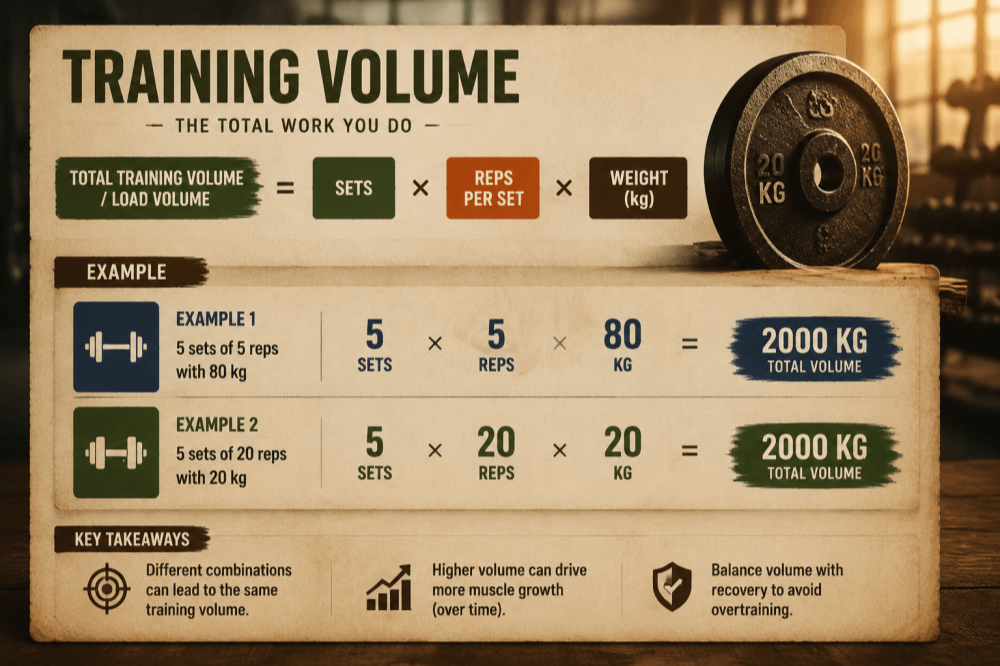
Assume a heavy-load program uses:5 sets × 5 repetitions and produces a total training volume of:2,000 kg
If you switch to lighter weights, you need enough repetitions to reach the same total volume.
Under the same number of sets, you may need approximately: 20 repetitions per set to achieve an equivalent workload.
However, because light-load hypertrophy requires approaching failure, your actual program might need to look like:
20 kg, 5 sets, 25–30 repetitions per set rather than simply matching the volume number.
Training Frequency
If you follow fitness influencers, you may notice that some of them train twice a day.
Some coaches also claim that two-a-day training is necessary to increase training intensity.
This often leads people to believe that higher training frequency automatically results in greater muscle growth.
However, this is not actually the case.
When total training volume is equal, training frequency does not have a significant impact on hypertrophy.
In contrast, if your training frequency is extremely high and the intensity is also excessive, you may actually increase the risk of overtraining.
Therefore, training frequency is not about: “The more, the better.”
It is more about finding the right balance between training and recovery.
Only when you can maintain adequate recovery while increasing training frequency to achieve higher total volume does a higher frequency become beneficial.
Eccentric Contraction & Time Under Tension
When designing a training program, we usually do not emphasize the exact duration of each repetition.
The reason is that current research suggests:
As long as a repetition lasts between approximately 0.5–8 seconds, the difference in hypertrophy outcomes is relatively small.
If there is one part that deserves more attention, it is the eccentric phase.
Both traditional training concepts and modern research suggest that eccentric contractions may have greater advantages for muscle growth compared with concentric contractions.
Specifically:
- Eccentric contractions can produce greater force and tolerate higher absolute loads.
- Eccentric contractions may create greater hypertrophy of type II muscle fibers.
- Eccentric contractions cause greater muscle damage, which may stimulate a stronger protein synthesis response.
- Eccentric contractions may have a greater effect on the distal regions of muscles.
Of course, this does not mean concentric contractions are unimportant.
Just as eccentric contractions have a greater influence on the distal portions of muscles, concentric contractions may contribute more to the middle regions of muscles.
Therefore, combining both eccentric and concentric phases is likely more beneficial for overall hypertrophy.
When designing your next training program, you may want to add a note: “2-0-2 tempo”.
Meaning:
- 2 seconds during the eccentric phase
- 0 seconds pause at the bottom
- 2 seconds during the concentric phase
Exercise Selection and Order
When arranging exercises in a training program, we usually place compound movements first and isolation exercises later.
The reason is simple:
Compound movements are generally more physically demanding.
Therefore, performing them when your energy levels are highest usually allows better performance.
There is currently little disagreement about this approach.
Although a few studies have suggested that exercise order may not significantly affect hypertrophy outcomes, the evidence is still limited.
The point I really want to emphasize here is:
Do not train only one type of exercise.
From my observation, there are two common types of people in the gym.
The first type almost completely avoids compound movements.
They walk into the gym and immediately start using machines.
At most, they occasionally pick up a pair of light dumbbells and perform lateral raises.
(This group is more common among beginners.)
The second type is the complete opposite.
They almost exclusively train compound movements.
To them, machines are at the bottom of the “fitness hierarchy” and are rarely used.
However, both approaches have advantages that cannot be replaced.
Compound movements require greater stability and involve many muscles that isolation exercises cannot effectively train.
But this also creates a limitation.
During compound movements, some biarticular muscles may maintain a relatively constant length throughout the movement.
As a result, they may not receive sufficient stimulation.
This is where isolation exercises become valuable.

They allow you to specifically target muscles that may not be fully challenged during compound movements.
Therefore, if your goal is to maximize hypertrophy:
You should include both compound and isolation exercises in your program.
The Best Time of Day to Train
Regarding the best time of day for training, as we discussed in previous articles:
Morning, afternoon, and evening training all have their own advantages.
If we had to choose one period that may be slightly more favorable, it would probably be the afternoon, especially around 6 PM.
But honestly:
This factor is not particularly important.
At least according to current research, training time has little influence on strength gains or muscle growth.
The best approach is simply:
Schedule your workouts according to your own routine and preferences.
Consistency matters far more than the exact time you train.
Final Thoughts
If you want to build muscle, having a reasonable training program is essential.
Do not simply follow a random workout routine you find online just because it looks popular.
And do not assume that creating an effective program is something only personal trainers can do.
You are the person who understands your own body best.
Remember the key points discussed in this article:
- Choose an appropriate training load.
- Manage total training volume.
- Balance intensity and recovery.
- Control your eccentric phase.
- Combine compound and isolation exercises.
- Adjust training frequency according to your recovery ability.
Then experiment and refine your own program.
After all:
The best training plan is not the one that looks perfect on paper.
It is the one that you can execute consistently and continue improving with over time.
If you want to learn more about the science behind muscle hypertrophy, check out: Hypertrophy training: The Complete Guide (plus workouts)
If you have been training consistently but are struggling to make further progress, check out: 6 Science-Backed Tips to Build Muscle Faster (That Most People Ignore)
References
[1] Schoenfeld BJ, Grgic J, Van Every DW, Plotkin DL. Loading Recommendations for Muscle Strength, Hypertrophy, and Local Endurance: A Re-Examination of the Repetition Continuum. Sports. 2021;9(2):32. doi:10.3390/sports9020032.
[2] Grgic J, Schoenfeld BJ, Orazem J, Sabol F. Effects of resistance training performed to repetition failure or non-failure on muscular strength and hypertrophy: A systematic review and meta-analysis. Journal of Sport and Health Science. 2022;11(2):202-211. doi:10.1016/j.jshs.2021.01.007.
[3] Lopez P, Radaelli R, Taaffe DR, Newton RU, Galvão DA, Trajano GS, Teodoro JL, Kraemer WJ, Häkkinen K, Pinto RS. Resistance Training Load Effects on Muscle Hypertrophy and Strength Gain: Systematic Review and Network Meta-analysis. Medicine & Science in Sports & Exercise. 2021;53(6):1206-1216. doi:10.1249/MSS.0000000000002585.
[4] Bernárdez-Vázquez R, Raya-González J, Castillo D, Beato M. Resistance Training Variables for Optimization of Muscle Hypertrophy: An Umbrella Review. Frontiers in Sports and Active Living. 2022;4:949021. doi:10.3389/fspor.2022.949021.
[5] Schoenfeld BJ, Contreras B. Resistance Training Volume Enhances Muscle Hypertrophy but Not Strength in Trained Men. Medicine & Science in Sports & Exercise. 2019;51(1):94-103. doi:10.1249/MSS.0000000000001764.
[6] Lasevicius T, Schoenfeld BJ, Silva-Batista C, Barros TS, Aihara AY, Brendon H, Longo AR, Tricoli V, Peres BA, Teixeira EL. Muscle Failure Promotes Greater Muscle Hypertrophy in Low-Load but Not in High-Load Resistance Training. Journal of Strength and Conditioning Research. 2022;36(2):346-351. doi:10.1519/JSC.0000000000003529.