


In our previous article, 6 Science-Backed Tips to Build Muscle Faster, we mentioned that more recent research has found that high-repetition, light-load training can produce muscle growth comparable to traditional moderate-repetition, heavy-load training.
This challenges one of the most widely accepted principles of traditional resistance training.
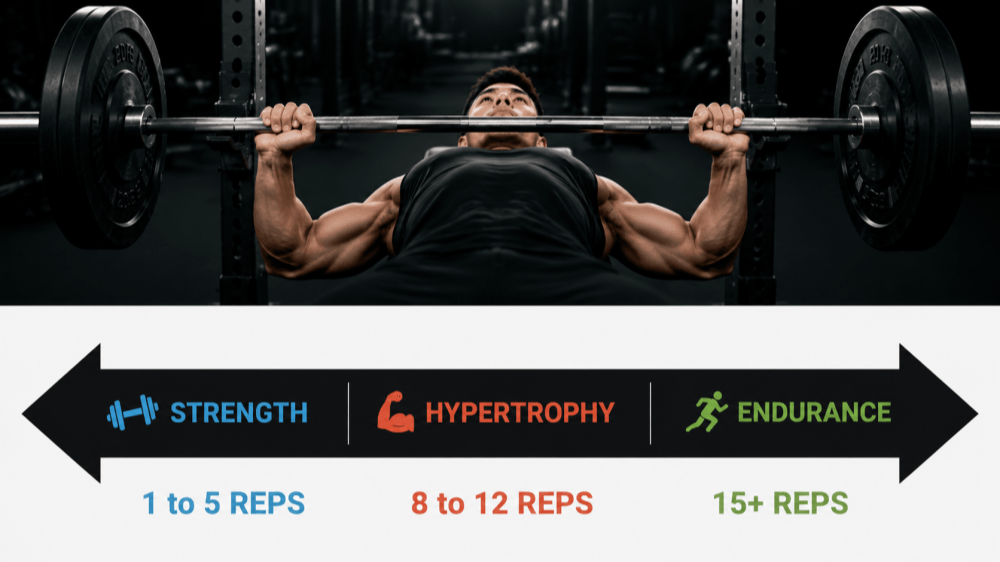
For decades, the conventional recommendations have been:
To increase maximal strength
- 4–6 sets
- 1–5 repetitions per set
- 85–100% of 1RM
- Long rest periods between sets
To maximize muscle growth
- 3–4 sets
- 8–12 repetitions per set
- 70–85% of 1RM
- 1–2 minutes of rest between sets
To improve muscular endurance
- 2–3 sets
- More than 15 repetitions per set
- Approximately 30% of 1RM
- 30–60 seconds of rest between sets
Even today, many popular strength-training textbooks still present these recommendations as the gold standard.
So which perspective is actually correct?
If light-weight, high-repetition training really produces the same hypertrophy as heavier loads, should it replace traditional training programs altogether?
In this article, we’ll take a closer look at how heavy-load, low-repetition training compares with light-load, high-repetition training in terms of maximal strength, muscle hypertrophy, and muscular endurance.
Heavy Loads Are Still the Best Choice for Building Maximal Strength
Do you remember the principle of specificity we discussed in our article comparing different squat depths?
When it comes to improving maximal strength, or more specifically your one-repetition maximum (1RM), the increase comes from two primary sources.
The first is adaptation to the specific movement and the load being trained—the principle of specificity.
The second is the additional strength gained through muscle hypertrophy.
From the perspective of specificity, training with heavier loads is by far the most important factor for increasing maximal strength.
Other variables, such as training volume, have a much smaller influence.
However, when strength improvements come solely from increased muscle mass, the difference between heavy-load and light-load training becomes much less apparent.
A number of studies using isometric strength testing have found that heavy-load training shows only a small advantage over light-load training, and that advantage is not statistically significant.
What does this actually mean?
Imagine you perform barbell back squats using either heavy loads or light loads for eight weeks.
If you then test your squat 1RM, the heavy-load group will almost certainly show the greatest improvement.
Groups training with moderate loads and repetitions or light loads and high repetitions typically improve as well, but to a smaller extent.
For example, the study by G. E. R. Campos et al. reported improvements of approximately 61%, 36%, and 32%, respectively.
However, if those same participants trained the squat but were instead tested on the 1RM of different lower-body exercises, such as the leg press or leg extension, the differences between the three training methods became much smaller.
One important point emerges from these findings.
The improvement produced by the principle of specificity appears to contribute more to maximal strength than the strength gained simply from adding muscle mass.
Therefore, from an overall perspective, heavy-load, low-repetition training remains the most effective approach for increasing maximal strength.
Light Loads Can Build Just as Much Muscle as Heavy Loads
If heavy loads are best for strength and high repetitions improve endurance, what is the primary driver of muscle growth?
Do you need both heavy weights and high repetitions?
Our understanding of what best represents a hypertrophic stimulus has changed considerably over the years.
Early researchers focused mainly on the total number of repetitions performed.
Later, attention shifted to total training volume, also known as volume load.
This is commonly expressed as:
Training Volume = Sets × Repetitions × Load
Most lifters are familiar with this concept.
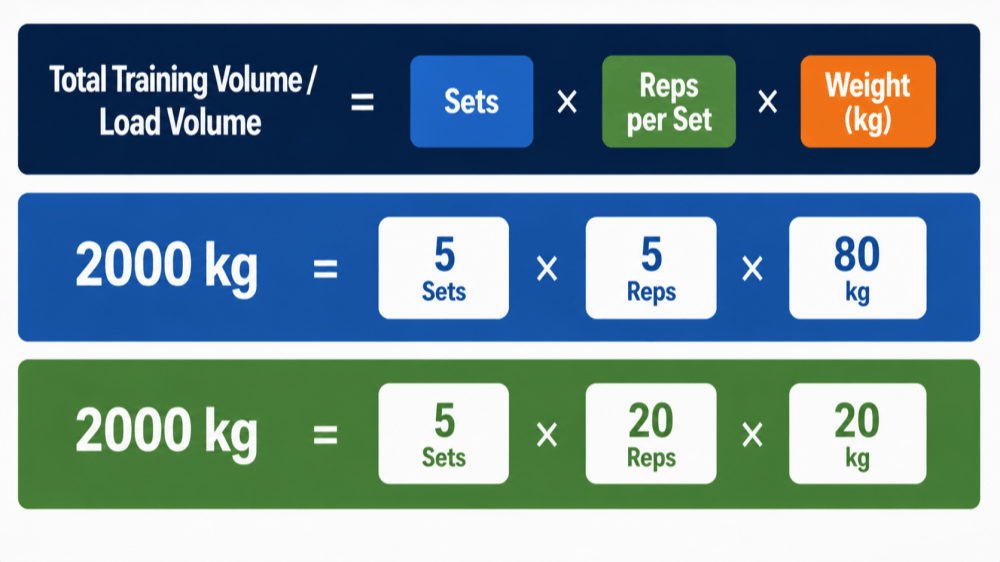
Many textbooks use total training volume to evaluate the intensity of a training program, and the traditional recommendation of 8–12 repetitions for hypertrophy largely originated from this volume-load model.
However, this approach has one important limitation.
Heavy-load training is typically performed for fewer repetitions, resulting in fewer total repetitions overall.
Subsequent research found that, for muscle growth, multiple sets consistently produce greater hypertrophy than a single set.
As a result, researchers began placing greater emphasis on the total number of sets rather than total training volume alone.
The idea was straightforward:
Whether a set consists of 5 repetitions, 10 repetitions, or 20 repetitions, as long as the load is appropriate, each set can bring the muscle close to failure and provide a meaningful hypertrophic stimulus.
But this created another question.
How hard does a set actually need to be before it counts as an “effective” training set?
The obvious answer was:
Train to failure.
This eventually led to the approach commonly used in modern hypertrophy research, where training volume is evaluated based on the number of sets performed and how close those sets are to muscular failure.
Using this model, researchers reached a surprising conclusion.
When sets are taken to true muscular failure, very high-repetition training with light loads can produce muscle growth comparable to low-repetition heavy-load training and moderate-repetition moderate-load training.
This similarity has been observed in both:
- Muscle fiber-type adaptations (such as the shift from Type IIX fibers to Type IIA fibers)
- Increases in muscle fiber cross-sectional area
P.S. Some studies have suggested that lighter loads may promote greater hypertrophy of Type I muscle fibers, while heavier loads may preferentially stimulate Type II fibers. However, the current evidence remains insufficient to draw firm conclusions.
This means that if you prefer not to lift heavy weights but still want to build muscle, light-load training can absolutely be a viable option.
At this point, you’re probably wondering:
“If that’s true, why don’t we see more people building impressive physiques with light weights?”
There are two main reasons.
Reason 1: “Light” Doesn’t Mean Extremely Light
Light-load training doesn’t mean using just any weight.
Current evidence suggests that, to achieve hypertrophy comparable to heavy-load training, the load should generally be at least 30% of your one-repetition maximum (1RM).
For example, if your dumbbell bench press 1RM is 40 kg, you would likely need to use at least 12 kg dumbbells and perform very high repetitions.
Simply relying on push-ups, bodyweight squats, or 5 kg dumbbells is unlikely to produce the same muscle-building effect.
Reason 2: Reaching True Failure Is Extremely Difficult
Although heavy-load and light-load training can produce similar hypertrophy, they do so through different mechanisms.
When lifting heavy weights, your nervous system recruits a large number of motor units from the very beginning of the set.
As a result, heavy-load training can achieve near-maximal muscle fiber recruitment even before reaching complete muscular failure.
Light-load training works differently.
Because the load is relatively small, the body has little reason to recruit all available muscle fibers early in the set.
Initially, the movement may rely primarily on Type I (slow-twitch) muscle fibers.
Only as fatigue accumulates and the working muscles approach failure does the nervous system progressively recruit additional motor units, including larger, high-threshold fibers.
This difference makes light-load training much longer and considerably more demanding.
Throughout the set:
- Lactate continues to accumulate.
- Blood flow to the working muscles becomes increasingly restricted.
- Central fatigue continues to rise.
In simple terms:
You become increasingly uncomfortable with every repetition.
To make matters worse, muscular failure itself is a subjective point.
Continuing to push after your body is already telling you to stop requires a tremendous amount of mental effort.
For this reason, although light-load training can build just as much muscle under ideal conditions, training with heavier weights and low-to-moderate repetitions remains the more practical and efficient approach for most people.
Light Loads May Not Be Better for Muscular Endurance After All
Whether high-repetition, light-load training is truly superior for improving muscular endurance remains one of the most controversial topics in resistance training research.
One reason is that muscular endurance can be measured in several different ways, and studies often use different definitions, making their findings difficult to compare.
At present, researchers generally assess muscular endurance using three approaches.
Absolute Muscular Endurance
This method uses a fixed external load for everyone—for example, asking participants to perform as many repetitions as possible with a 100 kg barbell.
Because everyone lifts the same weight, the results are heavily influenced by individual strength levels.
Relative Endurance Based on Pre-Training 1RM
In this method, participants perform repetitions using 40–60% of their pre-training one-repetition maximum (1RM).
The goal is to determine how many repetitions they can complete with a load based on their strength before the training program.
Relative Endurance Based on Post-Training 1RM
This approach is similar, except the testing load is calculated using 40–60% of each participant’s post-training 1RM.
In other words, the load is adjusted to reflect the strength gained during the intervention.
Results also vary depending on which method is used.
When absolute muscular endurance is measured, light-load training generally produces greater improvements than heavy-load training.
However, researchers still don’t know what training volume is optimal.
Should the best program use 15–20RM, 30–40RM, or even 100–150RM?
The evidence remains inconclusive.
The situation becomes even more complicated when looking at relative endurance based on pre-training 1RM.
Some studies report no significant difference between heavy-load and light-load training, while others suggest that lighter loads produce greater improvements.
Again, there is still no clear answer regarding the optimal training volume.
If there is one consistent finding, it is this:
Virtually all forms of resistance training significantly improve relative endurance when it is measured using pre-training 1RM.
The picture changes, however, when endurance is evaluated using post-training 1RM.
Because heavy-load training generally produces larger increases in maximal strength, participants in the heavy-load group must perform the endurance test with a heavier absolute load.
This naturally places them at a disadvantage compared with those in the light-load group.
As a result, the testing method itself may bias the outcome in favor of light-load training.
Given the conflicting evidence, it is difficult to draw firm conclusions at this point.
We’ll have to wait for more high-quality research before answering this question with greater confidence.
If we had to summarize the current evidence, it would be fair to say that light-load, high-repetition training still appears to have an advantage for improving muscular endurance.
One final clarification is worth mentioning.
Don’t confuse muscular endurance with aerobic endurance.
Improving muscular endurance primarily means increasing your ability to sustain muscular work, delaying fatigue, and improving maximal aerobic power within the working muscles. However, the activity itself still relies predominantly on anaerobic energy production.
Aerobic endurance, on the other hand, is typically defined by maximal oxygen uptake (VO₂ max).
P.S. This doesn’t mean resistance training has no value for aerobic performance. By increasing muscular strength and raising the lactate threshold, resistance training can still contribute to improvements in aerobic exercise capacity.
It’s Time to Add More Variety to Your Training
I know some of you may feel a little disappointed after reading this article.
Although we’ve shown that light-load, high-repetition training deserves far more credit than it traditionally receives, the practical recommendations haven’t changed dramatically.
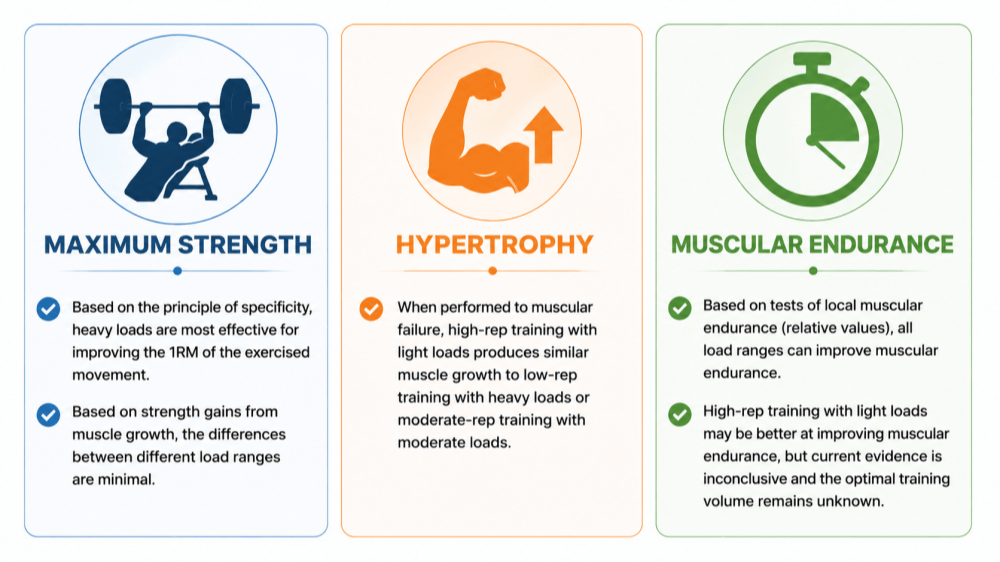
- For maximal strength: Heavy loads with low repetitions remain the best choice.
- For muscle growth: Heavy loads with low-to-moderate repetitions or moderate loads with moderate repetitions are still the most practical options.
- For muscular endurance: Light loads with high repetitions continue to have the advantage.
However, don’t forget another fundamental principle of training:
Variation drives adaptation.
Different training methods challenge the body in different ways.
Heavy-load training produces the greatest mechanical tension and is unmatched for developing maximal strength, but it provides less metabolic stress and is generally less effective for improving muscular endurance.
Moderate-load training offers a balanced stimulus, making it easier to sustain over the long term, although it may not be optimal for any single adaptation.
Light-load training, meanwhile, is capable of increasing maximal strength, stimulating substantial muscle growth, and providing unique metabolic adaptations that heavier training cannot fully replicate.
So why not take advantage of all three approaches?
Instead of relying on a single training style year-round, consider rotating between different loading schemes through periodization.
Doing so allows your body to develop a broader range of adaptations and may produce better long-term results.
In our next article, we’ll explain how to design an effective hypertrophy program, including how to organize sets, repetitions, and overall training volume for different goals.
If you found this article helpful, don’t forget to bookmark our website and stay tuned for future updates.
References
- Campos GER, et al. (2002). Muscular Adaptations in Response to Three Different Resistance-Training Regimens: Specificity of Repetition Maximum Training Zones. European Journal of Applied Physiology. https://doi.org/10.1007/s00421-002-0681-6
- Morton RW, et al. (2016). Neither Load nor Systemic Hormones Determine Resistance Training-Mediated Hypertrophy or Strength Gains in Resistance-Trained Young Men. Journal of Applied Physiology. https://doi.org/10.1152/japplphysiol.00154.2016
- Schoenfeld BJ, Grgic J, Van Every DW, & Plotkin DL. (2021). Loading Recommendations for Muscle Strength, Hypertrophy, and Local Endurance: A Re-Examination of the Repetition Continuum. Sports. https://doi.org/10.3390/sports9020032
- Bernárdez-Vázquez R, Raya-González J, Castillo D, & Beato M. (2022). Resistance Training Variables for Optimization of Muscle Hypertrophy: An Umbrella Review. Frontiers in Sports and Active Living.
- Grgic J, Schoenfeld BJ, Orazem J, & Sabol F. (2022). Effects of Resistance Training Performed to Repetition Failure or Non-Failure on Muscular Strength and Hypertrophy: A Systematic Review and Meta-Analysis. Journal of Sport and Health Science.
