

There is a popular saying in the fitness community: “Abs are made in the kitchen, but performance is fueled by what you eat.” This “eating” part doesn’t just refer to your total daily caloric intake; it also encompasses strategic supplementation before and after your training sessions. You’ve almost certainly heard the standard advice: “Eat carbs before you train, and down a protein shake immediately after.”
The real question we need to ask is: Is this rigid timing actually backed by science?
And if it is, how much of a negative impact will you really face if you miss these seemingly strict nutritional windows? Today, we are going to dive deep into what to eat before, during, and after a workout, and finally debunk the Anabolic Window Myth.
First and foremost, you need to realize that whether we are looking at the pre-, intra-, or post-workout phase, there are only three core nutrients that truly matter: carbohydrates, protein, and water. Depending on the specific timing and the type of exercise you perform, the ideal amounts and delivery methods will shift. But make no mistake: no matter how flashy or “game-changing” supplement marketing claims to be, no trendy ingredient will ever overshadow these three foundational macronutrients.
Before the Workout (Pre-Workout Nutrition)
The “pre-workout” phase is actually a much broader timeline than most people realize. Most scientific research surrounding pre-exercise nutrition focuses heavily on aerobic endurance training—specifically, prolonged endurance sessions lasting over an hour. This is because these types of training drain your glycogen stores and deplete your hydration levels the most.
If you are gearing up for a long aerobic endurance session, here is the ideal game plan:
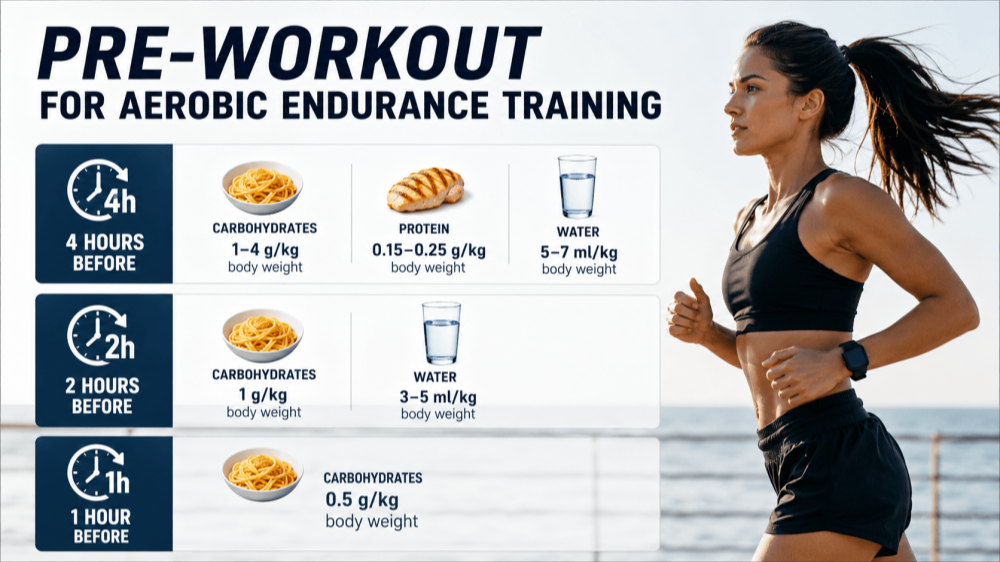
Ideally, you should begin a phased approach to fueling your body starting four hours prior to your session, gradually tapering down the volume of food as the workout draws closer.
- 4 Hours Pre-Workout (The Baseline Meal): Aim to consume 1–4g/kg of body weight in carbohydrates, 0.15–0.25g/kg of protein, and 5–7ml/kg of water. Think of this as your primary, well-balanced meal.
- 2 Hours Pre-Workout: Consume about 1g/kg of carbohydrates. This is also the time to assess your hydration status (for instance, checking if your body weight is at its baseline). If you suspect you are slightly dehydrated, consider drinking an additional 3–5ml/kg of water.
- 1 Hour Pre-Workout: A light snack of 0.5g/kg of carbohydrates is sufficient. For a 70kg individual, a single banana is usually perfect.
Now, if you prefer working out early in the morning, rolling out of bed four hours before sunrise just to eat a meal is completely unrealistic. A great workaround here is to eat a small, easily digestible snack 1 to 2 hours before you train, and then rely on intra-workout carbohydrates to bridge the gap.
What about resistance training or explosive power sessions? Interestingly, current clinical data has failed to prove that precise pre-workout nutrient timing significantly boosts strength or anaerobic performance. Most studies that claim to show a benefit were actually conducted on participants who had been fasting or severely restricted from carbs the day before.
This brings us back to my point that “the pre-workout phase is a very long timeline.” For anaerobic or strength training, your real “pre-workout window” spans the entire duration from the end of your last workout to the start of your next one. Your primary focus should simply be ensuring that your total intake of carbs, protein, and water is consistently sufficient over that period.
During the Workout (Intra-Workout Nutrition)
Intra-workout nutrition and pre-workout fueling are two sides of the same coin. If you fell slightly short on your carbohydrate or fluid intake before your workout, you must attempt to make up for it while you train.
Once again, intra-workout nutritional guidelines are primarily tailored toward aerobic endurance training, particularly sessions exceeding 60 minutes.
The golden rule here is to aim for 30–60g of carbohydrates per hour. Ideally, this should be delivered via a well-formulated sports beverage, since fluids are your primary loss during exercise.
A high-quality sports drink should meet the following benchmarks:
- A carbohydrate concentration of 6%–8%
- 460–690mg of Sodium per liter
- 78–195mg of Potassium per liter
For a comprehensive breakdown on how to manage your fluid intake, I highly recommend reading our dedicated guide: [How to Stay Hydrated During Workouts].
Insider Knowledge: When you sweat, you primarily lose minerals in a specific order of volume: Sodium, Potassium, Magnesium, and Calcium. Sodium is, by a landslide, the main mineral that needs replenishing.
As a quick side note, some athletes try adding glycerol or MCT (Medium-Chain Triglycerides) to their intra-workout drinks to extend their aerobic endurance. While glycerol can indeed give you a performance edge during ultra-endurance events (which we discussed in depth in our article, [Best Supplements for Muscle Hypertrophy & Performance]), MCT oil is a different story. Modern research has confirmed that MCTs do not improve performance and are highly likely to trigger sudden gastrointestinal distress, completely derailing your workout.
Applying this to resistance and explosive training: Unless your lifting sessions are exceptionally long (over an hour) or involve extreme, high-volume intensity, you don’t need to overcomplicate things. You can occasionally sip on some carbohydrates to delay fatigue in your slow-twitch muscle fibers during the final blocks of your workout, but for the average weightlifting session, plain water is more than enough.
After the Workout (Post-Workout Nutrition)
The post-workout phase is arguably where fitness folks obsess the most. However, a massive portion of the gym community directs 100% of their attention to slamming down a protein shake, completely ignoring the fact that for both aerobic and anaerobic exercise, replenishing carbohydrates is usually the true matter of urgency.
Clinical research has demonstrated that delaying carbohydrate intake by just two hours post-exercise can result in a staggering 60% reduction in muscle glycogen synthesis.
Therefore, to maximize glycogen replenishment, the general guidelines suggest:
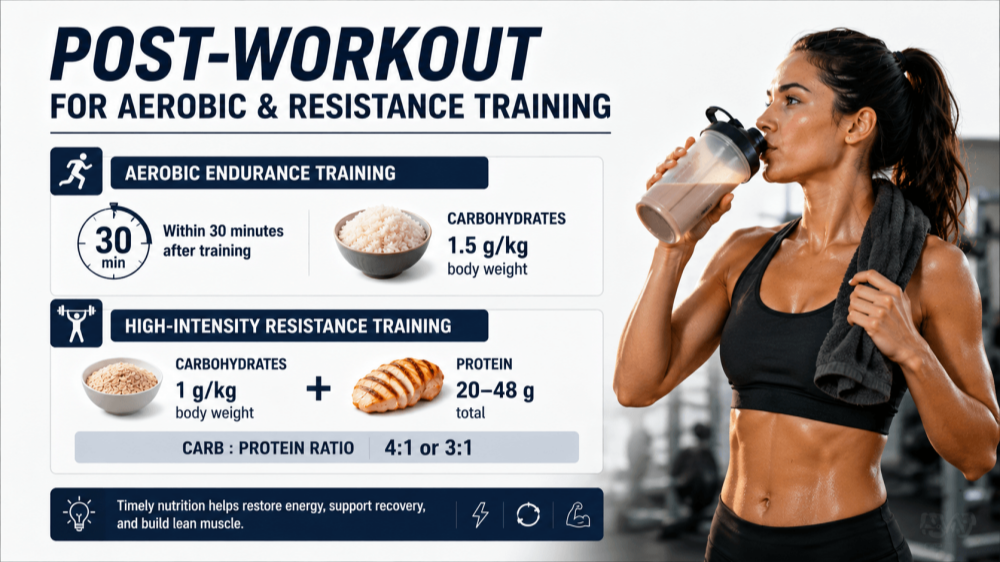
- For Aerobic Endurance Training: Consume 1.5g/kg of body weight in carbohydrates within 30 minutes of completing your session. If your schedule allows, continuing to ingest 0.7–3.0g/kg of carbohydrates every two hours post-workout has been shown to yield the absolute best results for fully topping off your glycogen stores.
- The Protein Question in Cardio: Whether you absolutely need protein after pure endurance training remains a bit of a gray area in current research. However, if you prefer to include it, aiming for at least 10g, or calculating a dose of 0.2–0.5g/kg of body weight, is a solid approach.
High-intensity resistance training, however, operates on a slightly different wavelength. Studies show that following a weightlifting session, muscle sensitivity to amino acids spikes and can remain elevated for up to 48 hours. That being said, this sensitivity is a depreciating asset—it gradually tapers off as time ticks by.
To account for both glycogen depletion and the stimulation of muscle protein synthesis (MPS), the golden standard for post-resistance training is a combined intake of carbohydrates and protein at a 4:1 or 3:1 ratio.
Specifically, you should aim for 1g/kg of body weight in carbohydrates. Once you calculate your protein based on the ratio, a dose of 20–48g of protein is generally the sweet spot to maximally stimulate rapid muscle protein synthesis.
P.S. The exact amount of protein you need largely hinges on its Leucine content. Leucine effectively acts as the body’s molecular “alarm clock,” signaling to your cells that it is officially time to start building muscle. If you want to optimize things further, you can aim to eat 20–30g of a leucine-rich protein source every 3 to 4 hours in the hours that follow.
Lastly, we cannot forget the vital component of rehydration. Regardless of whether you just finished a long run or a heavy lifting session, you need to replace lost fluids promptly. As we established in our previous guides, the protocol here is straightforward: simply weigh yourself before and after training, and drink enough water to make up the difference.
Debunking the Window: How Much Does Anabolic Timing Actually Matter?
With that, we have mapped out the full playbook for pre-, intra-, and post-workout nutritional strategies.
However, this brings us to the ultimate question: If I don’t follow this blueprint to a T—say, I fail to ingest carbs and protein immediately after stepping out of the gym—how much will it actually damage my long-term results?
The short answer? The impact is incredibly limited, and it entirely depends on your training schedule.
Yes, we did just mention two seemingly alarming facts: that delaying carbs slashes glycogen synthesis by 60%, and that amino acid sensitivity drops over time. But I need you to anchor this core truth in your mind: A transient, post-workout spike in muscle protein synthesis does not automatically equate to long-term muscle hypertrophy.
When you train intensely, you create microscopic tears and damage in the muscle fibers. The brief, exercise-induced spike in cortisol triggers a catabolic signal to break down protein. In response, your body naturally wants to ramp up repair and synthesis during the recovery phase. You can think of this immediate post-workout nutritional window as a tool to “accelerate the recovery clock,” rather than a magical muscle-building trigger.
The same logic applies to muscle glycogen.
Data has robustly proven that muscle glycogen can naturally fully recover within a 24-hour window. Therefore, unless you are an athlete performing multiple exhausting training sessions within a single 24-hour period, or you forced yourself to train in a completely fasted state, rushing to slam down carbs immediately after your final set simply isn’t that critical.
It is worth noting that the vast majority of these rigorous scientific studies are conducted on elite, professional athletes. These individuals have hyper-frequent training schedules, often contend with strict fasting protocols, and push their bodies to extreme limits. That is why timing is a make-or-break factor for them.
For the everyday fitness enthusiast, focusing on your total daily intake of carbohydrates, protein, and fats—alongside ensuring you get enough vitamins and minerals—is infinitely more important than stressing over whether you ate within 30 minutes of a workout.
An immediate post-workout snack might give you a tiny fractional advantage, but if life gets in the way and you miss it, do not let it become a psychological burden.