

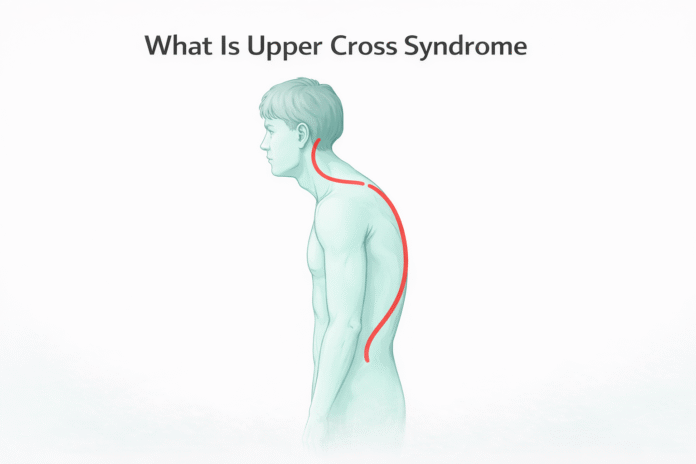
What Is Upper Cross Syndrome? Upper Crossed Syndrome (UCS), also known as shoulder girdle crossed syndrome, may sound unfamiliar at first. However, if terms like rounded shoulders, slouched posture, or hunchback posture sound familiar to you, then you are already very close to understanding it.
These postural patterns are considered typical symptoms of upper crossed syndrome. In fact, a large proportion of neck and shoulder discomfort—and even some cases of lower back pain—can be linked to UCS (although lower back pain may also be associated with lower crossed syndrome).
This condition is extremely common among modern office workers and urban professionals. So what exactly are the symptoms of upper crossed syndrome, how is upper crossed syndrome characterized? Let’s break it down step by step.
Upper Crossed Syndrome Symptoms
Upper crossed syndrome typically presents with the following five key postural characteristics:
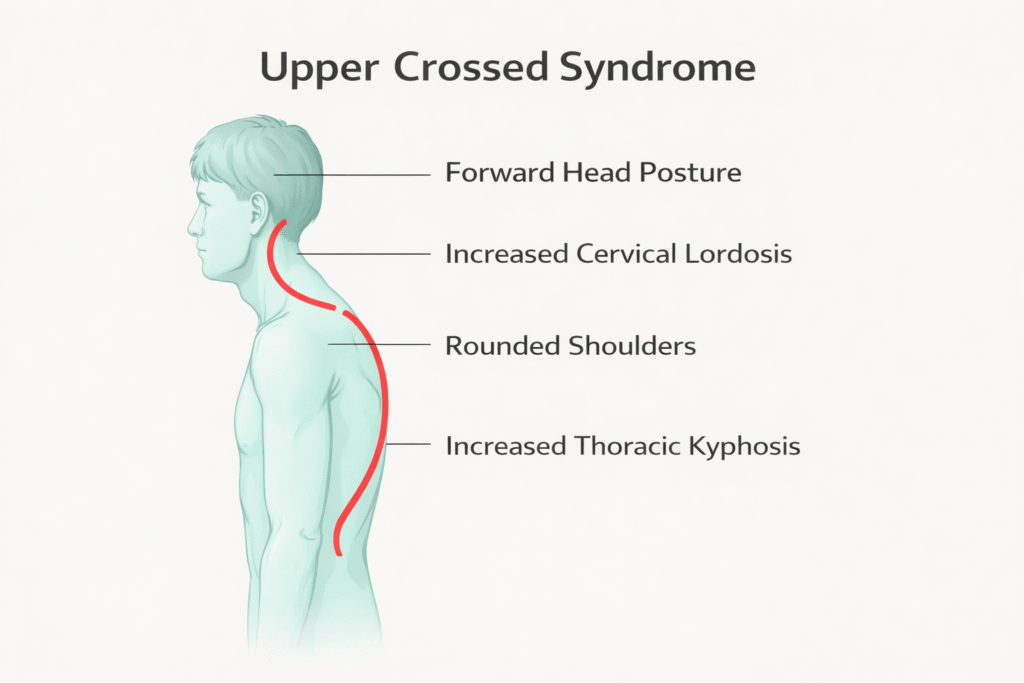
1. Forward Head Posture
The head no longer sits directly above the shoulders and is displaced forward.
2. Increased Cervical Lordosis
As the head shifts forward, the cervical spine adapts accordingly, resulting in an exaggerated inward curve compared to a normal cervical spine.
3. Increased Thoracic Kyphosis
Changes in the cervical spine inevitably affect the thoracic spine. This often manifests as excessive thoracic kyphosis—commonly referred to as a hunchback posture.
4. Shoulder Elevation and Protraction
The shoulders appear lifted and drawn forward, resembling a clothes hanger. Since bones and joints do not move independently, this posture is caused by excessive tension in the neck and shoulder musculature.
5. Scapular External Rotation and Abduction
This symptom is more common among people who train regularly. The lower angle of the scapula rotates outward, making the shoulders appear constantly “shrugged” or held up.
Note: A person does not need to present all five symptoms to be diagnosed with upper crossed syndrome. In most cases, the presence of three or more of these signs strongly indicates UCS.
Upper Crossed Syndrome Causes
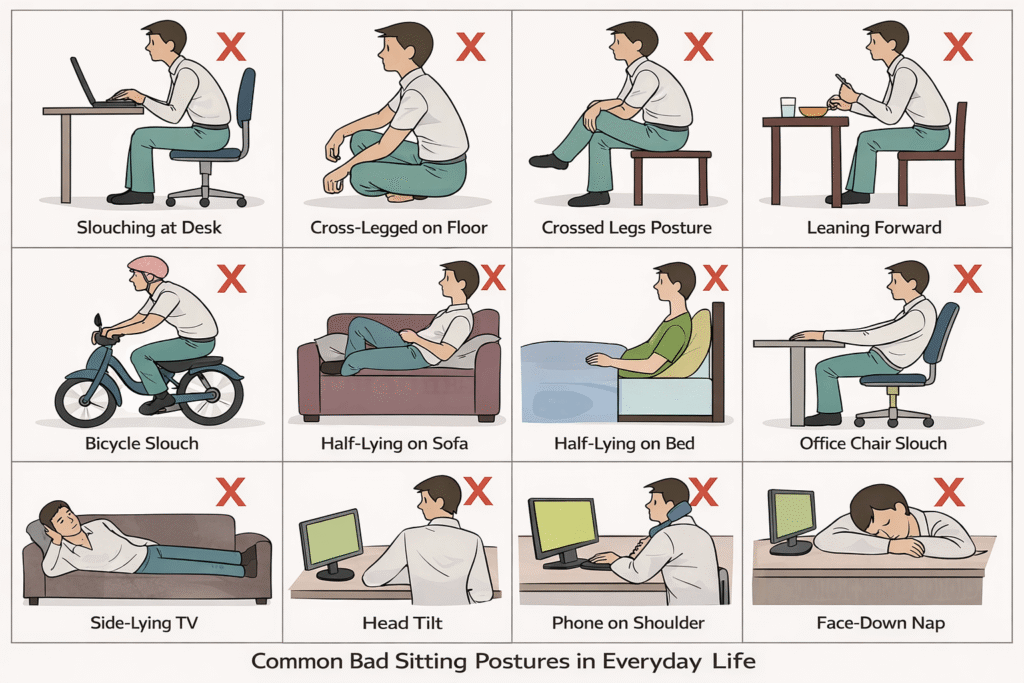
1. Poor Sitting Posture
This is the most obvious cause. Prolonged exposure to poor postural habits—such as slouching, leaning forward, or excessive screen use—gradually leads to upper crossed syndrome.
Over time, these faulty postures cause muscular imbalances that the body adapts to as “normal.”
2. Imbalanced Training Preferences
Interestingly, upper crossed syndrome is also common among fitness enthusiasts.
Many people train based on preference rather than balance. For example, individuals who frequently train the chest while neglecting the upper back often develop overly strong anterior muscles.
Without adequate stretching of the chest and strengthening of the upper back, this imbalance leads to rounded shoulders and a slouched posture.
3. Psychological Factors
Psychological factors are especially common in adolescent females. During puberty, as secondary sexual characteristics such as breast development appear, some girls experience embarrassment or self-consciousness.
To avoid standing out, they may unconsciously adopt a slouched or chest-collapsed posture. Since adolescence is a critical period of skeletal development, maintaining poor posture during this time can permanently alter adult bone structure and alignment.
As discussed previously in lower crossed syndrome, psychological factors can have a profound impact on physical health.
4. Aging and Muscle Degeneration
Among older adults (typically around 60 years of age), muscle mass and strength naturally decline. Retirement often leads to reduced physical activity, accelerating muscle loss.
As skeletal muscle volume decreases each year, the ability to maintain upright posture diminishes, resulting in a progressive forward-leaning and rounded posture.
What Does Upper Crossed Syndrome Feel Like?
Rounded Back and Slouched Chest
The most immediate impact is visual. Overdeveloped upper trapezius muscles can make the neck appear shorter, while a collapsed chest causes the shoulders to look narrow from the front.
Overall, the posture gives an impression of fatigue and low energy.
Rounded Shoulders
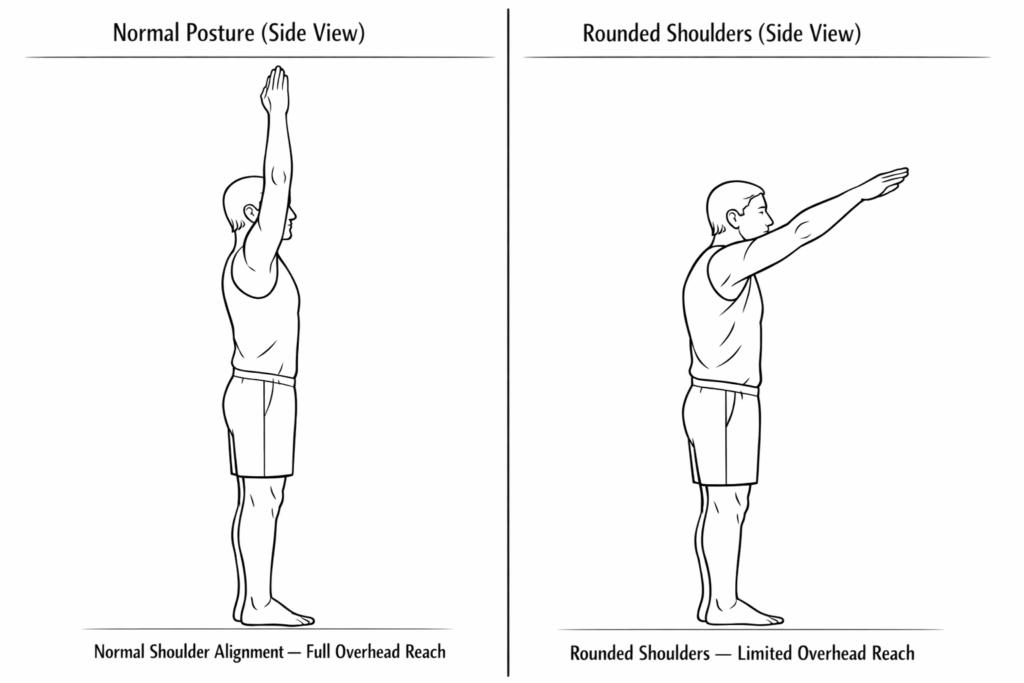
Rounded shoulders often accompany thoracic kyphosis. The shoulders shift forward while the thoracic spine curves backward, forming the classic “rounded shoulder” posture.
From the side, the shoulders appear significantly forward, and the upper back forms a pronounced curve.
Rounded shoulders restrict shoulder flexion. Normally, raising the arms forward should allow them to reach ear level—approximately 180 degrees relative to the ground. With rounded shoulders, this range often stops around 160 degrees or less.
In addition, rounded shoulders alter normal movement patterns. When the body does not start from a neutral position, the entire movement sequence becomes compensatory.
A common example appears during back training. Instead of the latissimus dorsi initiating the movement, the upper trapezius and biceps dominate, causing visible shoulder shrugging.
The same applies to chest training. Exercises like the bench press require scapular retraction and depression. Individuals with a slouched posture struggle to achieve proper scapular positioning, preventing effective contraction of the pectoralis major and resulting in poor chest activation.
Excessive Thoracic Kyphosis
When someone slouches, the thoracic spine curves excessively backward.
The spine provides maximum support only when its four natural curves—cervical, thoracic, lumbar, and sacral—are properly maintained. Excessive thoracic kyphosis flattens the curves of the thoracic, lumbar, and sacral regions while exaggerating the cervical curve.
This uneven distribution dramatically increases stress on specific spinal segments, leading to long-term degeneration.
Although sitting is often perceived as restful, it actually increases spinal load. If standing spinal pressure is considered 100, correct sitting posture raises this to approximately 140.
Poor sitting posture pushes this number far higher, explaining why prolonged sitting frequently results in lower back discomfort.
We also mentioned this point when we introduced What Does Lower Crossed Syndrome Feel Like.
Forward Head Posture and Neck Pain
Forward head posture places excessive strain on the cervical spine and compresses the carotid arteries, potentially reducing blood flow to the brain and triggering headaches.
This is a common experience among office workers who feel heavy-headed and fatigued by the end of the workday.
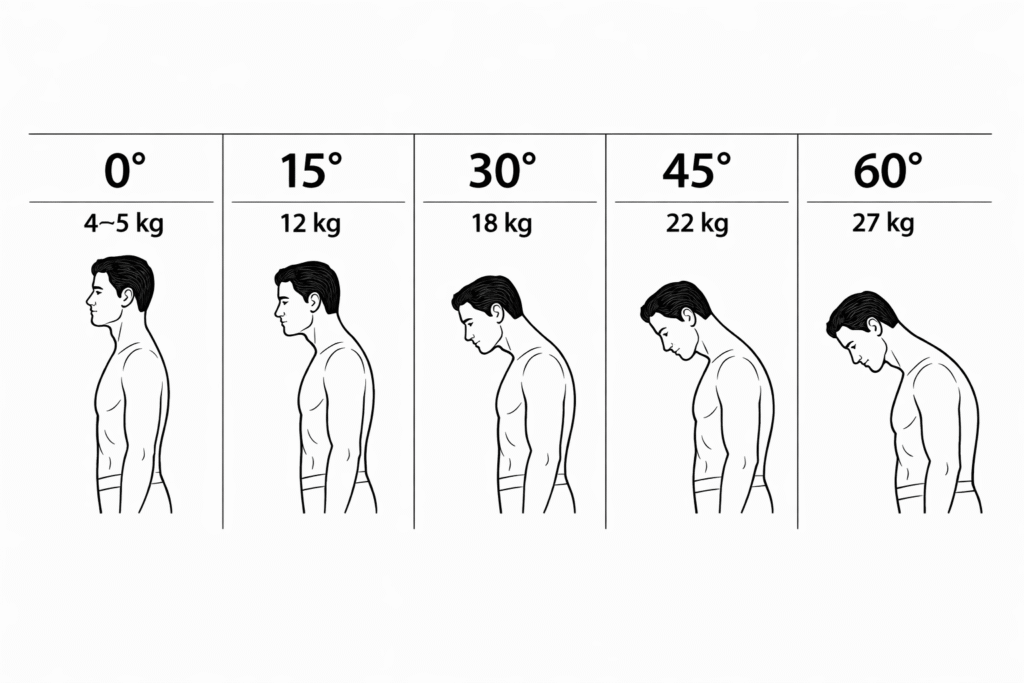
As the neck flexion angle increases, cervical curvature changes accordingly. The vertebral transverse foramina—responsible for transmitting blood and neural structures—are placed under increasing stress.
| Neck Angle | Cervical Load | Description |
|---|---|---|
| 0° | 4–5 kg | Normal, no abnormal stress |
| 15° | 12 kg | Neck and shoulder muscle tension |
| 30° | 18 kg | Headaches, neck and shoulder pain |
| 45° | 22 kg | Disc degeneration, joint wear |
| 60° | 27 kg | Permanent damage, chronic pain |
At just 15 degrees of forward tilt, cervical load nearly triples. To visualise this, imagine carrying an 18 kg bucket with one hand—it quickly becomes exhausting.
Once neck flexion reaches 45 degrees or more, structural damage is often already present, and even medical intervention may offer limited improvement.
Final Thoughts
Upper crossed syndrome is not something to ignore or “push through.” It is a condition that requires early awareness and timely intervention.
In the next article, we will introduce specific corrective and treatment exercises for upper crossed syndrome to help restore balance and posture.
If you’d like a more scientific explanation of Upper Crossed Syndrome and why it is called a “crossed” syndrome, you can check out this article.
