

- Understanding Exercise Intensity
- Why Does Your Body’s “Alarm System” Trigger After Intense Exercise?
- What Happens Inside Your Body During Intense Exercise?
- The Immune Repair Process After Exercise
- Why Are the Airways Especially Vulnerable?
- So Why Do Some People Stay Healthy While Others Get Sick Easily?
- Even Professional Athletes Can Get Sick
- Exercise Is Not the Problem. The Problem Is How You Approach It.
- Recovery Is Part of Training
- Build Exercise Capacity Gradually
In recent years, more and more people around us have started exercising.
Some people go to the gym to build muscle and sculpt their bodies.
Some run five kilometers every day along city trails.
Others seek adventure in nature—hiking through mountains or surfing in the ocean.
With such an enthusiastic fitness atmosphere everywhere, it is hard not to feel tempted.
Maybe you are usually the “fragile type” among your friends.
You rarely move unless necessary.
The biggest effort you make for your health is probably doing a set of Baduanjin every day.
But occasionally, when motivation suddenly hits, you follow your friends and join their activities:
Trying some gym machines.
Going hiking.
Exploring trails.
However, you soon discover something strange:
You and exercise seem to have a complicated relationship.
You do not exercise regularly, and when you suddenly push yourself hard, your body seems to secretly “punish” you.
Every time you complete an intense workout and proudly feel:
“Wow, I am finally becoming healthier.”
You return home and immediately crash.
At best, you catch a cold.
At worst, you develop a fever or even experience allergic reactions such as hives.
After this happens repeatedly, you start questioning:
“Am I simply not built for exercise?”
Why does exercise make other people healthier, while it seems to make you sick?
Before blaming yourself, hold on.
For people who are not used to exercise, there are actually many beginner-friendly activities:
- Tai Chi
- Yoga
- Light jogging
You can do these for 30 minutes and only feel slightly out of breath.
The problem usually appears when you suddenly jump into activities that require a much higher physical demand:
- Hiking for an entire day
- Intense outdoor activities
- Being pushed to train four times a week in the gym
Why does this happen?
The key factor is exercise intensity—how demanding and physically stressful the activity is.

Understanding Exercise Intensity
In 2017, China’s General Administration of Sport released the National Fitness Guide, which classified different physical activities into three intensity levels:
- Low intensity
- Moderate intensity
- High intensity
The classification is based on factors including:
- Heart rate
- Breathing pattern
- Perceived exertion during exercise
For example:
Taking a walk downstairs during your lunch break is relatively easy.
Your breathing remains steady, your heart rate stays around 50%–60% of your maximum heart rate, and it is generally below 100 beats per minute.
This is considered low-intensity exercise.
If you ride a bicycle in the park, go jogging, or practice Tai Chi with older adults, this falls into the category of moderate-intensity exercise.
At this point:
- Your heart rate is usually around 100–140 beats per minute
- It remains below 85% of your maximum heart rate
- You may breathe slightly harder and sweat a little
But you can still maintain the activity.
The most demanding category is high-intensity exercise.
Your heart rate exceeds 140 beats per minute and reaches above 85% of your maximum heart rate.
Your breathing becomes noticeably faster, and you clearly feel fatigue.
Examples include:
- Running
- Climbing stairs quickly
- Fast-paced hiking
- High-intensity aerobic workouts
Using heart rate to classify exercise intensity also shows an important point:
The experience of “intensity” is different for everyone.
Different people have different cardiovascular capacities.
Therefore, even when performing the same activity, their maximum heart rate response can vary.
For healthy adults, maximum heart rate during exercise is negatively correlated with age.
In other words:
The older you become, the lower your maximum heart rate generally is.
People with lower exercise capacity or risk factors such as:
- Smoking
- Diabetes
- Obesity
usually have a lower maximum heart rate compared with healthier individuals with better fitness levels.
Some studies have also suggested that women may have a lower maximum heart rate during exercise compared with men of the same age.
However, the rate at which maximum heart rate declines with age may be slower in women, meaning the difference gradually becomes smaller over time.
The difference is easy to understand with a simple example.
The same mountain climb can feel completely different for different people.
A university student with strong fitness ability may finish a night hike up Mount Tai quickly.
Meanwhile, a middle-aged office worker may end up sitting on the stairs with exhausted legs.
Similarly, during a HIIT workout:
Pamela Reif in a workout video may still look relaxed before she even starts breathing heavily.
But someone who has only trained for one and a half weeks may already feel completely exhausted.
Therefore:
Exercise intensity must match your current physical ability.
Otherwise, instead of appreciating the challenge you give it, your body may simply go into emergency mode.

Why Does Your Body’s “Alarm System” Trigger After Intense Exercise?
At this point, you may wonder:
Why does the body’s response to excessive exercise often appear as a cold or fever?
This is related to a somewhat counterintuitive phenomenon:
After intense exercise, your immune function may temporarily appear to become “weaker” compared with before exercise.
Researchers refer to this phenomenon as the “immune window” after exercise.
Recent studies suggest that this so-called “window period” is actually part of the immune system’s monitoring and regulation process.
During intense exercise, the body undergoes a series of physiological changes.
Your body places greater demands on the immune system, almost as if it is sending out urgent requests:
“More resources are needed here.”
As a result, large numbers of immune cells are redirected to different areas of the body to deal with exercise-induced stress and tissue damage.
During this period, microorganisms—especially viruses—may take advantage of this temporary imbalance.
It is similar to a thief finding a bank with the security system temporarily offline.
The virus can break through the body’s defense system more easily, increasing the risk of infection and illness.
What Happens Inside Your Body During Intense Exercise?
The beginning of this process comes from a series of stress responses triggered during intense physical activity.
When you run, lift weights, or perform pull-ups, your muscles repeatedly contract and lengthen.
If muscles continue producing force while being stretched, they are more likely to experience microscopic damage.
This is why, the next day after a hard workout, you may experience:
- Muscle soreness
- Stiffness
- Swelling
At the same time, intense exercise increases oxygen consumption in muscle tissue.
This can create a temporary state of relative oxygen shortage within local tissues.
Exercise also consumes muscle glycogen and depletes energy reserves.
These physical stresses trigger inflammatory responses, which activate the body’s protective repair mechanisms.
For example, when muscle glycogen stores become depleted, muscle fibers release large amounts of IL-6 (interleukin-6), a pro-inflammatory cytokine.
IL-6 acts as a signal during inflammation.
It attracts immune cells toward areas of muscle damage, helping remove damaged cells and begin the repair process.
The Immune Repair Process After Exercise
The first “emergency responders” to arrive are neutrophils.
They appear in damaged tissues approximately 2 hours after injury, reaching their highest concentration between 6 and 24 hours.
After that, macrophages take over.
Phagocytic macrophages continue increasing between 24 hours and 2 days after injury.
Non-phagocytic macrophages reach their peak around 4 days after injury and may remain active for more than a week.
At the same time, IL-6 can activate the release of hormones such as:
- Cortisol
- Catecholamines, including adrenaline, noradrenaline, and dopamine
These hormones help regulate the body’s stress response.
However, they can also reduce the number and activity of immune cells, leaving your immune system with fewer resources available for defense.
The result is:
While the immune system is focusing heavily on inflammation and tissue repair, its ability to defend against external pathogens (such as viruses) may temporarily decrease.
This increases the risk of infection and viral reactivation.
Why Are the Airways Especially Vulnerable?
The upper respiratory tract is one of the areas most affected.
After intense exercise, the immune function of the mucosal system in the upper respiratory tract can remain reduced for up to 24 hours.
During this period, susceptibility to upper respiratory tract infections increases.
This explains why some people experience:
- Sore throat
- Runny nose
- Cold symptoms
after unusually intense exercise.
So Why Do Some People Stay Healthy While Others Get Sick Easily?
If getting sick after intense exercise is a common physiological response, why does it seem to happen much more often to some people?
The answer is actually simple:
People who rarely exercise but suddenly push themselves extremely hard are more likely to experience problems.
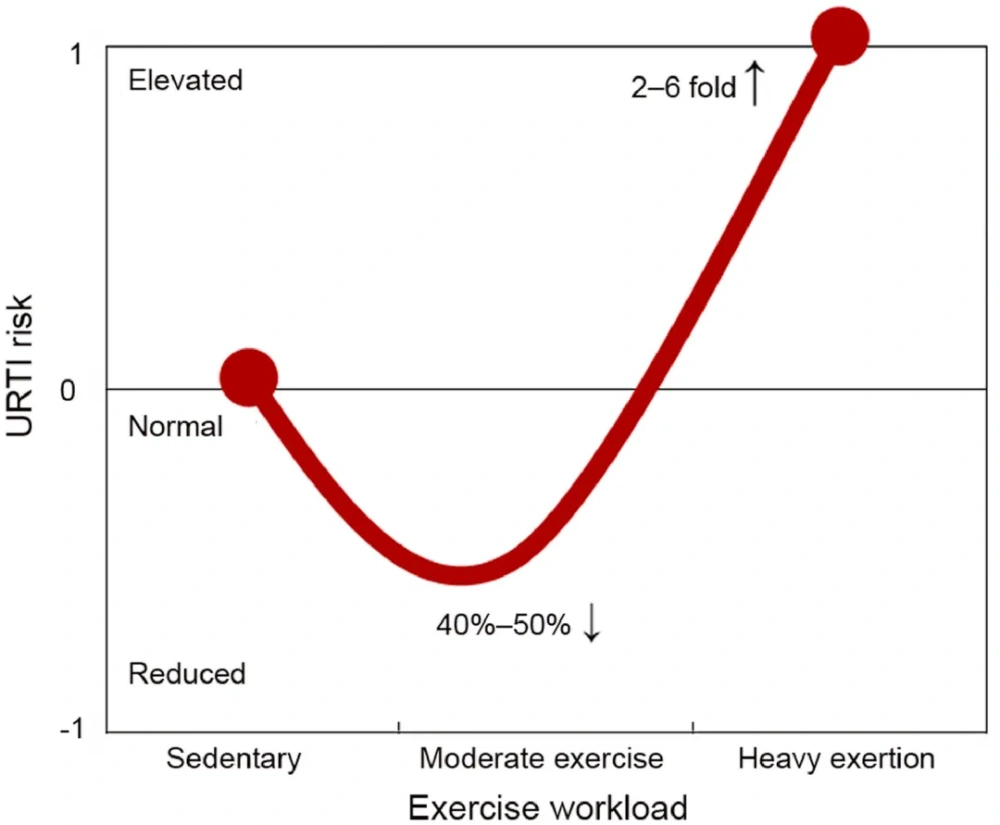
Research has found that the relationship between exercise load and upper respiratory tract infection follows a J-shaped curve.
For most people:
Moderate-intensity exercise actually reduces the risk of upper respiratory tract infections.
It can lower infection rates and shorten illness duration by approximately 40%–50%.
However:
High-intensity exercise can increase infection risk by 2–6 times, potentially making you more vulnerable than doing no exercise at all.
Therefore, if you consider yourself someone who is easily affected by intense exercise, but still want the benefits of training without constantly getting sick:
Moderate-intensity exercise is usually the best choice.
For people who are already physically fit and regularly active, the body can adapt to higher training demands.
However, this does not mean you can ignore basic physiology.
Even highly trained individuals can experience problems when high-intensity exercise is combined with other stressors.
Even Professional Athletes Can Get Sick
A 2018 review study found that athletes experience increased rates of upper respiratory tract infection symptoms during competition periods.
The reason is that athletes are not only dealing with high-intensity training.
They are also exposed to additional stressors, including:
- Long-distance travel
- Sleep disruption
- Poor nutrition
- Psychological stress
When these factors accumulate, even highly trained athletes may eventually get sick.
Exercise Is Not the Problem. The Problem Is How You Approach It.
After reading this far, you may have started reconsidering whether exercise is actually harmful for you.
But don’t rush to cancel your gym membership just yet.
The problem is not exercise itself.
The problem is how you perform it.
Getting a cold or fever after training is more like an alarm signal from your body.
It is telling you:
“I need recovery.”
When you experience discomfort after exercise, the solution is not:
“Train harder, push further, become stronger.”
The most basic solution is often the most effective:
Eat well and sleep well.
Research has found that consuming an appropriate amount of carbohydrates during high-intensity exercise can help maintain blood glucose levels and produce immune-regulating effects.
This protective effect can continue into the recovery period after exercise.
On the other hand:
Training while deliberately restricting food intake will not make you lose fat faster.
It may simply make you get sick faster.
Recovery Is Part of Training
The U.S. National Library of Medicine clearly emphasizes that:
Rest is an essential part of training.
If you do not allow enough recovery time between workouts, it can negatively affect not only your performance but also your overall health.
Insufficient recovery may lead to:
- Mood changes
- Difficulty sleeping
- Persistent muscle soreness
- More frequent illnesses
Therefore, there should generally be at least six hours of rest between training sessions, and you should aim for approximately eight hours of sleep every night.
If you insist on staying up late just to lift weights like some extreme fitness enthusiasts, the only thing you may achieve is:
a muscular body that cannot function properly.
Build Exercise Capacity Gradually
In the long term, your training plan should follow one simple principle:
Long-term progress requires long-term consistency.
Do not fight against your own body.
Research has shown that previously untrained healthy individuals can improve endurance performance by performing treadmill training:
- Three times per week
- Approximately 20 minutes per session
By gradually increasing exercise intensity according to their own physical ability, meaningful improvements can be achieved within around six weeks.
The key is not destroying yourself in one workout.
The key is gradually teaching your body to tolerate greater challenges.
Only by building your capacity step by step can you enjoy exercise in a sustainable way.
Exercise exists to help you live longer and live better.
It is not supposed to turn your immune system into another employee who receives unrealistic performance targets.
So the next time you decide to completely destroy yourself in a workout, take a moment and think:
Your body is already working overtime.
Why make your hardworking “employee” fight against itself?
Train smarter, recover properly, and let exercise become something that improves your life—not something that constantly takes from it.
References
[1] General Administration of Sport of China. (2017). National Fitness Guide. China Sports Press.
[2] Tanaka, H, Monahan, K, Seals, D. (2001). Age-predicted maximal heart rate revisited. JACC, 37 (1), 153–156.
[3] Nóra Sydó, Sahar S. Abdelmoneim, Sharon L. Mulvagh, Béla Merkely, Martha Gulati, Thomas G. Allison. (2014). Relationship Between Exercise Heart Rate and Age in Men vs Women,Mayo Clinic Proceedings,89(12),1664-1672.
[4] Vida Rahimi, Maryam Koushkie Jahromi. (2026). Ginger consumption enhances fat utilization during exercise in young women: An acute randomized crossover trial,Advances in Integrative Medicine,13(2),100668.
[5] Shi X, Hu L, Nieman DC, Li F, Chen P, Shi H and Shi Y (2025) Exercise workload: a key determinant of immune health – a narrative review. Front. Immunol. 16:1617261. doi: 10.3389/fimmu.2025.1617261
[6] Campbell, J. P., & Turner, J. E. (2018). Debunking the Myth of Exercise-Induced Immune Suppression: Redefining the Impact of Exercise on Immunological Health Across the Lifespan.Frontiers in immunology,9, 648.
[7] Jonathan M. Peake, Oliver Neubauer, Neil P. Walsh, and Richard J. Simpson. (2016). Recovery of the immune system after exercise. Journal of Applied Physiology, 122(5),1077-1087.
[8] Byrne, C., Twist, C. & Eston, R. (2004). Neuromuscular Function After Exercise-Induced Muscle Damage.Sports Med, 34, 49–69.
[9] Stebel, A., Ligoda, J., Gładysz, A., Zamorski, M., Mach, F., Machaj, R., & Ragan, G. (2026). The Post-Exercise Window of Susceptibility to Infection: A Literature Review. Bangladesh Journal of Medical Science, 25(2), 413–422.
[10] Pernille Hojman, Camilla Brolin, Nynne Nørgaard-Christensen, Christine Dethlefsen, Britt Lauenborg, Cecilie Køllner Olsen, Mette Marie Åbom, Thomas Krag, Julie Gehl, and Bente Klarlund. (2019). IL-6 release from muscles during exercise is stimulated by lactate-dependent protease activityPedersen. APSselect, 6(4), 940-947
[11] Richard Baskerville, Linda Castell, Stéphane Bermon. (2024). Sports and Immunity, from the recreational to the elite athlete. Infectious Diseases Now, 54(4), 104893.
[12] James G. Tidball, S. Armando Villalta. (2010). Regulatory interactions between muscle and the immune system during muscle regeneration. American Journal of Physiology-Regulatory, Integrative and Comparative Physiology, 298(5), 1173-1187.
[13] David M. Shaw, Fabrice Merien, Andrea Braakhuis, Deborah Dulson. (2018). T-cells and their cytokine production: The anti-inflammatory and immunosuppressive effects of strenuous exercise. Cytokine, 104, 136-142.
[14] Nieman, David C.; Wentz, Laurel M. (2019). The compelling link between physical activity and the body’s defense system. Journal of Sport and Health Science, 8(3), 201-207.
[15] Kurowski M, Seys S, Bonini M, et al. (2022). Physical exercise, immune response, and susceptibility to infections—current knowledge and growing research areas. Allergy, 77, 2653–2664.
[16] Gleeson M. (2006). Immune system adaptation in elite athletes.Current opinion in clinical nutrition and metabolic care,9(6), 659–665.
[17] Jonathan M. Peake,Oliver Neubauer,Neil P. Walsh, andRichard J. Simpson. (2017). Recovery of the immune system after exercise. Journal of Applied Physiology. 122:5,1077-1087.
[18] Jacob Berman. (2024). Are you getting too much exercise? A.D.A.M. Medical Encyclopedia [Internet].
[19] Ashleigh J. McNicol; Brendan J. O’Brien; Carl D. Paton; Wade L. Knez (2009).The effects of increased absolute training intensity on adaptations to endurance exercise training. , 12(4), 485–489.
This article is reproduced from publicly available online sources. If you believe it infringes your copyright, please contact us, and we will remove it promptly.
