

- 1. Building Muscle Doesn’t Automatically Mean You’re Using Your Body Correctly
- 2. Poor Posture Doesn’t Always Mean You’re Not Training Enough. Sometimes You’re Just Training the Wrong Things
- 3. Forward Head Posture: Your Head Isn’t Too Heavy, It Just Loves Moving Forward
- 4. Rounded Shoulders: Don’t Blame Your Front Delts Too Quickly
- 5. Crossing Your Legs: You Think You’re Relaxing, But Your Body May Be Quietly Adapting
- 6. Why Has Your Posture Not Improved Despite Years of Training?
- 7. How to Start Improving Your Posture
- 8. Don't Turn Posture Problems Into Anxiety
- 9. Final Thoughts: Don't Build Muscle on the Wrong Foundation
Have you ever noticed this kind of person in the gym?
They look strong when wearing clothes.
Their chest looks thick.
Their arms have some definition.
From the back, they look like someone who has been training for years.
But the moment they turn around, everything changes.
Their head sits forward, almost as if they are always trying to answer a question before anyone asks.
Their shoulders roll inward, like they are permanently trying to protect themselves from the cold.
When they walk, their upper body looks slightly collapsed, creating a strange impression:
“The muscles are there, but the person still looks tired.”
The most confusing part is that some people even mistake rounded shoulders for having well-developed front delts.
They might say:
“Look, aren’t my front delts pretty full?”
And I would think:
“Brother, that may not be your front delts. Your shoulders might have simply decided to move forward and live there.”
And that is exactly what we are going to discuss today:
Why do some people build noticeable muscle, yet their posture still looks poor after years of training?
1. Building Muscle Doesn’t Automatically Mean You’re Using Your Body Correctly
Many people have a misunderstanding about fitness:
“Once you build enough muscle, your posture will naturally improve.”
This statement is only half true.
Muscle can definitely improve posture.
However, the key conditions are:
- You are training the right muscles.
- You are using proper movement patterns.
- Your daily habits are not constantly forcing your body into poor positions.
Otherwise, you can end up in a frustrating situation:
You train your back in the gym and feel great afterward.
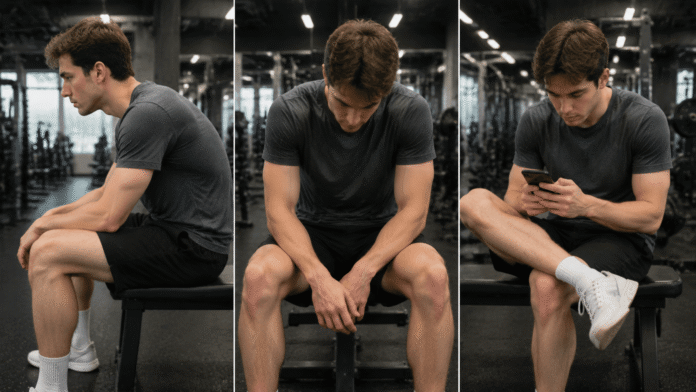
But during rest periods, you sit down, look at your phone, and your head drops almost between your thighs.
You train for one hour.
Then you spend two hours looking downward.
The result?
Your back doesn’t improve much, but your neck gradually starts looking more and more like a searchlight pointing forward.
The same thing happens with shoulder training.
You finish a shoulder workout and feel an amazing pump in your front delts.
But throughout the day, you sit with your chest collapsed, shoulders internally rotated, and your arms constantly positioned forward.
Eventually, you think your front delts are simply well developed.
But in reality, your shoulders may just be stuck in a forward position.
And then there is leg training.
You perform your exercises with good technique.
But the moment you sit down, your legs automatically cross.
Left over right.
Right over left.
Your pelvis is basically performing a small dance routine every day.
So here comes the important question:
Training is only one part of your life. Your everyday posture is the position your body spends the most time in.
You may train for one hour every day.
But you may spend ten or more hours:
- Sitting
- Standing incorrectly
- Looking down
- Crossing your legs
- Scrolling on your phone
The body is surprisingly fair.
It adapts to the positions you spend the most time in.
2. Poor Posture Doesn’t Always Mean You’re Not Training Enough. Sometimes You’re Just Training the Wrong Things
In the gym, the most popular muscles are usually the ones you can see in the mirror.
Chest.
Front delts.
Arms.
Abs.
These muscles look good.
They are easy to understand.
They provide immediate visual feedback.
After a workout, you can look in the mirror and immediately feel:
“Today’s workout worked.”
But many structures that are actually important for posture are much less noticeable.
For example:
- Whether your shoulder blades are stable
- Whether your thoracic spine can extend properly
- Whether your lower trapezius is working
- Whether your serratus anterior is functioning well
- Whether your gluteus medius has enough strength
- Whether your deep neck flexors are still doing their job
These muscles and functions are not exactly ideal for taking selfies.
They also do not immediately give you the feeling of:
“I look like a completely different person today.”
However, they determine whether your body can maintain a position that is:
- Comfortable
- Stable
- Efficient
Some people build a bigger chest, but their thoracic spine becomes increasingly stiff.
Some people develop bigger shoulders, but their shoulder blades become less controlled.
Some people have plenty of back muscle, yet still have rounded shoulders because they cannot properly position their scapula.
That is why posture is not something that can simply be fixed by saying:
“Just train your back more.”
Sometimes you train your back extremely hard, but the movement is dominated by your arms.
Sometimes you train rear delts constantly, but your scapular control is still poor.
Sometimes you train your core until you are shaking, but in daily life you still sit with:
- A collapsed lower back
- Forward head posture
- Rounded shoulders
It is similar to renovating a house.
You can replace the sofa and television, but if the foundation is tilted, the problem is still there.
3. Forward Head Posture: Your Head Isn’t Too Heavy, It Just Loves Moving Forward
Forward head posture is extremely common in gyms.
Many people stand there, and before their body even starts moving, their head has already arrived somewhere else.
From the side view, their ears are no longer aligned above their shoulders.
Instead, the head has shifted forward.
The whole posture looks like they are saying:
“What did you say? Let me move closer so I can hear you better.”
Forward head posture is not usually caused by having a “short neck” or a “heavy head.”
More often, it comes from:
- Spending too much time looking downward
- Rounded shoulders
- Poor thoracic spine mobility
- Weak or inactive deep neck flexors
Especially during rest periods between sets.
Many people finish a hard set, sit down exhausted, and immediately look down at their phone.
The head drops forward.
The shoulders round.
The back arches.
The whole body looks like a shrimp charging its battery.
The problem is:
You may have just finished training your back, shoulders, or core.
But during your rest period, your body immediately returns to the posture it is most familiar with.
No matter how perfect your exercises are, spending your rest periods folded forward can still work against your posture goals.
This is why I increasingly believe:
Rest periods are also part of training.
You can rest.
But don’t bury your head in your phone.
You can check messages.
But don’t fold yourself into the shape of an old receipt.
4. Rounded Shoulders: Don’t Blame Your Front Delts Too Quickly
Rounded shoulders are another extremely common posture issue.
Especially among people who train their chest frequently.
A typical pattern looks like this:
The chest becomes bigger.
The shoulders become more developed.
But the entire upper body starts drifting forward.
Some people assume this happens because their front delts are simply too developed.
However, you need to understand the difference:
Muscle size is about shape. Shoulder position is about alignment.
Someone can have well-developed front delts and still maintain an open, upright posture.
Someone can also have relatively small front delts but appear to have a prominent front shoulder because the shoulder itself has moved forward.
These are not the same thing.
If you spend years with:
- Rounded posture
- Forward shoulder position
- Tight pectoralis minor
- Poor back and scapular control
your shoulders will naturally tend to move forward.
At this point, continuing to focus only on:
- Bench press
- Overhead pressing
- Chest fly movements
may simply reinforce the movement pattern your body is already good at.
You feel your chest working.
You feel your shoulders pumped.
The front side of your body feels stronger.
But when viewed from the side, you still look closed and collapsed.
That is why improving rounded shoulders is not simply about:
“Train your rear delts more.”
You also need to develop:
- Thoracic extension
- Scapular retraction and depression control
- Better activation of the middle and lower back
- Proper function of the serratus anterior and lower trapezius
These muscles are often overlooked, but they play an important role in keeping your shoulders positioned correctly.
In simple terms:
Your shoulders do not look better just because they are bigger. They look better when they are in the right position.
5. Crossing Your Legs: You Think You’re Relaxing, But Your Body May Be Quietly Adapting
Let’s talk about another extremely common daily habit:
Crossing your legs while sitting.
For many people, the moment they sit down, their legs automatically cross.
It almost feels like a default setting built into their body.
They cross their legs:
- During conversations with friends
- At the office
- Even while resting between sets at the gym
They sit there scrolling through their phone, one leg crossed over the other, and then complain:
“Why does my pelvis always feel uncomfortable?”
This is a little like pouring extra chili oil into a hot pot and then wondering why it becomes too spicy.
Crossing your legs occasionally is not going to destroy your body.
However, if you constantly cross the same leg in the same direction, your body may gradually adapt to this asymmetrical position.
Over time, you may develop:
- Increased tightness on one side of the hip
- Reduced strength on one side of the glute muscles
- A habitually rotated pelvis
- Changes in standing posture and movement patterns
Then you start noticing:
Your feet feel like they produce different amounts of force during squats.
One side of your lower back feels tighter during deadlifts.
One knee feels more uncomfortable while running.
You assume the problem is your training technique.
But the issue may have started much earlier—the moment you sat down.
Posture problems do not appear overnight.
They are slowly created by the positions you repeatedly put your body into:
Sitting.
Looking down.
Leaning to one side.
6. Why Has Your Posture Not Improved Despite Years of Training?
At the end of the day, many people’s problem is not that they don’t train.
The problem is that their training and their lifestyle are working against each other.
Inside the gym:
You train your back.
You train your shoulders.
You train your core.
You train your glutes and legs.
You work hard to bring your body into a stronger and more balanced position.
But outside the gym:
You look down.
You round your shoulders.
You cross your legs.
You collapse your lower back.
You carry your bag on one shoulder.
You curl up in a chair while scrolling on your phone.
It is like saving money carefully during the day, then spending everything at night.
At the end of the month, your balance is still unchanged.
Training improvements are your income.
Poor daily habits are your expenses.
If your expenses are greater than your income, you won’t see meaningful progress.
So instead of only asking:
“What exercises should I do to improve my posture?”
You should also ask:
“What habits am I repeating every day that are creating posture problems?”
This question may be more important than any single exercise.
7. How to Start Improving Your Posture
Posture improvement does not need to become extremely complicated.
You do not need to spend one hour every day doing corrective exercises.
You also do not need to force yourself to stand perfectly like a human anatomy model.
Start with a few simple changes.
1. Stop Dropping Your Head During Rest Periods
You can use your phone during rest periods.
But hold it higher.
Try to keep your ears roughly aligned above your shoulders.
Avoid letting your head constantly fall forward.
You are not trying to read a secret exam paper.
Your face does not need to be that close to the screen.
2. Reduce Excessive Leg Crossing
This does not mean you can never cross your legs again.
The problem is repeatedly staying in the same position for long periods.
When sitting:
- Try to keep both feet on the floor.
- Avoid constantly shifting your pelvis to one side.
- Do not completely collapse into the chair.
For most people, improving posture is not about adding one more exercise.
It is often about removing one harmful habit.
3. After Training Chest, Pay More Attention to Your Back and Scapular Control
If you perform a lot of chest training and pressing movements, you should pay more attention to:
- Pulling exercises
- Scapular control
- Thoracic mobility
This does not mean chest training is bad.
The point is that your body needs balance between the front and back sides.
If you only know how to push forward but never how to pull back, your body will eventually become a:
“forward-development athlete.”
4. Perform Some Thoracic Spine Mobility Work Every Day
Many people with rounded shoulders and forward head posture do not only have shoulder problems.
A stiff thoracic spine can also prevent the upper body from opening properly.
You can use:
- Foam roller thoracic extensions
- Wall angels
- Cat-cow movements
- Quadruped thoracic rotations
You don’t need a lot.
A few minutes every day is far more valuable than doing an hour once a month.
5. During Training, Ask Yourself One More Question:
“Is my posture correct right now?”
When performing an exercise, don’t only focus on completing repetitions.
Also observe:
- Is my head moving forward?
- Are my shoulders shrugging?
- Are my ribs flaring?
- Is my lower back arching excessively?
- Is my pelvis tilted?
- Am I producing equal force on both sides?
These details may seem small.
But posture is built from thousands of small habits.
8. Don’t Turn Posture Problems Into Anxiety
Of course, this does not mean everyone needs to stand perfectly like an anatomy diagram all day.
Real life does not work that way.
You will get tired.
You will look down.
You will relax into a chair.
You will occasionally cross your legs.
That is normal.
Improving posture is not about becoming someone who is never allowed to relax.
The real purpose is:
- Knowing when your body is moving into poor positions.
- Understanding why something feels uncomfortable.
- Recognizing where compensation happens during training.
- Identifying which daily habits affect your body.
- Gradually bringing yourself back to a more comfortable and stable position.
The goal is not just to look better in photos.
The goal is to train longer, move safer, and build a higher-quality body.
Muscle is the result.
Posture is the underlying system.
When the system is unstable, bigger muscles can sometimes make the problems even more obvious.
9. Final Thoughts: Don’t Build Muscle on the Wrong Foundation
The most interesting part of fitness is not simply making your body bigger.
It is learning how your body actually works.
Eventually, you begin to realize:
Some soreness is not because you trained the target muscle—it is because you compensated.
Some “big front delts” are actually shoulders stuck in a forward position.
Some people cannot feel their back working because their shoulder blades do not move properly.
Some lower-back discomfort may be related to how they sit, cross their legs, or look down every day.
So if you have trained for years but your posture still looks poor, it does not necessarily mean you are not training hard enough.
It may simply mean you have focused only on building muscle while ignoring how your body moves and functions.
From today onward, don’t just track your weights and repetitions.
Also pay attention to:
- Did I shrug my shoulders during training?
- Did I spend my rest periods looking down?
- Did I always cross the same leg while sitting?
- After training, do I feel muscle fatigue or joint discomfort?
- Are my ears, shoulders, and pelvis roughly aligned when I stand?
These things may not look like training.
But they determine how far your training can ultimately take you.
This article is reproduced from publicly available online sources. If you believe it infringes your copyright, please contact us, and we will remove it promptly.
