

In the previous article How to Break Your Bench Press Plateau and Reach 150kg Faster, we provided training suggestions for beginner and intermediate lifters. Most people should be able to achieve noticeable progress by applying those methods.
However, that alone is not enough.
No one can rely on just one or two training methods to achieve long-term progress. So where should we look next for further improvement?
The answer can be found in physics. You do not need advanced knowledge—middle school physics is sufficient.
P.S. The training methods described in this article are mainly intended for lifters who can bench press at least 120kg, or at least 1.5 times their body weight if they are relatively light.
How Physics Defines Force
In physics, force is defined as something that changes the motion state or shape of an object.
During a bench press, the force you apply to the barbell is expressed through the first type of change: a descending barbell is reversed and pushed upward by your force.
Newton’s second law expresses this relationship as:
F = ma
If you think carefully about this equation, you may already see what comes next.
When your strength reaches a plateau, increasing weight is not the only way to improve. Changing speed is also an important variable in strength training.
This means you do not need to frequently attempt maximal weights and risk injury. Training with moderate loads can still improve your performance when attempting heavy lifts.
Why Speed Matters
Improving bar speed does more than increase strength—it also increases your chances of successfully setting a new personal record.
Have you ever experienced failing a heavy lift because the bar “stalled” at a certain point?
This happens because you lack sufficient speed to take advantage of the stretch reflex at the bottom of the movement. Without enough speed, you cannot pass through the sticking point, and failure becomes almost inevitable unless you rely purely on willpower.
By increasing your pressing speed, your body learns to utilize the elastic energy stored during the stretch reflex, allowing you to overcome this sticking point and improve your bench press performance.
What Weight Should Be Used for Speed Training?
Soviet strength training expert Yuri Verkhoshansky conducted experiments in which trained athletes lifted different loads with maximal effort.
The results showed that maximum force output occurred at approximately 58% of the athlete’s one-rep max.
Considering individual differences, he suggested that using 55%–60% of one’s maximum weight and lifting it as fast as possible allows the athlete to produce force exceeding what is typically achieved when lifting maximal loads.
This principle has been followed by many elite lifters, including:
- George Halbert (227 lbs bodyweight, 683 lbs bench press, over three times bodyweight)
- Fred Boldt (5’9″, 165 lbs, 551 lbs bench press at the 2003 Arnold Classic)
- Mike Brown (bench pressed 735 lbs at age 19, bodyweight 295 lbs)
- Glenn Chabot (635 lbs bench press without a bench shirt)
Their approach emphasizes improving strength through both training load and lifting speed.
Training Structure
If you choose to apply this method, it is recommended to structure your training as follows:
- Monday: Max effort day
- Friday (3 days later): Speed training day
Monday Training Plan
Start with the bench press.
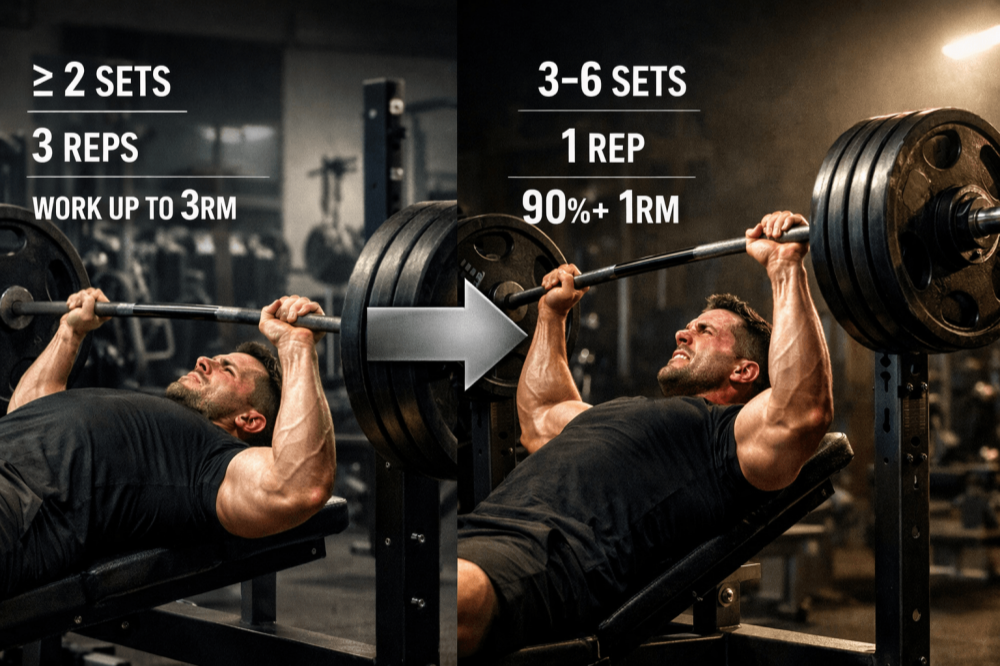
Perform sets of 3 repetitions, gradually increasing the weight until completing 3 reps becomes difficult.
Then switch to single repetitions and continue increasing the weight until reaching your maximum.
The total number of near-maximal and maximal single attempts should not exceed 6 sets.
According to Soviet strength expert Prilepin, the total number of lifts at or above 90% intensity in a single session should be between 4 and 10 repetitions.
In this plan, the final set of 3 repetitions already reaches approximately 90% of your maximum. Adding 3 to 6 single attempts afterward falls within this recommended range.
Bench Press Variation
You may alternate between:
- Flat bench
- Incline bench
- Decline bench
Perform only one variation per session and rotate them weekly.
If the bar touches the upper chest, use incline bench as your variation.
If it touches the mid-to-lower chest, use decline bench.
You may also rotate all three variations.
Assistance Training
After max effort bench press, perform assistance exercises.
For strength-focused bench press, the primary muscle is the triceps rather than the chest.
Therefore, triceps training becomes the priority.
Recommended exercises include:
- Close-grip partial bench press
- Triceps pushdowns
- Lying barbell triceps extensions
- Lying dumbbell extensions with neutral grip
According to experienced lifters, reverse-grip barbell extensions are particularly effective.
Select two exercises per session. Perform 3–4 sets each, training to failure.
- Use weights that allow 10–20 repetitions
- For close-grip partial bench press, use 6–15 repetitions
If you want variety, you may try vertical dumbbell triceps extensions. This movement feels different but may take time to master.
Shoulder Training
Perform front raises using dumbbells.
- 10–20 repetitions per set
- Train to failure
You may also use a barbell or weight plates.
For additional challenge, side-lying external rotations can be included. When performed correctly, they create a very intense stimulus.
Upper Back and Rear Delts
Train the upper back and posterior deltoids using:
- Pull-ups
- Barbell rows
- Dumbbell rows
- Lat pulldowns
Perform:
- 10–20 repetitions per set
- For barbell rows, 8–15 repetitions
If your shoulders are particularly weak, you may prioritize shoulder training before triceps work.
However, in most cases, bench press plateaus are caused by insufficient triceps strength.
Friday Training Plan (Speed Day)
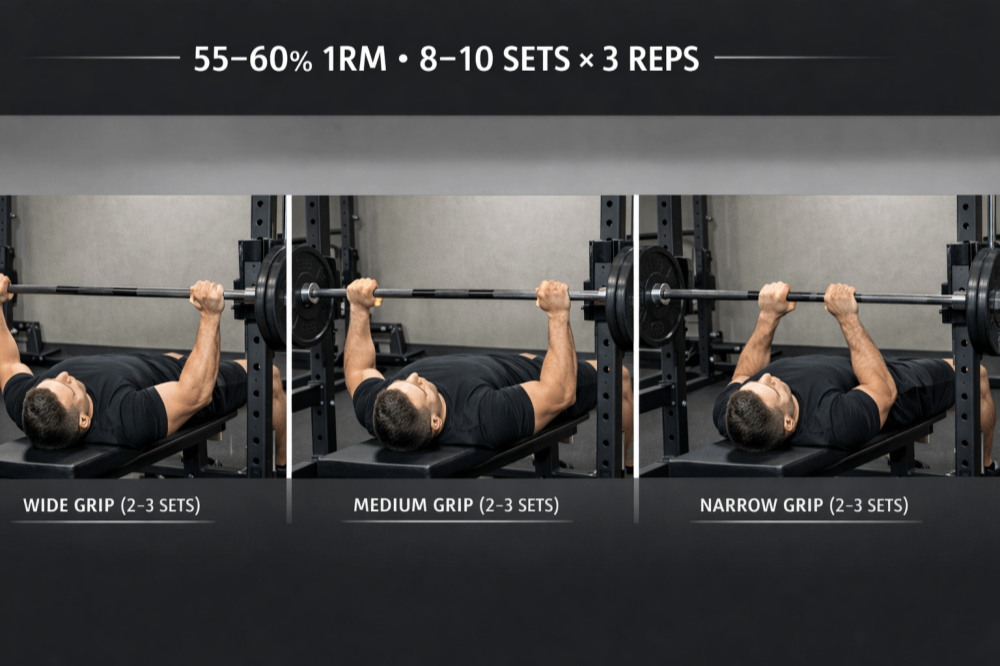
Use 55%–60% of your Monday maximum.
Perform:
- 8–10 sets
- 3 repetitions per set
You may alternate between flat, incline, and decline bench, but flat bench should remain the primary focus.
During each session, include:
- Wide grip
- Medium grip
- Narrow grip
Perform 2–3 sets for each grip,You can refer to the following for the exact positions of the three grip widths.
Raising the Bar: Analyzing Grip Widths and Bench Press Performance
Key Execution Principle
Every repetition must be performed with maximum intent.
Lower the bar quickly but under control, ensuring that the bar reaches zero velocity exactly when it touches the chest.
Then press upward with maximum explosive force.
Speed is the core of this training session.
Assistance Training
After bench press, perform the same assistance exercises as Monday.
However, increase the weight:
- Barbell exercises: 5–8 repetitions per set
- Dumbbell exercises: up to 12 repetitions
You may also increase the number of sets.
Training Time Control
It is essential to control both rest intervals and total training time.
Except for maximal bench press attempts on Monday:
- All rest intervals must not exceed 1 minute
- Total session time should be kept within 1 hour
This structure promotes lactic acid accumulation, which stimulates growth hormone secretion and supports muscle growth and strength development.
Finally, we hope that you will soon break through your current bench press limits.
If you find these methods helpful, feel free to share your feedback in the comments.