

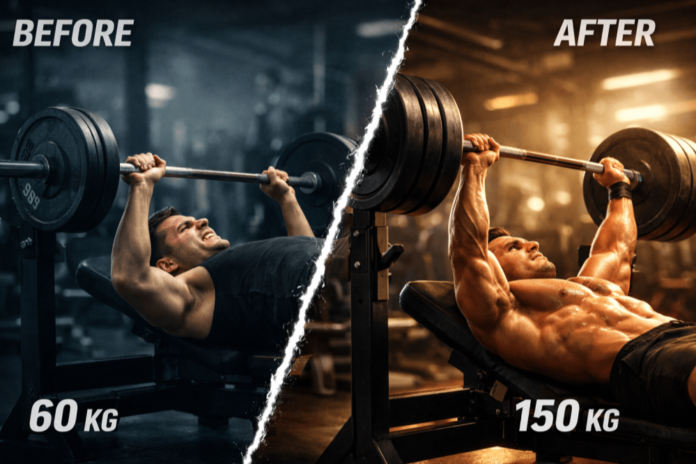
Among all exercises in the gym, the bench press is undoubtedly the most popular. The bench press station is always one of the most in-demand pieces of equipment, and how much weight you can press is a topic that many fitness enthusiasts care deeply about.
However, many people make some initial progress and then stop improving. They often increase their training volume and frequency, train until they are drenched in sweat, yet still see no progress, which leaves them frustrated.
So how do you overcome this barrier? How can you “easily” bench press 150kg? Read this article carefully, and you will likely gain new insights.
Important Note
A considerable part of the training methods and programs presented in this article comes from Louie Simmons’ How to Bench Press 500 Pounds (Easy!) and strength training literature from the former Soviet Union.
Considering that most recreational trainees may not be familiar with these materials (which are often extensive and complex), and may also differ in training level, equipment, nutrition, and recovery, this article simplifies and adapts the original content so that it can be more easily understood and applied.
P.S. If you are able to warm up with 180kg and gradually increase to 250kg, you can skip the rest of this article.
The Current Situation of Bench Press Training
Based on observation, most recreational lifters encounter two major barriers in the bench press:
- 80–100 kg
- 120–140 kg
Very few are able to move past these and reach 150kg. (This refers to lifting without assistance, with the bar touching the chest, without hip drive, and without bouncing the bar off the chest.)
In fact, as long as training methods are appropriate, consistency is maintained, and nutrition and recovery are properly managed, most people should be able to reach a 150kg bench press within two to three years.
So what is preventing most people from making progress?
Below, we will analyze the factors that prevent recreational lifters from reaching a 150kg bench press and provide corresponding solutions.
Proper Bench Press Form Is Key
The first thing to emphasize is proper form: “you can’t sacrifice form for weight.” Many elite powerlifters, such as Eddie Coan and Becca Swanson, consider this one of the most important rules for beginners.
However, if you look around the gym, you will see many people lifting weights beyond their ability using incorrect form. This is not only misleading, but more importantly, consistently using poor form—especially in the last one or two repetitions of each set—leads to improper muscle development.
This kind of imbalance means that the muscles that should be strengthened do not improve in strength or size, while opposing muscle groups become uneven. Over time, this can result in injury or structural imbalance.
For example, if the triceps become significantly stronger than the biceps, it may lead to joint misalignment in the elbow, causing pain and structural issues.
Key Bench Press Technique
Bar Path
The bar should move vertically.
Many recreational lifters tend to press the bar toward the head during the lift. This increases stress on the shoulders and raises the risk of shoulder injury.
Elbow Position
If your goal is chest development, you should flare your elbows outward so that they point away from the body.
If your goal is to lift heavier weight, you should keep your elbows closer to your body. This allows the primary muscle in the bench press—the triceps—to contribute more effectively.
Bar Touch Point
If your goal is chest development, the bar should touch the upper chest, but not beyond the clavicle, as this could be dangerous if you fail the lift.
If your goal is strength, the bar should touch around the nipple line, which allows you to handle heavier weight.
Two Often Overlooked Factors That Affect Bench Press Performance
Grip Width
For strength-focused bench press training, a medium to slightly narrow grip is recommended. This allows the triceps to contribute more without limiting the involvement of other muscle groups.
For chest development, a medium to wide grip is more suitable, as it provides a better stretch for the chest muscles.
Very wide or very narrow grips are typically used to target specific muscle groups and will not be discussed in detail here.
Grip Width Classification
Under a standard overhand grip (with the thumbs facing each other):
- When the distance between both little fingers is less than shoulder width, it is considered an ultra-narrow grip
- When the distance between both thumbs is less than shoulder width, it is considered a narrow grip
- When the distance between both thumbs is greater than shoulder width and the distance between both little fingers is less than 81 cm, it is considered a medium grip
- When the distance between both little fingers is greater than 81 cm and the distance between both thumbs is less than 81 cm, it is considered a wide grip
- When the distance between both thumbs is greater than 81 cm, it is considered an ultra-wide grip
The 81 cm limit is defined by the International Powerlifting Federation as the maximum allowable distance between the thumbs during the bench press.
Barbell Descent Speed
Barbell descent speed is another factor that has a significant impact on performance.
Allowing the bar to drop rapidly onto the chest and relying on the rebound to press it back up is unsafe and should not be adopted.
On the other hand, lowering the bar too slowly—like placing a fragile object—will waste energy during the descent.
To safely press heavier weights, you should lower the bar as fast as possible while maintaining control. Control means that you are able to stop the bar at any point during the descent.
Limitations of Traditional Training Methods
Another common issue among beginners is relying too heavily on traditional bodybuilding-style training:
- 8 to 12 repetitions per set
- 3 to 5 sets per exercise
This point is also briefly mentioned in the article 5 Common Workout Mistakes That Limit Your Progress.
This method can bring some progress in the first six months to one year, but relying solely on it will not lead to continuous long-term improvement.
If you want to achieve further gains in strength and muscle, you must adjust your training methods.
The key change is incorporating heavy weight training.
Training Methods for This Stage
Before applying the following programs, make sure you meet the following conditions:
- At least six months of consistent training (training at least three times per week, with no more than two breaks longer than five days, and all muscle groups trained with appropriate intensity and volume)
- Ability to bench press your body weight for five repetitions using proper form
- No serious injuries in the past three months (including muscle tears, ligament injuries, fractures, or dislocations in the upper body, shoulders, chest/back, or core)
Method 1: 5×5 Training
There are two variations of this method.
The first approach is to use a weight that you can lift for five repetitions and perform five sets.
Due to fatigue (assuming you are not resting for excessively long periods between sets), it will be difficult to complete five repetitions in all sets after the first one. Continue training with this weight until you can complete five sets of five repetitions, then increase the weight and repeat the process.
The second approach is slightly different. Use a weight that allows you to complete five sets of five repetitions, with the last set being difficult but achievable.
Train with this weight and attempt to perform six or more repetitions in the final set of each session.
When you are able to exceed five repetitions in the final set (while completing five repetitions in the first four sets), increase the weight and return to five sets of five repetitions.
Train twice per week, and every three to four weeks, include a session where you attempt a heavier weight.
Method 2: Fatigue Accumulation Combined with Max Effort
Train twice per week.
In the first session, use a weight that you can lift eight times. Perform only five to six repetitions in the first set. Keep rest intervals strictly between one minute and one and a half minutes.
Perform the same number of repetitions in each set until you can no longer match the repetitions of the first set.
The purpose of this method is to accumulate fatigue. In the later sets, the muscle fibers initially recruited will be fatigued, forcing additional muscle fibers to be activated.
Three days later, perform the second session. (For example, if the first session is on Monday, the second session would be on Friday.)
After completing three sets of five repetitions as a warm-up, choose a weight that you can lift for five to six repetitions and perform three sets to failure, with rest intervals of three to five minutes.
A training partner is required, but their role is not to assist you in completing more repetitions. They should only step in when you are unable to lift the weight.
When you are able to perform eight repetitions with this weight in the second session, move this weight to the first session, and increase the weight used in the second session so that it returns to five to six repetitions per set.
Reference
Finally, here is a classic article by Louie Simmons published on the Westside Barbell website:How to Bench Press 500 Pounds (Easy!)
