
In a previous article, we discussed how much water should you drink in a day. In short, sedentary men and women are generally recommended to consume about 3L (around 13 cups) and 2.2L (around 9 cups) of water per day.
The key phrase here is “sedentary.” For people who train regularly, hydration needs are obviously higher. The real questions are: how to hydrate, how much to drink, and what kind of water to choose.
I’ve seen people in the gym drink large amounts of water at once due to thirst, only to experience bloating, stomach pain, and even reduced strength performance. On the other hand, some people avoid1 drinking water during workouts and only rehydrate afterward—by then, they are already dehydrated.
So, how to stay hydrated during workouts? Let’s break down everything you need to know about hydration during exercise.
Is It Good to Drink Water During Workout?
Some people believe that drinking water during exercise:
- increases cardiovascular strain
- slows gastric emptying
- causes stomach discomfort
So they avoid drinking altogether.
This view is incorrect.
Research shows that prolonged exercise leads to significant sweating, reducing plasma volume by about 16%. A decrease in plasma volume increases blood flow resistance and reduces cardiac efficiency, which negatively affects endurance performance.
Another study suggests that when total fluid loss reaches 2% of body weight, it has a clear negative impact on the circulatory system and directly reduces performance.
Therefore, fluid lost during exercise must be replenished in time. The importance of hydration during exercise cannot be overstated—just like daily water intake.
How Much Water Should I Drink During a Workout?
First, hydration should not start during the workout—it should begin before training.
A useful reference is your baseline body weight. Ideally, you should hydrate until your body weight is at or slightly above your normal level before starting your session.
During exercise, hydration mainly serves to replace fluids lost through sweat and urine.
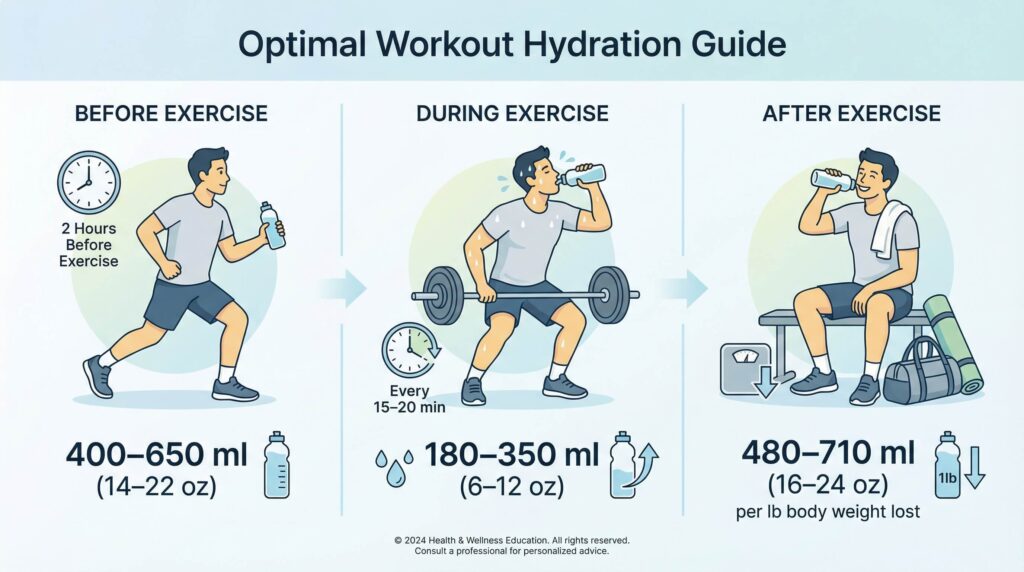
If you need specific guidelines, you can follow these:
- 2 hours before exercise: Drink 400–650 ml (14–22 oz) of fluid
- During exercise: Drink 180–350 ml (6–12 oz) every 15–20 minutes
- After exercise: For every pound of body weight lost, drink 480–710 ml (16–24 oz) of fluid
However, avoid drinking too much at once. Large volumes are not only harder to absorb but can also cause stomach distension, affecting diaphragm movement and digestion.
The better approach is small, frequent sips.
For resistance training, this is simple:
- Take a small sip (about 30 ml / 1 oz) between sets
- Or hydrate every 5 minutes, with each intake not exceeding 100 ml (3 oz)
Cold Water vs Ice Water vs Warm Water
For workouts, cold water (around 10–15°C / 50–59°F) is recommended.
The advantage of cold water is that it allows for faster gastric emptying, helping your body absorb fluids more efficiently.
Some people prefer warm water (30–40°C / 86–104°F). While it is gentler on the stomach, it has a weaker cooling effect and is less suitable, especially in hot environments.
The least recommended option is ice water, particularly in large amounts, as it can easily cause gastrointestinal discomfort.
What Kind of Water Should You Choose?
As mentioned in previous articles, mineral water is generally the best choice for daily hydration.
If you enjoy lemon water, it’s fine—as long as your stomach tolerates it. However, since lemon water is acidic, it may cause irritation in some people.
| Type | Advantages | Disadvantages | Suitable for Long-Term Use |
|---|
| Mineral Water | Contains natural minerals (calcium, magnesium, potassium); helps replenish electrolytes; better taste | Some types have high mineral content; relatively more expensive | Yes, recommended as a primary daily water source |
| Purified Water | Low in impurities; high safety; affordable | Contains little to no minerals; nutrients must come from diet | Yes, suitable for long-term use |
| Distilled Water | Very high purity; free from contaminants | No minerals; flat taste; may affect electrolyte balance if consumed long-term | Not recommended as the only long-term water source |
| Lemon Water | Provides small amounts of vitamin C; improves taste; may increase water intake | Acidic (may damage tooth enamel); may irritate the stomach; no proven detox effect | Can be consumed long-term with precautions (dilution, avoid excessive intake) |
Can I Drink Electrolyte Water During Workout?
In general:
- If your workout is less than 60 minutes, plain water is sufficient
- If it exceeds 60 minutes, you can consider electrolyte drinks
(Make sure carbohydrate concentration does not exceed 8%)
Some people consider using sugar water or salt water, but neither is ideal:
- Sugar water provides carbohydrates but lacks sodium
- Salt water provides sodium but lacks carbohydrates
Electrolyte drinks are more balanced.
If you must make your own, use lightly sweetened water with a small amount of salt.
Can I Drink Coconut Water During Workout?
Some people treat coconut water as an electrolyte drink, but this is not entirely accurate.
Coconut water:
- Contains relatively low sodium
- Has 2–4% carbohydrates, which is lower than typical sports drinks (3–8%)
So in situations with heavy sweating, coconut water is not ideal as a primary hydration source.
By the way, there have been reports of some “100% natural coconut water” products being adulterated. Personally, I’ve also noticed large differences in calorie content between brands.
Considering both your training goals and these potential issues, it’s better to treat coconut water as an occasional drink, not your main hydration strategy.
While coconut water isn’t the best drink for supplementing sodium, it is an excellent way to replenish potassium.
If your daily diet is high in sodium (for instance, if you eat a lot of salty foods) or if the electrolyte water you drink during workouts doesn’t contain potassium, you might want to consider using coconut water afterward to get an adequate amount of potassium.
By the way, most people don’t get enough potassium in their daily lives. Read The Best Vitamins for Energy and Performance to find out how many vitamins and minerals you need in a day.
Final Thoughts
All of the hydration strategies above apply whether you are:
- doing resistance training or running
- aiming for fat loss or muscle gain
Ultimately, hydration is not determined by the type of training, but by:
- duration
- intensity
- sweat rate
The longer and more intense your workout—and the more you sweat—the more fluids you need. In such cases, you may also need to replenish electrolytes and carbohydrates, not just water.
There is one more group that should pay extra attention: people trying to lose weight.
According to NASM, individuals should drink an additional 240 ml (8 oz) of water for every 25 pounds above their ideal body weight.
Drinking water alone will not directly cause fat loss, but it can help suppress appetite and support metabolism, thereby indirectly assisting with weight loss.