
In everyday life, you’ve probably noticed that some people seem unable to gain weight no matter how much they eat, while others feel like they “gain weight even from drinking water.” As early as the 1940s, researchers began studying this phenomenon and eventually classified human body types into three categories.
So what are the advantages and disadvantages of these body types when it comes to fitness? And regardless of your type, most of us ultimately want a more “aesthetic” physique. Based on your body type, what should you pay attention to in terms of training and diet? Today, let’s get straight to the point.
P.S. The concept of the three body types dates back decades. There is a detailed explanation on Wikipedia:Somatotype_and_constitutional_psychology. Here, we will focus only on the key takeaways to help you quickly understand the training and nutrition strategies for each type.
The Three Body Types
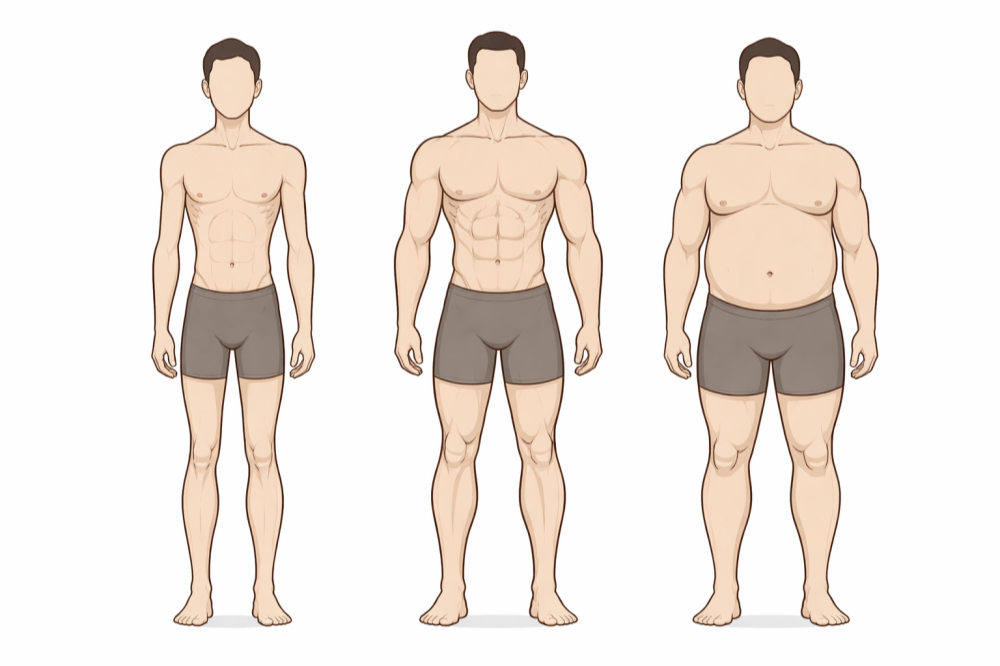
We generally divide body types into ectomorphic, mesomorphic, and endomorphic.
Ectomorphic
- Small joints
- Naturally thin appearance (often described as “skinny”)
- Higher basal metabolic rate (BMR)
- Can eat pizza, fried chicken, ice cream, and still not gain weight
- Gets full easily
- Narrow chest and hips
- Harder to build muscle
- Difficult to gain weight
- Low body fat
Mesomorphic
- Broad shoulders
- Narrow waist
- Low body fat
- High muscle mass
- Moderate appetite
- Builds muscle easily
- Loses fat relatively easily
Endomorphic
- Prone to storing fat
- Gets fatigued more easily
- Rounder body shape
- Strong appetite, can keep eating continuously
- Difficult to lose weight
- Muscle definition is less visible due to higher body fat
- Lower basal metabolic rate
Most People Are Not “Pure” Types
Just like personality traits, body types exist on a spectrum. Very few people are purely one type.
As explained on Wikipedia, early researchers used a 1–7 scoring system:
- First number: Endomorphic
- Second: Mesomorphic
- Third: Ectomorphic
For example:
- “Pure” endomorph: 7-1-1
- “Pure” mesomorph: 1-7-1
- “Pure” ectomorph: 1-1-7
So in reality, your body type may be a combination. For instance:
- A mix of endomorphic and mesomorphic: 4-4-1 or 3-5-1
- Mostly ectomorphic with slight mesomorphic traits: 1-2-6
Generally speaking, endomorphic and ectomorphic traits tend to be mutually exclusive.
Of course, if you happen to be a genetically gifted “pure” mesomorph (1-7-1), congratulations. But even if you’re not, that’s completely fine. No matter your body type, training can still significantly change your physique.
For those of us stepping into fitness, the key is to identify your general type based on the characteristics above, then follow a training and nutrition strategy that suits you.
Training and Diet Strategies by Body Type
Ectomorphic
Diet recommendations:
- Prioritize higher-calorie foods
- Add calorie-dense options like peanut butter, avocado, and nuts
- If you have a small appetite, eat smaller meals more frequently
- Increase carbohydrate intake
- Drink more milk (if you are not lactose intolerant)
- It’s okay to include some “less healthy” foods in moderation
Training recommendations:
- Focus on heavier weights (around 5–10 reps)
- Take longer rest between sets (due to heavier loads)
- Prioritize compound movements
- Limit excessive cardio
- If doing cardio, consider HIIT
Mesomorphic
Diet recommendations:
- Eat enough to maintain muscle mass
- Carbohydrates should make up about 40%–60% of total calories
- Eat 5–6 meals per day
Training recommendations:
- Keep rest intervals around 30 seconds to 1 minute
- Include moderate cardio to maintain low body fat
Endomorphic
Diet recommendations:
- Carbohydrates should make up about 30%–40% of total calories
- Focus on whole, unprocessed foods
- Choose whole grains
- Eat plenty of vegetables to increase satiety
- Drink plenty of water to help control appetite
- Split meals into 5–6 smaller portions to avoid overeating
Training recommendations:
- Do more cardio
- Focus on compound exercises to burn more calories
Final Thoughts
It’s important to remember that your body type is largely determined by genetics. Training alone cannot completely “change your body type.”
However, regardless of whether you are ectomorphic, mesomorphic, or endomorphic, you can still achieve the physique you want through the right combination of training and nutrition.
So in the end, it comes back to this:
Your body is a reflection of your long-term habits.
Also Recommend:when-is-the-best-time-of-day-weights-train