

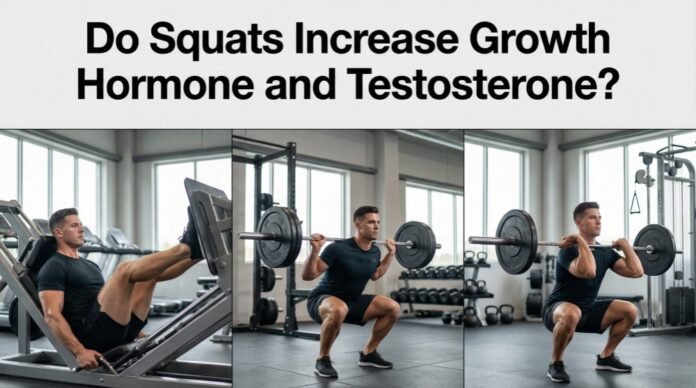
When it comes to building muscle, training and nutrition are not the only factors. Two key topics that cannot be ignored—especially for many men—are growth hormone (HGH) and testosterone.
Many people believe that increasing these hormones will help build muscle, and some also associate testosterone with improved sexual performance. As a result, many individuals rush into the gym and train intensely.
But does every type of training increase HGH and testosterone?
The answer is clearly no.
Free Weights vs Machines: What Does Research Say
A 2014 study published in a journal by the National Strength and Conditioning Association (NSCA) explored the question:
“Which produces greater hormonal response—machine training or free weights?”
Researchers compared the leg press and the barbell squat (Barbell Squat) to determine which exercise would stimulate greater secretion of testosterone and growth hormone.
The study recruited 10 healthy male participants with resistance training experience. They first performed leg press using 80% of their one-repetition maximum (1RM) for 6 sets of 10 reps, with 2 minutes of rest between each set.
After several days of recovery, the participants performed barbell squats under the same conditions—6 sets of 10 reps at 80% 1RM, also with 2-minute rest intervals.
Blood samples were taken immediately after each training session. The results are presented in the two figures below.
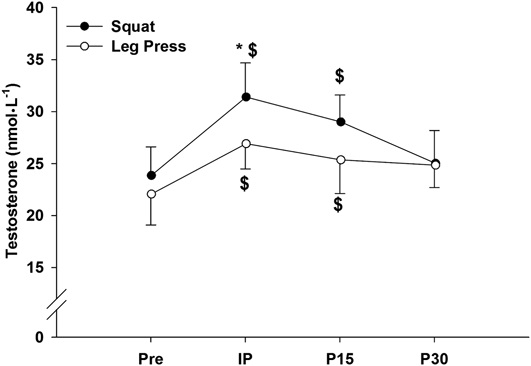
Testosterone concentrations were measured before exercise (PRE), immediately post-exercise (IP), and at 15 (P15) and 30 (P30) minutes after exercise. A dollar sign ($) indicates a significant difference from the corresponding PRE value (p ≤ 0.05), while an asterisk (*) indicates a significant difference compared to the leg press at the same time point. Values are expressed as mean ± standard error (SE).
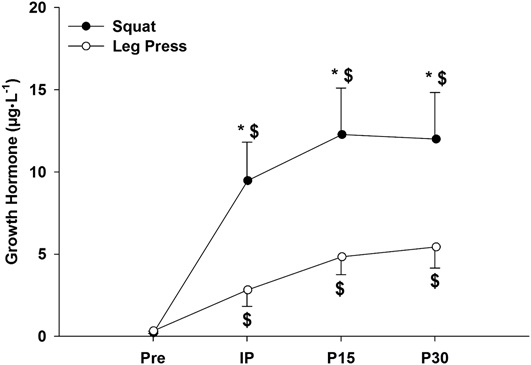
Growth hormone concentrations were also measured at PRE, IP, P15, and P30. The same symbols apply: $ indicates a significant difference from PRE (p ≤ 0.05), and * indicates a significant difference compared to the leg press at the corresponding time point. Values are presented as mean ± SE.
Results
The findings were not surprising.
Compared to leg press, barbell squats resulted in:
- About 25% higher testosterone levels
- Up to 200% higher growth hormone levels
Even 30 minutes after training:
- Growth hormone remained about 100% higher with squats
- Cortisol levels were also higher after squats
Why Squats Produce More Hormonal Response
From the findings, although both free weights and machines can target the same primary muscle groups and involve similar lower-body joint actions, their training effects are not necessarily equal.
In the study, both the squat and the leg press rely on the same main movers, such as the quadriceps and glutes.
However:
- Squats = closed-chain movement
- Leg press = open-chain movement
More importantly:
- Squats require full-body stabilization
- Greater core and stabilizer muscle activation
- Higher neuromuscular demand
Research also shows that:
Free weight training recruits more muscle mass overall, engages more large muscle groups and stabilizers, and as a result, triggers a greater hormonal response.
Are All Free Weight Exercises Equal?
This leads to another question:
Do all free weight exercises produce the same hormonal effect?
Using squats as an example:
- Back squat (barbell)
- Bodyweight squat
- Front squat
The study already provides a clue:
Both exercises were performed at 80% 1RM.
Key Factors for Increasing Testosterone and HGH
More recent studies from 2020 and 2021 further confirm that resistance training characterized by moderate-to-high intensity, high volume, large muscle group involvement, and short rest intervals is most effective for increasing testosterone and growth hormone responses.
NOTE:It is also worth noting that some literature suggests growth hormone is more dependent on high intensity, while testosterone is less selective—training to failure with short rest intervals can consistently elevate testosterone levels. Overall, however, programming based on the factors above remains the most effective approach.
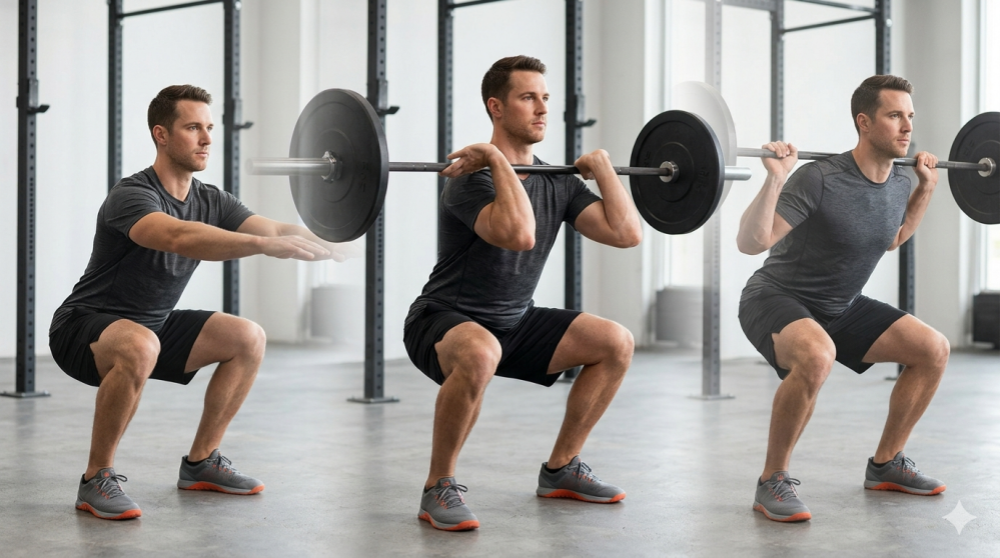
Practical Comparison
- Bodyweight squats
→ Insufficient intensity → Limited hormonal response - Front squats
→ Depends on load → Moderate effect - Barbell back squats
→ Highest load potential → Strongest hormonal response
In practice, front squats typically cannot match the loading capacity of back squats.
Therefore, from the perspective of maximizing testosterone and growth hormone:
Barbell back squats are the most effective option.
This is why they are often referred to as the “King of All Exercises.”
Takeaway
If your goal is to maximize hormonal response for muscle growth:
- Prioritize compound free-weight movements
- Train with sufficient intensity and volume
- Keep rest periods relatively short
And next time you go to the gym, don’t just focus on the bench press.
Start squatting!
If your goal is fat loss, you can also refer to our leg day fat loss workout plan for a structured approach.
