

You may often hear fitness influencers or gym-goers say things like, “Today is push day” or “I’m following a push day workout plan.” But what does a push day workout actually mean?
Push Day Workout Definition
A push day workout is a training day that focuses on exercises where you push weight away from your body.
These movements primarily train the muscles involved in pushing actions, including the chest, shoulders, and triceps.
In simple terms, a push day workout targets the muscles responsible for pressing movements. However, the exact structure of a push day workout can vary depending on individual goals, experience level, and training frequency. It does not have to include every push muscle in every session.
Why Do a Push Day Workout?
Push day workouts are most commonly used as part of a Push / Pull / Legs (PPL) split, where one training day is dedicated to all pushing movements.
Benefit 1: Better Training Focus
By grouping push exercises into one session, you can focus on muscles that share similar joint functions. This reduces unnecessary interference between muscle groups and allows the nervous system and assisting muscles to work more efficiently.
Benefit 2: More Beginner-Friendly
Beginners rarely train five or more times per week like advanced lifters. For most beginners, three training days per week are more than enough.
A traditional five-day body-part split (chest, back, legs, arms, shoulders) often becomes impractical due to time constraints. A PPL split allows beginners to train the entire body within three sessions.
As training frequency increases, PPL can also scale well. For example, training six days per week using a PPL split twice makes sense, as muscle protein synthesis typically peaks within 24–72 hours, allowing adequate recovery between sessions.
Benefit 3: More Effective for Fat Loss
A push day does not only train the chest—it also involves the shoulders and triceps. This makes it easier to include compound exercises such as:
- Bench presses
- Overhead presses
Compound movements engage multiple muscle groups at once, helping maintain a higher heart rate during training and increasing overall energy expenditure. This makes push day workouts particularly suitable for individuals focused on fat loss.
Benefit 4: More Balanced Physique Development
If you spend enough time in the gym, you’ll notice a common pattern: many people enjoy training chest, fewer enjoy training back, and even fewer enjoy training legs.
When following a five-day split but only managing two or three workouts per week due to work or travel, training bias becomes amplified. Over time, this can lead to imbalanced posture and movement patterns.
With a PPL split, you only need three sessions per week to train the entire body. On push day alone, you train not just the chest, but also the shoulders and arms—reducing the risk of rounded shoulders, forward head posture, and muscular compensation.
Which Muscles Are Trained on Push Day?
On a push day, the primary muscles worked include:
- Chest – responsible for horizontal pushing movements
- Shoulders (deltoids) – especially the front and middle delts
- Triceps – assist with elbow extension during pressing exercises
Because these muscles work together during pushing movements, training them on the same day is both efficient and practical.
How Often Should You Do Push Day?
Beginners typically start with one push day per week, increasing frequency as recovery improves.
Common weekly training structures include:
- 3 days per week: Push / Pull / Legs
- 6 days per week: Push / Pull / Legs (repeated twice)
The ideal setup depends on your schedule and recovery capacity.
- If you can only train twice per week, an upper/lower split may be more suitable.
- If you can only train once per week, a full-body workout is usually the best option.
Push Day Exercises List
Push day exercises can be categorized in different ways. Two common approaches are:
- By resistance type / equipment
- By movement structure (compound vs isolation)
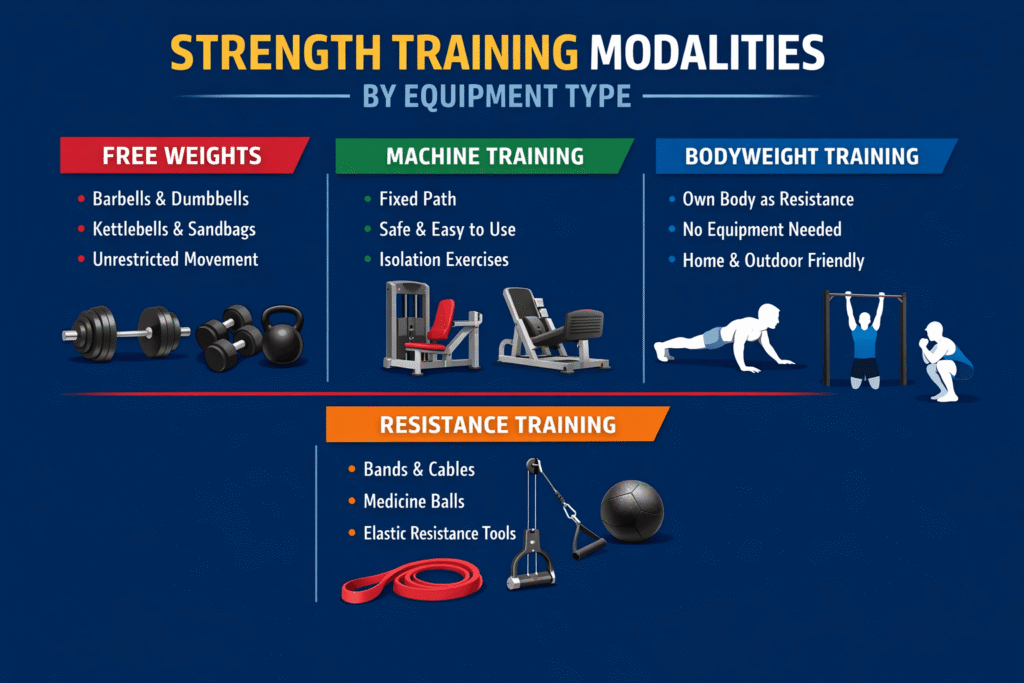
Below are push day exercises categorized by resistance type.
Free Weight Exercises
Chest
- Barbell Bench Press
- Dumbbell Bench Press
- Incline Dumbbell Press
- Dumbbell Fly
- Dumbbell Pullover
Shoulders
- Barbell Overhead Press
- Dumbbell Shoulder Press
- Dumbbell Lateral Raise
- Dumbbell Front Raise
- Arnold Press
Triceps
- Close-Grip Bench Press
- Dumbbell Skull Crushers
- Overhead Dumbbell Triceps Extension
- Dumbbell Kickback
- Dumbbell Floor Press
Machine Training Exercises
Chest
- Chest Press Machine
- Incline Chest Press Machine
- Pec Deck (Chest Fly Machine)
- Seated Chest Fly
- Plate-Loaded Chest Press
Shoulders
- Shoulder Press Machine
- Lateral Raise Machine
- Rear Delt Fly Machine
- Plate-Loaded Shoulder Press
- Upright Row Machine
Triceps
- Triceps Pushdown Machine
- Assisted Dip Machine
- Seated Triceps Extension Machine
- Plate-Loaded Dip Press
- Triceps Press Machine
Bodyweight Training Exercises
Chest
- Push-Up
- Decline Push-Up
- Diamond Push-Up
- Wide-Grip Push-Up
- Archer Push-Up
Shoulders
- Pike Push-Up
- Handstand Push-Up (or Assisted)
- Wall-Supported Pike Hold
- Elevated Pike Push-Up
- Shoulder Tap Push-Up
Triceps
- Bench Dips
- Diamond Push-Up
- Close-Grip Push-Up
- Isometric Triceps Hold (Top Push-Up)
- Straight-Bar Dip Hold
Elastic Band & Cable Resistance
Chest
- Cable Chest Press
- Cable Fly (High / Mid / Low)
- Resistance Band Chest Press
- Standing Cable Press
- Single-Arm Cable Press
Shoulders
- Cable Lateral Raise
- Cable Front Raise
- Cable Shoulder Press
- Band Face Press
- Single-Arm Cable Raise
Triceps
- Cable Triceps Pushdown
- Overhead Cable Triceps Extension
- Single-Arm Cable Pushdown
- Resistance Band Kickback
- Cable Skull Crusher
Push Day Workouts
Finally, one of the most common questions is whether there is a ready-to-use push day workout plan.
Below is a beginner fat loss push day training plan currently used by one of our trainees. It is specifically designed for individuals with little to no training experience.
Beginner Fat Loss Push Day (Chest & Shoulders) Training Plan
Warm-Up
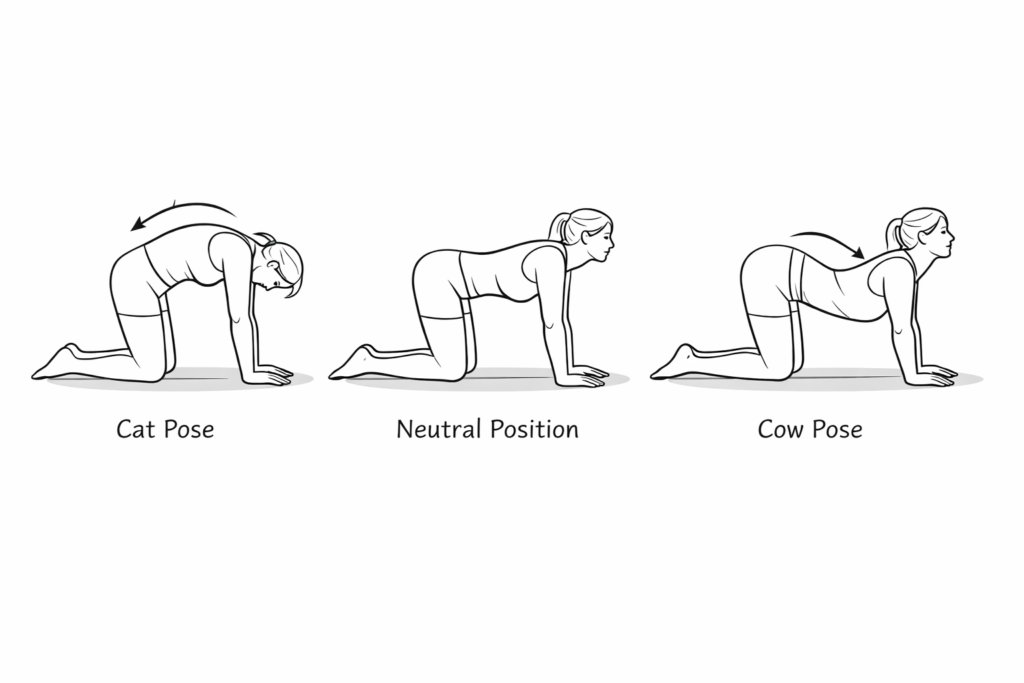
Cat Stretch (Cat Pose)
- 20 reps
- 1 set
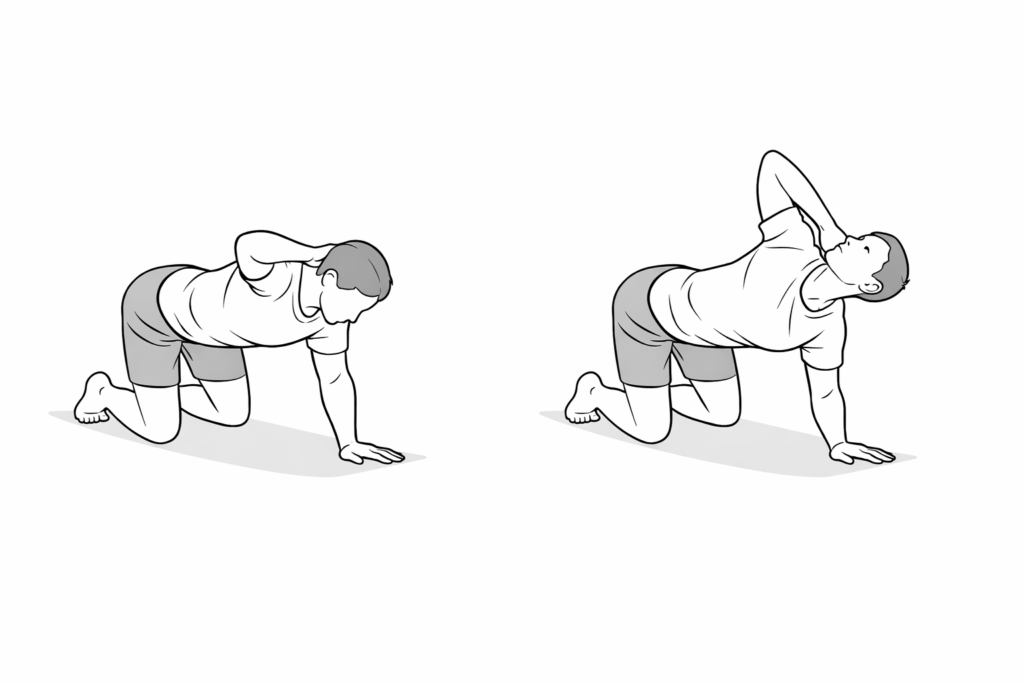
Thoracic Rotation in Quadruped
- 5 reps per side
- 2 sets
Main Exercises
Incline Barbell Bench Press
- 12 reps
- 4 sets
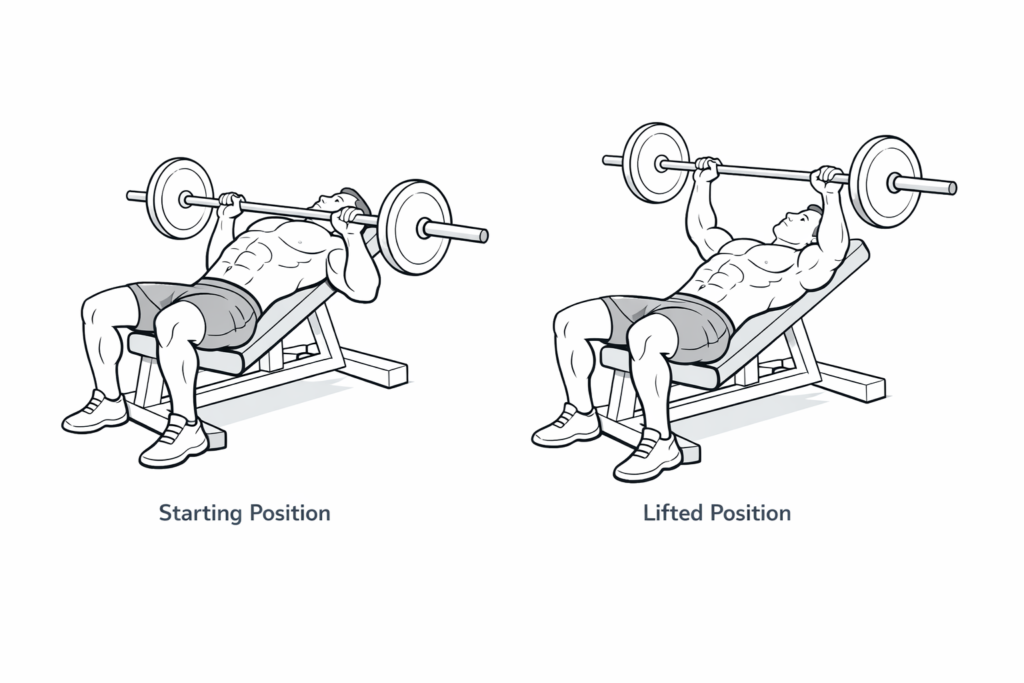
- Set up the bench: Adjust the bench to 30–45°. Lie back with feet flat and planted.
- Grip & position: Grip the bar slightly wider than shoulder-width. Wrists stacked over elbows.
- Brace: Pull shoulder blades back and down (retract + depress). Keep ribs down, core tight.
- Unrack: Bring the bar above your upper chest/shoulder line with arms locked out.
- Lower (eccentric): Inhale and lower the bar slowly toward the upper chest. Elbows track about 30–60° from your torso (not fully flared).
- Touch/near touch: Lightly touch the upper chest (or stop just above it). Keep forearms vertical.
- Press (concentric): Drive the bar up and slightly back to the start position while exhaling. Keep shoulders pinned to the bench.
- Finish: Lock out without shrugging. Reset breath and tension before the next rep.
Dumbbell Bench Press
- 12 reps
- 4 sets
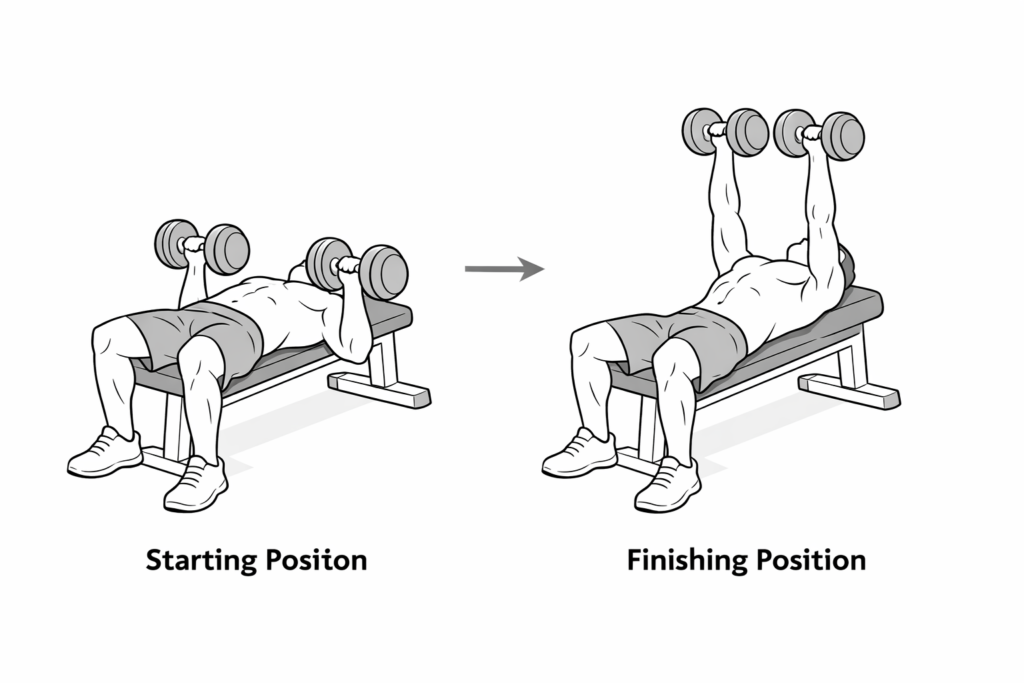
- Start position: Sit down with dumbbells on thighs, then lie back and bring them to chest level.
- Set the shoulder blades: Pull shoulder blades back and down; chest up slightly, neck neutral.
- Hand/arm alignment: Palms face forward or slightly inward. Elbows under wrists; forearms close to vertical.
- Press up: Exhale and press both dumbbells up until arms are nearly straight above mid-chest.
- Top position control: Dumbbells close but not clanging together; shoulders stay packed (no shrug).
- Lower down: Inhale and lower slowly until elbows are near 90° (or slightly deeper if shoulders tolerate).
- Bottom control: Feel a stretch in chest, but don’t let shoulders roll forward.
- Repeat: Keep tempo smooth and symmetric; maintain foot drive and core tension.
Standing Dumbbell Shoulder Press
- 12 reps
- 4 sets
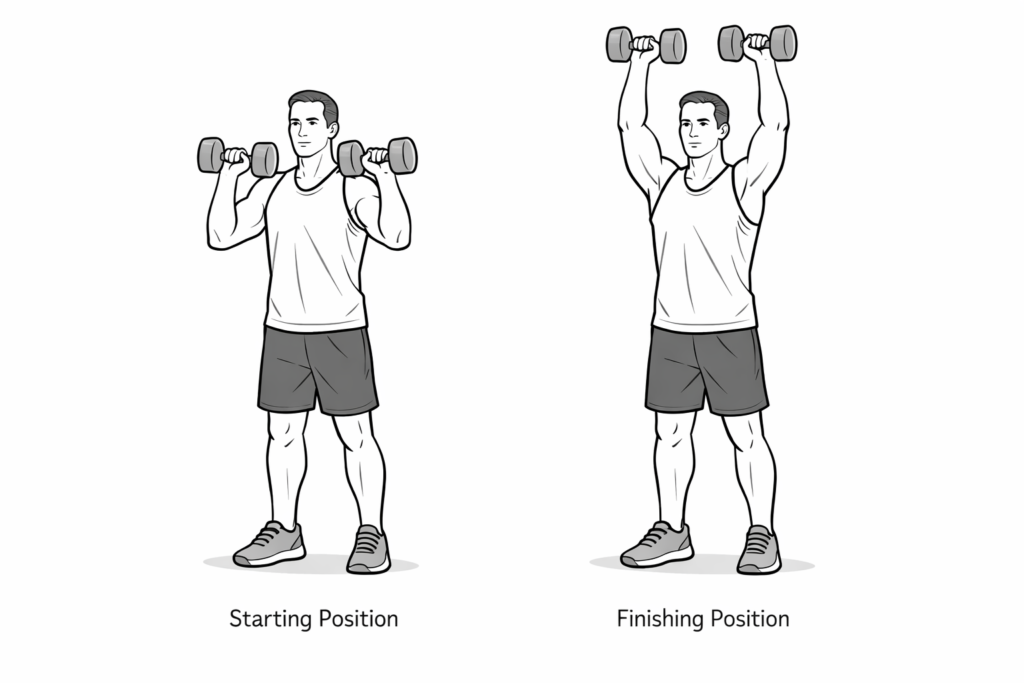
- Stance: Stand tall, feet shoulder-width, knees softly unlocked.
- Rack position: Hold dumbbells at shoulder height, elbows slightly in front of body (not flared straight out).
- Brace: Tighten core and glutes to prevent lower-back arching; ribs down.
- Press overhead: Exhale and press dumbbells up in a smooth line, moving slightly back so they finish over mid-foot.
- Head through: At the top, bring head slightly “through” so biceps are near ears (without shrugging).
- Lockout: Arms straight, shoulders stable; avoid leaning back.
- Lower under control: Inhale and bring dumbbells down to shoulder level slowly.
- Reset: Re-brace before the next rep; keep the same pressing path.
Push-Ups
- 15 reps
- 4 sets
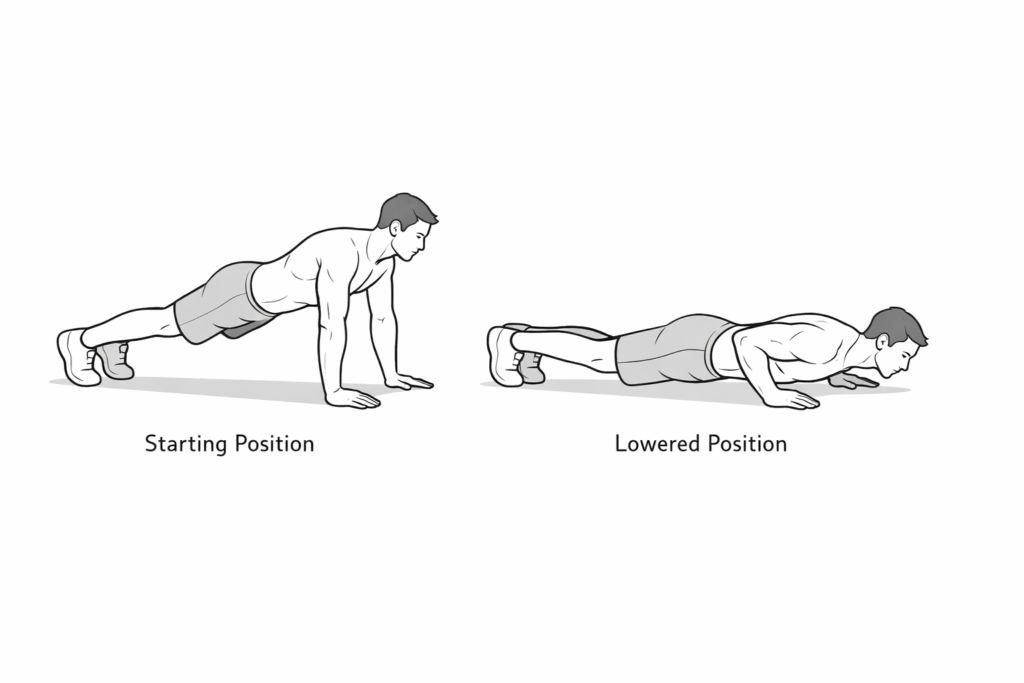
- Hand placement: Hands slightly wider than shoulders, fingers spread, palms under shoulders/chest line.
- Body line: Form a straight line head-to-heels; squeeze glutes, brace core.
- Elbow angle: Rotate elbows slightly inward so they track 30–45° from torso (not flared out).
- Lower: Inhale and descend with control until chest is close to the floor (or elbows reach ~90°).
- Maintain alignment: Don’t let hips sag or pike; keep neck neutral.
- Press up: Exhale and push the floor away, returning to full plank.
- Lockout: Arms straight, shoulder blades protracted slightly at the top (a “push away” finish).
- Repeat: Keep rhythm controlled; stop a rep or two before form breaks.
You can click to view the earlier detailed version——Beginner Push Day Workout for Fat Loss