

In the previous two articles, we introduced methods to improve bench press strength through heavy weight training and controlled fast barbell movement.
Strength and speed are arguably the two most important factors in training, but they are clearly not everything.
This means that beyond these two methods, there are still additional ways to further improve strength.
What are they?
First, you may not need to bench press as much anymore.
P.S. The training methods described in this article are mainly intended for individuals who can bench press at least 120 kg (or at least 1.5 times their body weight for lighter individuals).
Improving Bench Press Without Bench Press
Yes, that is correct. At a certain stage, you no longer need to bench press as frequently.
However, this does not apply to everyone.
Here, “not needing to bench press as much” refers to a frequency of at least once per week.
Whether you fall into this category depends on how well you have mastered the movement.
That statement may still seem vague, so here is a practical way to evaluate it:
Choose a weight that you can lift for only 4–5 repetitions. Perform it twice.
If the first attempt feels harder than the second, it means your body has not fully mastered the movement.
If the second attempt feels harder than the first, then you meet the standard of not needing to bench press as frequently.
Why This Happens
The reason is simple.
If your body has not truly adapted to the movement, the first attempt acts as a form of “warm-up,” allowing your nervous system and muscles to become familiar with the movement pattern.
This is why the second attempt may feel easier.
If your nervous system and muscles are already well adapted, this effect will not occur, and the second attempt will feel harder.
At this point, you no longer need to bench press as often.
What Should You Do Instead?
If you reduce bench press frequency, what should you train instead?
This brings us to the third key variable in training: range of motion.
The Third Factor in Strength: Range of Motion
Most people have experienced failing a bench press at the same point:
The bar reaches the midpoint, stops, struggles briefly, and then fails.
This point is the key to improving your bench press.
Until now, we have used full range of motion, which allows for full stretch and contraction of the muscles.
However, it does little to address this sticking point.
Now, we need to change the pressing variation to specifically target it.
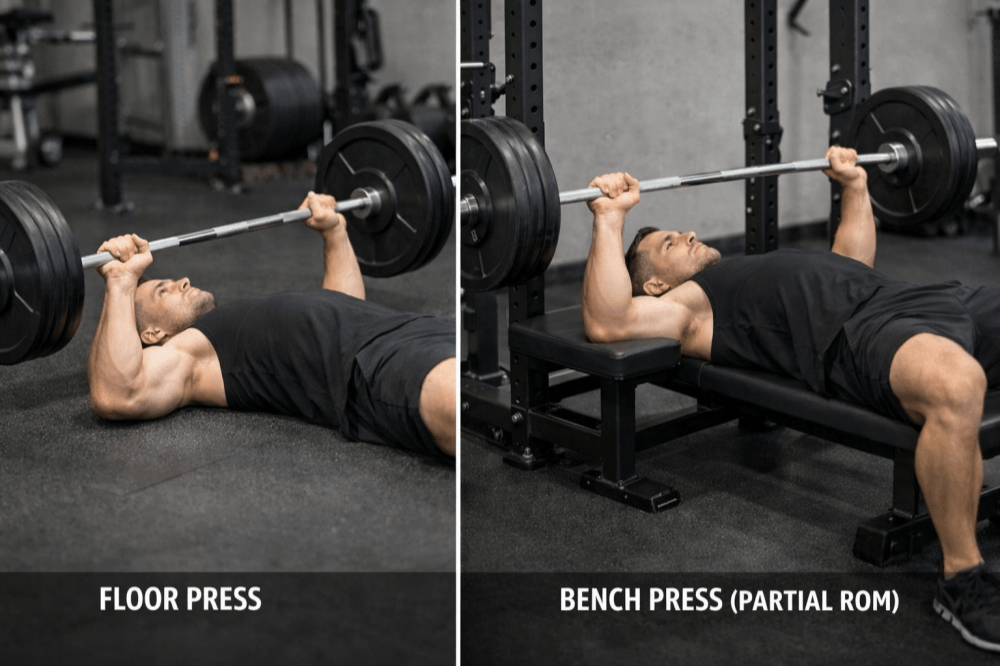
Floor Press (Partial Range Bench Press)
The method is to perform a partial bench press while lying on the floor, using a medium-to-narrow grip.
Unless your chest and back are extremely thick, or your technique is highly unusual, your elbows should touch the ground before the bar reaches your chest.
Since the sticking point usually occurs in the mid-to-upper range, the bar may still be below that point when your elbows touch the ground.
In this case, place pads or weight plates on both sides of your body so that when your elbows touch them, the bar is positioned exactly at your sticking point.
Alternatively, you can place two benches on either side of a rack so that your elbows land on them during the press.
Both methods achieve the same effect.
Important Execution Detail
When using this movement to improve pressing speed:
Pause for 2–3 seconds at the bottom (when the elbows touch the ground), then press upward explosively.
P.S. This exercise can be used as a substitute for max effort bench press or speed training.
The pause eliminates the stretch reflex, which helps improve contraction speed.
When using this movement for maximal strength attempts, do not pause at the bottom, just like in a normal bench press.
Variation
Another variation can be performed in a power rack.
Place a bench inside the rack and set safety pins at the height of your sticking point. Rest the barbell on the pins and perform the press from that position.
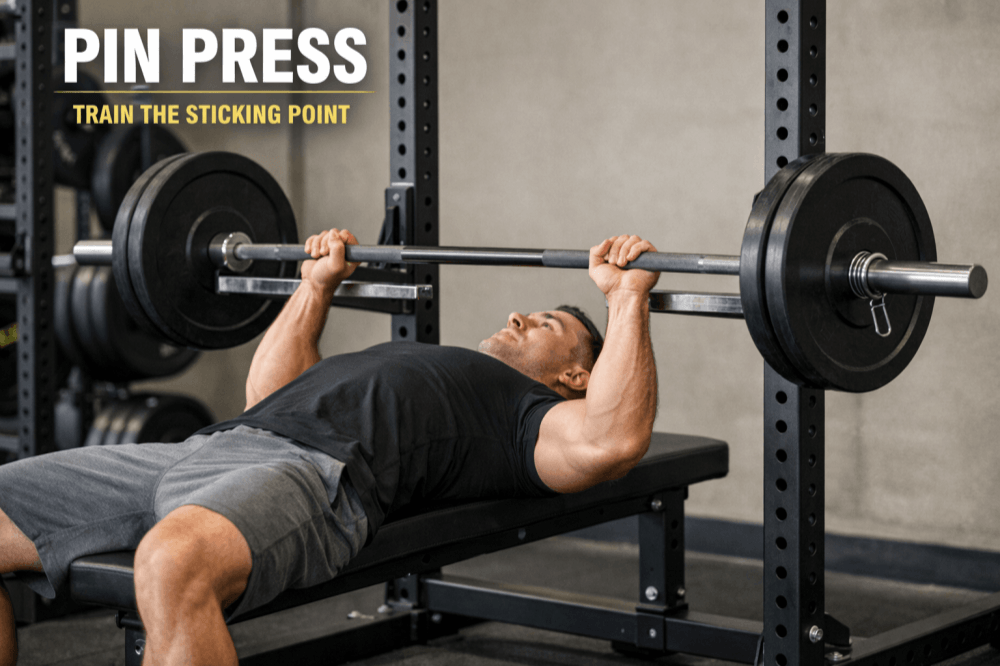
This exercise can be alternated with the floor press.
The difference is that this variation is more suitable for heavy weight training, while its effect on speed development is slightly weaker.
Training Rotation
At an advanced level, you cannot perform the same bench press training continuously.
For high-level trainees, attempting maximal loads on the same movement for three weeks or longer will lead to nervous system fatigue and a decline in performance.
Therefore, the two variations above can replace the bench press.
It is recommended to use a two-week cycle:
- In each cycle, select one variation
- Perform one max effort session and one speed session
Alternatively, you may use both variations, assigning one to max effort and the other to speed training.
In the next cycle, switch to a different variation.
After rotating through several variations over 8–12 weeks, return to the standard bench press.
Compare your performance to 8–12 weeks earlier and analyze your progress.
Accessory Training Rotation
Accessory exercises following max effort or speed work should also be rotated periodically.
However, they do not need to follow a strict two-week cycle.
As long as you are still progressing in weight and repetitions, there is no need to change them.
When progress stops, replace them with a different set of exercises.
Increasing Training Volume
Beyond weight, speed, and range of motion, there are many other variables that can be adjusted.
One fundamental principle remains:
With equal efficiency, results are proportional to effort.
To achieve greater progress, training volume must increase within a reasonable range.
However, after 45–60 minutes of intense training, testosterone levels begin to decline.
This means a single training session should ideally not exceed 60 minutes.
Increasing Frequency Instead of Duration
So how can we increase training volume?
The answer is simple: increase training frequency.
However, these additional sessions are not for max effort or speed training.
Their purpose is:
- Strengthening weak points
- Promoting recovery
Option 1: Weak Point Training
If the goal is to strengthen weak points, it is recommended to begin with triceps training, followed by shoulders and then back.
This essentially repeats the accessory portion of your main training sessions.
Rest intervals must be strictly controlled, with a maximum of 1 minute.
This short-rest, high-intensity approach helps increase growth hormone secretion, improving both strength and muscle growth.
Option 2: High-Rep Recovery Training
If recovery is a concern, you can instead perform very high-repetition training.
For example:
Incline dumbbell bench press, completing 60–100 repetitions within 6–10 minutes.
Between repetitions, take a few deep breaths before continuing.
Key Points for High-Rep Training
First, the weight should not exceed 30% of your maximum, and is generally recommended to be 20–25%.
Second, within safe limits, increase the range of motion to allow more oxygen-rich blood to flow into the muscles, promoting waste removal and recovery.
Final Note
The high-repetition training described above may seem to contradict the traditional idea that heavy weight and low repetitions are best for strength.
Similarly, increasing training frequency may raise concerns about overtraining.
Therefore, it must be emphasized that this program is designed for advanced lifters whose primary goal is to increase bench press strength.
At the same time, there is more than one path to achieving a 150 kg or even 200 kg bench press.
A well-structured combination of multiple methods will lead to greater progress.
If you still find these methods difficult to accept, consider the gap between yourself and higher-level lifters.
Remember: if your mindset does not change, your results will not change either.
If you’re not satisfied with this article, we’ve also compiled related articles on “Boost Your Bench Press” from other websites.